
The preceding involution gives an exact polynomial condition. For a matrix \(A=(a_{ij})\), require all entries of \(A^2-I\) to vanish. In
the ideal \(J\) is generated by
For \(D\) and every conjugate \(QDQ^{-1}\) these equations vanish. The condition is valid in every admissible frame. By contrast, the equation \(a_{12}=0\) holds for \(D\) but fails for the conjugate displayed on Visual 23.
The reconstruction argument is coefficientwise
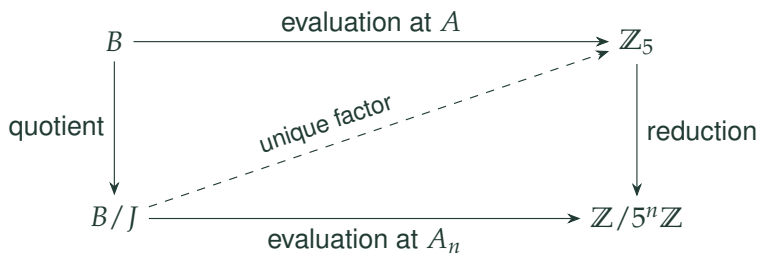
Let \(A_n\) be compatible matrices modulo \(5^n\), each satisfying these four equations. Completeness reconstructs \(A\in M_2({\mathbb Z}_5)\). For each polynomial \(f\in J\), evaluation commutes with reduction, so
Separatedness supplies the last equality. Thus the actual evaluation map \(B\to{\mathbb Z}_5\) kills \(J\) and factors uniquely through \(B/J\). If inverse matrices were reconstructed as well, this is an actual representation in \({\operatorname{GL}}_2({\mathbb Z}_5)\).
Reading the drawing
The upper evaluation maps B to the five-adic integers. Vertical arrows quotient the source and reduce the target. The lower evaluation maps B modulo J to integers modulo a power of five. The dashed diagonal is the required unique factor.
Drawing labels and data 9 labels
Read the original labels as selectable text. Tables preserve grid relationships; other short labels are grouped compactly.
- \(B\)
\(\mathbb Z_5\)
- \(B/J\)
\(\mathbb Z/5^n\mathbb Z\)
- evaluation at \(A\)
- quotient
- reduction
- evaluation at \(A_n\)
- unique factor
Evidence note from the source edition
Every finite evaluation kills the declared ideal. Reduction commutes with evaluation, and separatedness gives integral vanishing. The displayed diagram represents this exact polynomial condition.
The scope of the effectivity conclusion
The companion theorem needs integral Frobenius polynomials, finite admissible continuous classes, reduction closure, finite occupancy, and the declared triviality subgroup. A condition in one frame needs a compatible-frame argument. An arbitrary Hodge or Weil–Deligne condition is not automatically a polynomial ideal in matrix entries.
Represented local quotient conditions use continuous ring maps and the closed-kernel argument on Visual 19. These are different supplied objects from the polynomial evaluation model.
Read this as
The precise coefficient and admissibility hypotheses preserve declared equations. Representability of a desired arithmetic condition remains a separate input.