
Let every level be \(V_m=k^3\). For a transition matrix \(F\), compatibility means \(v_m=Fv_{m+1}\). The directions visible at level \(m\) after looking \(h\) levels ahead form \({\operatorname{im}}(F^h)\).
A surviving direction
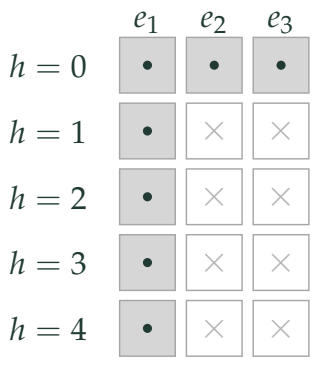
Reading the drawing
Rows are horizons zero through four; columns are the three coordinate directions. All three are present at horizon zero. Only the first direction remains at every positive horizon.
Drawing labels and data 16 labels
Read the original labels as selectable text. Tables preserve grid relationships; other short labels are grouped compactly.
- \(h=0\)
| Row / column | \(e_2\) | \(e_3\) |
|---|---|---|
| \(h=1\) | \(\times\) | \(\times\) |
| \(h=2\) | \(\times\) | \(\times\) |
| \(h=3\) | \(\times\) | \(\times\) |
| \(h=4\) | \(\times\) | \(\times\) |
- \(e_1\)
Evidence note from the source edition
At every positive horizon, precisely the \(e_1\) direction remains visible.
Every direction eventually dies
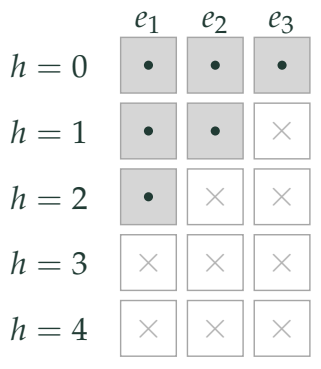
Reading the drawing
The three directions are present at horizon zero. Two remain at horizon one, one at horizon two, and none at horizon three or four. The levels can all have dimension three while their compatible inverse limit is zero.
Drawing labels and data 17 labels
Read the original labels as selectable text. Tables preserve grid relationships; other short labels are grouped compactly.
- \(h=0\)
- \(h=1\)
- \(\times\)
- \(h=2\)
- \(\times\)
- \(\times\)
- \(h=3\)
- \(\times\)
- \(\times\)
- \(\times\)
- \(h=4\)
- \(\times\)
- \(\times\)
- \(\times\)
- \(e_1\)
- \(e_2\)
- \(e_3\)
Evidence note from the source edition
Image dimensions are \(3,2,1,0,0,\ldots\), although every level still has dimension three.
Now compute the limits, not just their level dimensions
For the \(P\)-system, the limit consists of the constant compatible sequences \((a e_1,a e_1,\ldots)\), so it is isomorphic to \(k\). For the \(N\)-system, every compatible sequence satisfies
and the limit is zero. This is an all-level argument from the identity \(N^3=0\), not a finite experimental guess.
What the stable core measures
In a general inverse system of finite-dimensional spaces,
contains exactly the vectors visible from arbitrarily remote levels. The paper proves that the transition maps restrict to surjections \(Y_{m+1}\twoheadrightarrow Y_m\). A prescribed nonzero vector in \(Y_1\) can then be lifted recursively to a coherent nonzero sequence.
Read this as
The stable core tests persistence through the transition maps. Counting nonzero spaces at separate levels does not test persistence.