
Let \(\Gamma=C_2\) with the discrete topology, and represent its generator by \(D=\operatorname{diag}(1,-1)\) over \({\mathbb Z}_5\). At precision \(n\), its conjugacy class is an admissible class in \({\operatorname{GL}}_2({\mathbb Z}/5^n{\mathbb Z})\). These classes are compatible. Arbitrary representatives need not be.
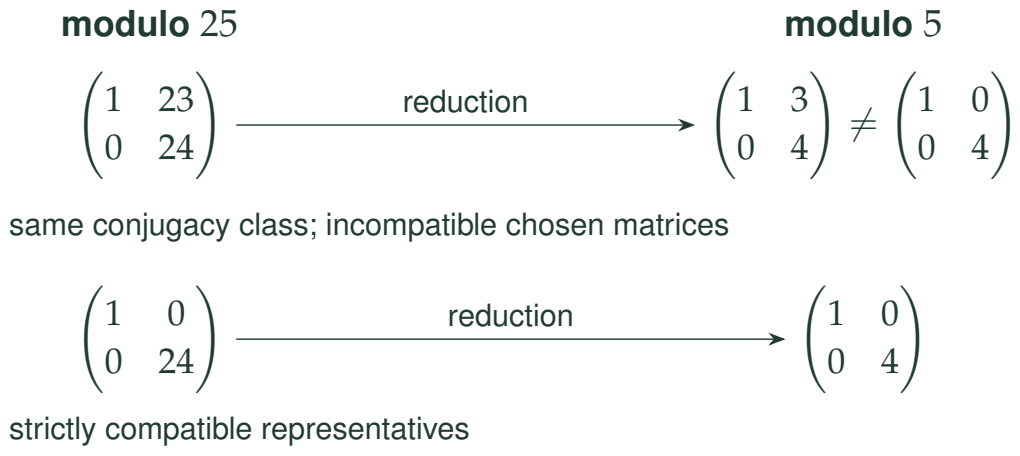
Reading the drawing
The upper matrix modulo twenty-five reduces to a matrix modulo five with a nonzero upper-right entry, rather than the independently chosen diagonal matrix. The lower choice reduces exactly to the diagonal representative. Strict compatibility concerns actual representatives.
Drawing labels and data 10 labels
Read the original labels as selectable text. Tables preserve grid relationships; other short labels are grouped compactly.
- modulo \(25\)
- modulo \(5\)
\(\begin{pmatrix}1&23\\0&24\end{pmatrix}\)
- reduction
same conjugacy class; incompatible chosen matrices
\(\begin{pmatrix}1&0\\0&24\end{pmatrix}\)
\(\begin{pmatrix}1&0\\0&4\end{pmatrix}\)
- reduction
- strictly compatible representatives
Evidence note from the source edition
The upper representatives are conjugate to the same diagonal involution, but their reductions are unequal matrices. The lower choices use \(D\) consistently at both precisions. All entries displayed are canonical residues.
Calculate the mismatch
For \(Q=\left(\begin{smallmatrix}1&1\\0&1\end{smallmatrix}\right)\),
It reduces to \(\left(\begin{smallmatrix}1&3\\0&4\end{smallmatrix}\right)\) modulo five, not the chosen diagonal matrix \(\left(\begin{smallmatrix}1&0\\0&4\end{smallmatrix}\right)\). Nevertheless, their residual conjugacy classes agree.
The proof chooses representatives through a finite tree
A finite coefficient quotient has a finite group of invertible basis matrices. Each of the finitely many admissible classes therefore has only finitely many representatives. Take all actual continuous representatives of the admissible classes at each level. Reduction is a total map between these finite nonempty sets because admissibility is preserved under reduction. A branch then gives strictly compatible matrices. Completeness reconstructs entries and inverse entries over \({\mathcal O}_\lambda\); finite-level continuity gives continuity in the ideal-adic topology.
This argument does not assume that a chosen conjugating matrix lifts, nor that every representative has an admissible successor. The theorem retains the declared residual class. It specifies neither a prescribed residual frame nor uniqueness up to integral conjugacy.
Read this as
Compatibility of classes is the input. Strictly compatible continuous representatives are a constructed output, obtained with the finite-frame and coefficient hypotheses in the revised statement.