
Compare the previous module with a slightly different presentation:
Their support sets coincide. Their residue-field fiber dimensions also coincide at every prime. But their Fitting ideals do not.
| Invariant | \(M\) | \(M'\) |
|---|---|---|
| Zeroth Fitting ideal | \((xy)\) | \((x^2y)\) |
| First Fitting ideal | \((x,y)\) | \((x^2,y)\) |
| Support as a set | \(V(x)\cup V(y)\) | \(V(x)\cup V(y)\) |
| Fiber dimension at \((x,y)\) | 2 | 2 |
Magnify transversely, rather than draw a thicker line
Take the slice \(y=1\). The second summand vanishes because \(y\) becomes a unit. What remains is
The first has basis \(1\); the second has basis \(1,x\). Multiplication by \(x\) distinguishes them exactly:
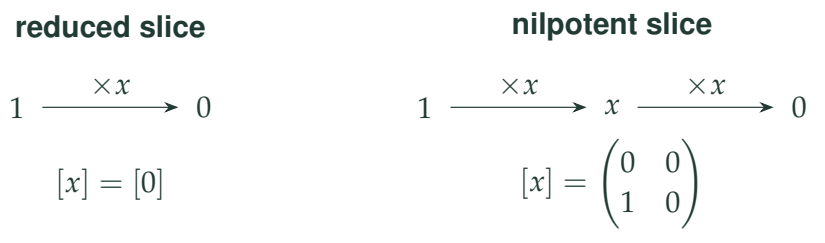
Reading the drawing
The reduced slice has a one-dimensional basis, on which multiplication by x sends one to zero. The nilpotent slice has basis one and x, with one mapping to x and then zero. The displayed multiplication matrices are respectively the zero scalar and a nonzero nilpotent two by two matrix.
Drawing labels and data 12 labels
Read the original labels as selectable text. Tables preserve grid relationships; other short labels are grouped compactly.
- reduced slice
- \(1\)
- \(0\)
- \(\times x\)
- nilpotent slice
- \(1\)
- \(x\)
- \(0\)
- \(\times x\)
- \(\times x\)
- \([x]=[0]\)
\([x]=\begin{pmatrix}0&0\\1&0\end{pmatrix}\)
A test ring detects the higher-stratum thickening
Let \(D=k[\delta]/(\delta^2)\) and send \(x\mapsto\delta\), \(y\mapsto0\). The ideal \((x^2,y)\) maps to zero, but \((x,y)\) does not. Therefore this \(D\)-point lies in the scheme defined by the first Fitting ideal of \(M'\), but not in the corresponding scheme for \(M\).
No extra ordinary point has appeared. What changed is the behavior on nilpotent test rings. This is the same distinction encountered in the formal model on Visual 3.
Read this as
Taking \(V(I)\) forgets nilpotent thickness. Fitting ideals can retain information that both the support set and the fiber-dimension function fail to distinguish.