
Let
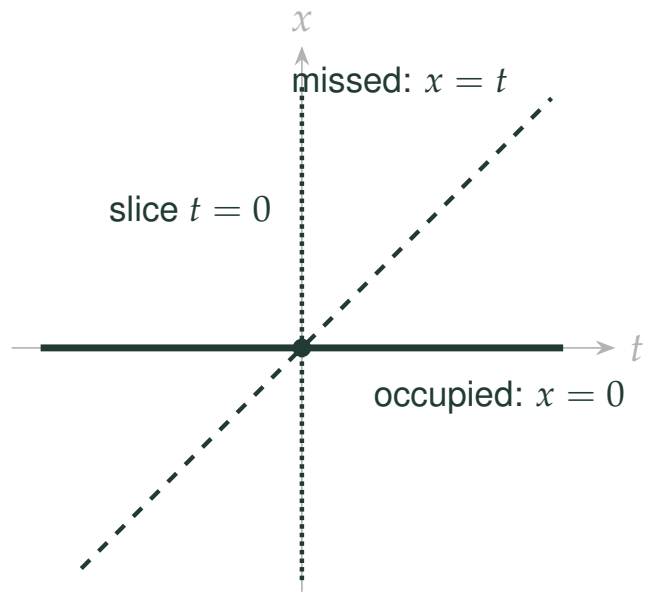
The module is free of rank one over \(S\). Yet over \(R_\infty\) its support is only \(V(x)\); the generic point \((x-t)\) of the other branch is not occupied.
Reading the drawing
The horizontal branch x equals zero is occupied. The diagonal branch x equals t is missed. Both meet the vertical special-fiber slice t equals zero at the same origin. A nonzero special fiber does not show full support on both branches.
Drawing labels and data 5 labels
Read the original labels as selectable text. Tables preserve grid relationships; other short labels are grouped compactly.
- \(t\)
- \(x\)
- occupied: \(x=0\)
- missed: \(x=t\)
- slice \(t=0\)
Remove the auxiliary variable
Set \(t=0\). Then
The two branches meet in a nonreduced special fiber. The relation becomes \(x^2=0\), not \(x=0\).
Evidence note from the source edition
The drawing is a real algebraic shadow of \(x(x-t)=0\). It is not the complete local spectrum. The special fiber's nilpotent structure is recorded by its quotient algebra, not by the point drawn at the intersection.
Full support need not mean faithful action
The ring \(R\) has one prime, \((x)\). The nonzero module \(M=k\) therefore has full support. But \(x\) annihilates \(M\), so the action is not faithful. It is nearly faithful: the annihilator \((x)\) is nilpotent. This distinction disappears over a reduced ring.
The actual descent theorem is one-way
For a finite module over a Noetherian ring,
If the initial support is full, the resulting support is full on the quotient. Our example shows that full support at the quotient can occur even when initial support was not full. It also shows why freeness over \(S\) alone is not the required patching hypothesis.
Read this as
A statement about freeness must name the base ring. A statement about occupancy must name the spectrum. Switching between them without a theorem loses the missing component.