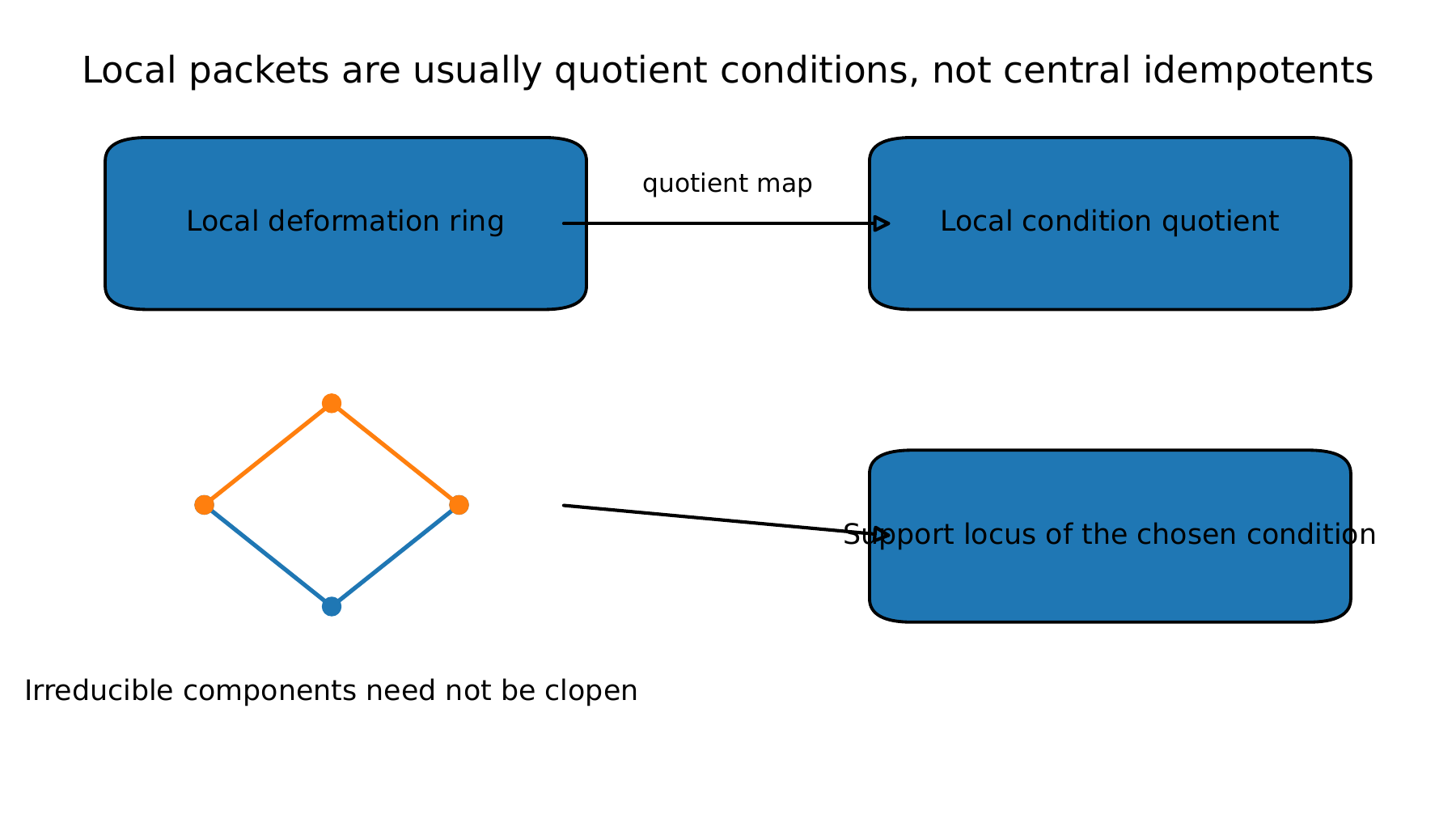
3 Local conditions are quotient packets
On this page · Permalink · Source line 252
The completed tensor product combines the local deformation conditions. The first theorem records the exact quotient law.
Theorem 3.1: Completed tensor quotient
Let \(R_1,\ldots,R_s\) be complete Noetherian local \({\mathcal O}\) algebras with common residue field \(k\). Let \(I_i\subseteq R_i\) be closed ideals. Put
and let \(J\) be the closed ideal generated by the images of the \(I_i\). Then there is a canonical isomorphism
Read proof · Visual guide: Local conditions remove directions · Visual guide: Completion retains every precision · Visual guide: Return to the proofs with a concrete object · Visual guide: Complete the actual topology · Read statement and proof side by side · Permalink · Source line 256 · Claim record · Lean coverage · Code · Worked examples
Proof of Theorem 3.1
Write \(S=\bigotimes_{i=1}^{s}R_i\) for the ordinary tensor product. Its ideal of definition is
The scalar term retains the base adic topology when the family is empty. The ordinary quotient theorem gives a canonical algebra isomorphism
carrying the image of \({\mathfrak a}\) to the defining ideal on the right. The quotient topology on \(S/L\) is precisely this image ideal topology.
Here completion means the actual Hausdorff completion for the additive uniformity of the indicated adic topology. For every adic ring \(S\) and ideal \(L\), there is a canonical bicontinuous ring isomorphism
Indeed, the completed quotient map kills the closed extended ideal. In the other direction, the quotient map from \(S/L\) to \(\widehat S/\overline{L\widehat S}\) extends to its completion. The latter quotient is complete: the adic uniformity has a countable base, and the quotient of a complete countably based additive group is complete. Its closed defining subgroup makes it Hausdorff. The two composites agree with the identity on dense quotient representatives, so continuity proves both inverse laws.
Applying this comparison to the displayed ordinary tensor isomorphism proves the claim. The closed extended ideal is exactly \(J\), since extension commutes with the finite sum of the factor ideals. The maps preserve coefficients and each canonical factor map. The common residue field identifies \(S/{\mathfrak a}\) with \(k\); finite generation of \({\mathfrak a}\), supplied by the Noetherian factor hypotheses, identifies the completed topology with its maximal ideal topology. Proper quotients retain locality. If a condition is the unit ideal, the ring comparison remains valid with the zero ring, without treating it as a local ring with residue field \(k\).
Back to statement · Read statement and proof side by side · Permalink · Source line 271 · Claim record · Lean coverage · Code · Worked examples
Corollary 3.2: Simultaneous local conditions
A continuous point of \(R^{\mathrm{loc}}\) with Hausdorff target factors continuously through \(R^{\mathrm{loc}}/J\) if and only if its restriction to every \(R_i\) factors continuously through \(R_i/I_i\). Each factor is unique. If the original point is local, its quotient factor is local.
Read proof · Visual guide: Local conditions remove directions · Visual guide: Complete the actual topology · Visual guide: Equations survive every precision · Read statement and proof side by side · Permalink · Source line 292 · Claim record · Lean coverage · Code · Worked examples
Proof of Corollary 3.2
Let \(f:R^{\mathrm{loc}}\to A\) be the point. Since \(A\) is Hausdorff and \(f\) is continuous, \(\ker f\) is closed. Thus it contains the closed ideal \(J\) if and only if it contains the algebraic ideal generated by the images of the \(I_i\). This is equivalent to every local restriction killing \(I_i\). The universal property of the actual ideal quotient gives the factors, and the quotient topology gives their continuity. Surjectivity of the quotient map gives uniqueness. If \(f\) reflects units, lift an element of the quotient to the original ring to see that its factor also reflects units.
Back to statement · Read statement and proof side by side · Permalink · Source line 296 · Claim record · Lean coverage · Code · Worked examples
Proposition 3.3: Global base change for local conditions
In the global deformation datum of Definition 2.1, let \(R^\square\) be a complete Noetherian local \({\mathcal O}\) algebra receiving a continuous local \({\mathcal O}\) algebra map from \(R^{\mathrm{loc}}\). Then
represents the base change of the global deformation problem to the simultaneous local conditions. A continuous local \({\mathcal O}\) algebra point of \(R^\square\) with complete Hausdorff coefficient target factors uniquely and continuously through \(R^{\tau}\) exactly when all of its local restrictions satisfy the declared quotient conditions.
Read proof · Visual guide: An atlas of the objects · Visual guide: A point is a test of the equations · Visual guide: Complete the actual topology · Read statement and proof side by side · Permalink · Source line 300 · Claim record · Lean coverage · Code · Worked examples
Proof of Proposition 3.3
Put \(A=R^{\mathrm{loc}}\), \(B=R^\square\), and let \(J\subseteq A\) be the closed local condition ideal. By Theorem 3.1, the independently constructed ring \(R^{\mathrm{loc},\tau}\) is canonically \(A/J\). The ordinary tensor identity
carries the defining ideal of the tensor to the image of \({\mathfrak m}_B\). Here the structural map is local by the stated global deformation datum, so it carries \({\mathfrak m}_A\) into \({\mathfrak m}_B\). Completing, and applying the completion and quotient comparison from the preceding proof, gives a bicontinuous isomorphism
The construction commutes with the canonical map from \(B\), which is therefore surjective. It is also unchanged by transporting the tensor factor from \(A/J\) to the actual completed tensor of the local quotients. The transported ideal is exactly its natural defining ideal.
For a continuous algebra point \(x:B\to C\) with complete Hausdorff target, the kernel of \(x\) is closed. Consequently \(x\) has a unique continuous factor through \(R^\tau\) if and only if it kills \(JB\), equivalently if its restriction to \(A\) kills \(J\). By Corollary 3.2, this is exactly the requirement that all local restrictions satisfy their quotient conditions. The factor is an algebra map because its composite with the canonical global map is \(x\). If \(x\) is local, surjectivity of that map shows that its factor reflects units and is local. Uniqueness also proves naturality under coefficient preserving maps of targets. This identifies the represented base change; it does not supply representability of a new arithmetic deformation problem.
Back to statement · Read statement and proof side by side · Permalink · Source line 310 · Claim record · Lean coverage · Code · Worked examples
The local coefficient points in Proposition 3.3 are test rings in the represented deformation category. Later field valued points \(x:R\to E'\) are algebraic or generic specializations, and continuity of \(\rho_x\) is imposed separately. Such a field specialization need not be a local ring map: under \({\mathcal O}\to E\), a uniformizer becomes a unit.
Proposition 3.4: Idempotents in a local ring
If \(R\) is a commutative local ring, then its only idempotents are zero and one.
Read proof · Visual guide: A branch is not an Artin packet · Read statement and proof side by side · Permalink · Source line 326 · Claim record · Lean coverage · Code · Worked examples
Proof of Proposition 3.4
Let \(e^2=e\). Since \(e+(1-e)=1\), at least one of \(e\) and \(1-e\) is a unit. If \(e\) is a unit, then \(e=1\). If \(1-e\) is a unit, then \(e=0\).
Back to statement · Read statement and proof side by side · Permalink · Source line 330 · Claim record · Lean coverage · Code · Worked examples
Remark 3.5
An irreducible component of \({\operatorname{Spec}} R\) for a local deformation ring need not be open and closed. It therefore need not be selected by an idempotent. Components and local conditions should be described by quotient ideals and module support. Idempotent packet formulas are reserved for finite Artin algebras or other settings with an actual product decomposition.