
Nested nonzero subspaces inside one fixed finite-dimensional space behave differently from nested tails inside an infinite-dimensional space.
Fixed carrier \(k^5\)
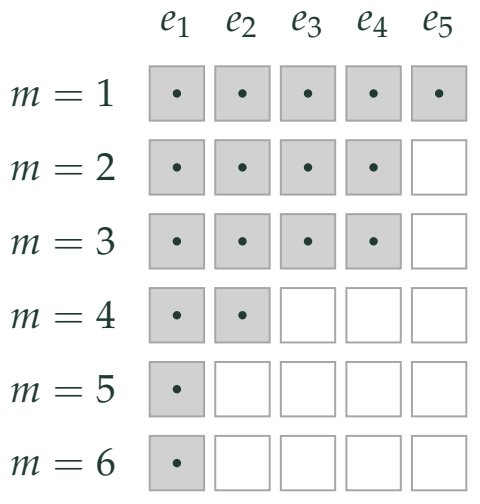
Reading the drawing
Six rows display nested spans of five fixed basis vectors. The rightmost direction disappears successively until only the first remains. The finite-dimensional chain has a nonzero stable intersection in this example.
Drawing labels and data 11 labels
Read the original labels as selectable text. Tables preserve grid relationships; other short labels are grouped compactly.
- \(m=1\)
- \(m=2\)
- \(m=3\)
- \(m=4\)
- \(m=5\)
- \(m=6\)
- \(e_1\)
- \(e_2\)
- \(e_3\)
- \(e_4\)
- \(e_5\)
Evidence note from the source edition
The projectors retain initial basis directions with dimensions \(5,4,4,2,1,1,\ldots\). In this explicitly defined example the projector is constant from level five onward.
Infinite carrier \(\ell^2(\mathbb N)\)
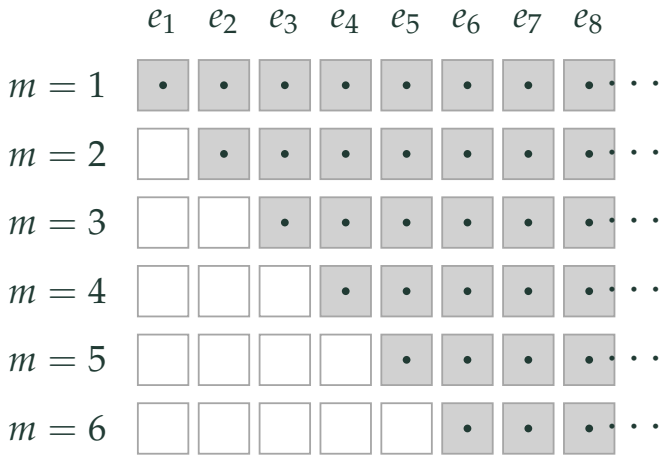
Reading the drawing
Each row retains all basis vectors from its index onward. Dots at the right indicate the infinite tail. Every displayed row is nonzero, yet no fixed basis direction survives every row.
Drawing labels and data 20 labels
Read the original labels as selectable text. Tables preserve grid relationships; other short labels are grouped compactly.
- \(m=1\)
- \(\cdots\)
- \(m=2\)
- \(\cdots\)
- \(m=3\)
- \(\cdots\)
- \(m=4\)
- \(\cdots\)
- \(m=5\)
- \(\cdots\)
- \(m=6\)
- \(\cdots\)
- \(e_1\)
- \(e_2\)
- \(e_3\)
- \(e_4\)
- \(e_5\)
- \(e_6\)
- \(e_7\)
- \(e_8\)
Evidence note from the source edition
Row \(m\) retains all basis vectors \(e_j\) with \(j\ge m\). Every row continues infinitely to the right. The display is a finite window, not a truncation of the actual carrier.
Why the finite chain eventually stops changing
Suppose idempotents satisfy
Their ranges are nested. In dimension \(d\), nonzero ranges allow at most \(d-1\) strict dimension drops. There may be long gaps between drops, but only finitely many drops. The chain therefore becomes constant and has nonzero intersection.
Source reading note
A single repeated dimension does not certify final stabilization. The finite example deliberately has a plateau \(4,4\) before another drop. Finite dimension bounds the number of strict drops, not the time of the last one.
Why every infinite tail can be nonzero while their intersection vanishes
Let \(P_m\) project onto the closed span of \(e_m,e_{m+1},\ldots\). Each range is nonzero. But a vector belonging to every range has its \(j\)-th coordinate zero once \(m>j\). Every coordinate is therefore zero:
Read this as
Fixed finite-carrier stabilization, stable images in an inverse system, and infinite Hilbert-space tails are different situations. Their hypotheses cannot be exchanged.