Paper XII visual guide · Visual 12 of 27 · MODEL C / A NONSEMISIMPLE HECKE ALGEBRA

A packet contains an entire Jordan chain

Main text: Theorem 8.2, Corollary 8.3 and Example 8.6 Main statement 8.2

Start reading

Resources & source

Original plate in the visual-guide PDF · Original atlas source

Skip contents and start reading

Work over \({\mathbb Q}\) and let

\[ T={\mathbb Q}[z]\big/\bigl((z-1)^2(z+1)^3\bigr),\qquad V=T. \]

The Chinese remainder theorem gives

\[ T\cong \underbrace{{\mathbb Q}[\varepsilon]/(\varepsilon^2)}_{T_+,\ z=1+\varepsilon} \times \underbrace{{\mathbb Q}[\eta]/(\eta^3)}_{T_-,\ z=-1+\eta}. \]

Multiplication by \(z\) is an operator \(H\). In the ordered local bases \(1,\varepsilon\) and \(1,\eta,\eta^2\), its matrix is
\[ H=\left(\begin{array}{cc|ccc} 1&0&0&0&0\\1&1&0&0&0\\\hline 0&0&-1&0&0\\0&0&1&-1&0\\0&0&0&1&-1 \end{array}\right). \]
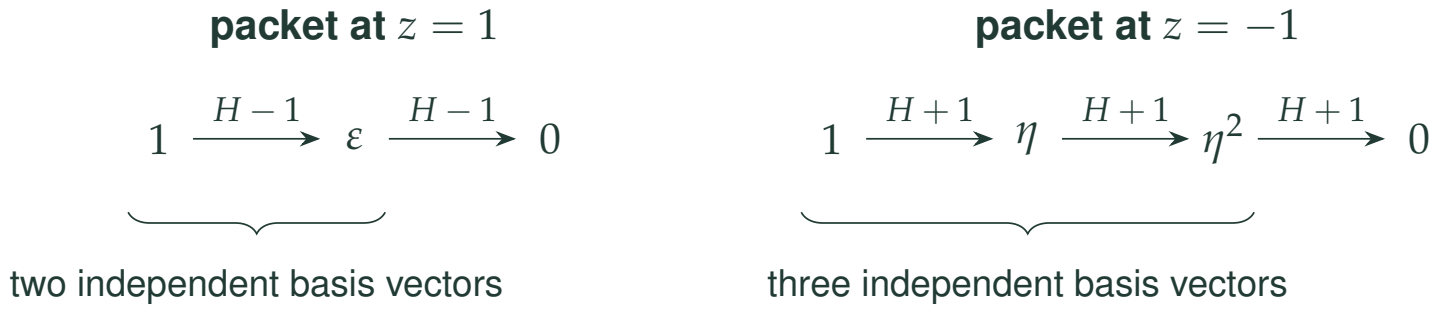
The two Artin packets contain different Jordan chains
Original drawing. Read the description below; expand the labels and data for selectable text.

Reading the drawing

The packet at z equals one has basis one and epsilon, with multiplication by H minus one moving one to epsilon to zero. The packet at z equals minus one has basis one, eta and eta squared, with multiplication by H plus one giving a three-term nilpotent chain.

Drawing labels and data 16 labels

Read the original labels as selectable text. Tables preserve grid relationships; other short labels are grouped compactly.

  • packet at \(z=1\)
  • packet at \(z=-1\)
  • \(1\)
  • \(\varepsilon\)
  • \(0\)
  • \(H-1\)
  • \(H-1\)
  • \(1\)
  • \(\eta\)
  • \(\eta^2\)
  • \(0\)
  • \(H+1\)
  • \(H+1\)
  • \(H+1\)
  • two independent basis vectors
  • three independent basis vectors

Open the full-size drawing

Evidence note from the source edition

These arrows are the actual nilpotent actions \(H-1\) and \(H+1\). Each nonzero displayed basis vector belongs to the indicated packet. Only the last nonzero vector in each chain is an ordinary eigenvector.

The projectors can be written explicitly

Modulo \((z-1)^2(z+1)^3\), put

\[ e_+(z)=\frac{(5-3z)(z+1)^3}{16},\qquad e_-(z)=1-e_+(z). \]

Then \(e_+\equiv1\pmod{(z-1)^2}\) and \(e_+\equiv0\pmod{(z+1)^3}\). Consequently

\[ e_+(H)=\operatorname{diag}(1,1,0,0,0),\qquad e_-(H)=\operatorname{diag}(0,0,1,1,1). \]

The packet dimensions are two and three. The ordinary eigenspaces each have dimension one; the generalized eigenspaces have dimensions two and three.

Read this as

Canonical idempotents isolate the full primary pieces, including their nilpotent structure. Semisimplicity is not required, and replacing a packet by an ordinary eigenspace can discard most of it.

Source and conversion record

The original atlas wording, equations, and drawing labels are retained. Drawings are views of the retained visual-guide PDF. Text descriptions and table headings are added reading aids. This conversion does not rebuild TeX, rerun the examples, audit proofs or compile Lean.

The guide contains 27 plates and 23 drawings: 21 from separate drawing files and two embedded directly in the page source. The unused rotated-support sketch is retained in the source archive. The final claim-delta and evidence pages preserve the distinction between the revised contract and the historical original wording.

Conversion checks and source hashes

Notation in Paper XII

Look up a symbol without leaving this chapter. Select text before opening help to search for it.

Search this work’s notation.

    Symbols can have different meanings in different passages. Read each result in its own context.

    Open the full notation index