
Take \(\Delta=C_4\times C_2\) in residue characteristic two. If \(g\) and \(h\) generate its two factors, put \(X=g-1\), \(Y=h-1\). Then
The identity \((1+X)^4-1=X^4\) and its \(Y\) analogue provide the relations. The eight surviving monomials provide the exact dimension \(|\Delta|=8\) and establish the isomorphism after surjectivity.
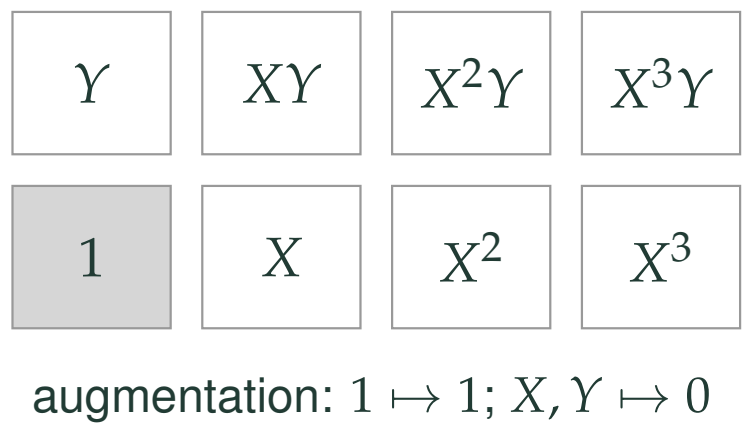
Reading the drawing
Two rows show one, X, X squared, X cubed and their products with Y. The shaded constant survives augmentation. X and Y, and hence the other displayed nonconstant monomials, map to zero.
Drawing labels and data 9 labels
Read the original labels as selectable text. Tables preserve grid relationships; other short labels are grouped compactly.
| Row / column | Column 1 | Column 2 | Column 3 | Column 4 |
|---|---|---|---|---|
| Row 1 | \(Y\) | \(XY\) | \(X^{2}Y\) | \(X^{3}Y\) |
| Row 2 | \(1\) | \(X\) | \(X^{2}\) | \(X^{3}\) |
- augmentation: \(1\mapsto1\); \(X,Y\mapsto0\)
Evidence note from the source edition
All eight basis monomials are displayed. The filled scalar slot survives augmentation; all other displayed monomials lie in the augmentation ideal. This is a basis array, not a spectrum with eight points.
The residual ring is local
The augmentation ideal is \((X,Y)\), its quotient is \({\mathbb F}_2\), and \((X,Y)^5=0\): a degree-five monomial has \(X\)-exponent at least four or \(Y\)-exponent at least two. Every element outside \((X,Y)\) has the form \(1+n\) for nilpotent \(n\), with inverse the finite geometric series. Thus \((X,Y)\) is the unique maximal ideal, and the only idempotents are \(0,1\).
A quotient of groups gives a quotient of algebras
Map \(C_4\times C_2\to C_2\) by \(g\mapsto\bar g\), \(h\mapsto1\). The induced algebra map sends \(X\) to \(\bar X\) with \(\bar X^2=0\) and sends \(Y\) to zero. It is surjective. Augmentation commutes with this map because every group basis element is sent to another group element of augmentation one.
Recover a free carrier, with its base ring named
For \(\Lambda={\mathbb Z}_2[\Delta]\) and the right module \(M=\Lambda^r\),
The quotient applies augmentation to each basis coordinate. This remains valid for nonabelian finite two groups with the stated right-module convention. It establishes the rank over the coefficient ring after coinvariants, without establishing full support over a separate deformation ring.
Read this as
The augmentation quotient keeps the scalar coordinate. It needs no averaging denominator and supplies no missing patching-support hypothesis.