
Let \(R^\square={\mathcal O}[[u,v]]\) and send \(x\mapsto u\), \(y\mapsto v-u\). The local conditions become
Probe this ring using \(D_3={\mathbb F}_5[\delta]/(\delta^3)\), with the fixed coefficient map \({\mathbb Z}_5\to{\mathbb F}_5\). A continuous local point is specified by
It factors through \(R^\tau\) precisely when
First-order coefficients
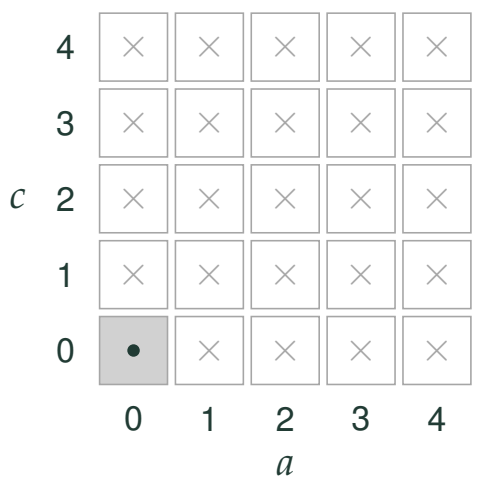
Reading the drawing
A five by five array indexes a horizontally and c vertically over the field with five elements. Only the cell a equals c equals zero is filled. All other pairs are crossed out.
Drawing labels and data 36 labels
Read the original labels as selectable text. Tables preserve grid relationships; other short labels are grouped compactly.
- \(\times\)
- \(\times\)
- \(\times\)
- \(\times\)
- \(\times\)
- \(\times\)
- \(\times\)
- \(\times\)
- \(\times\)
- \(\times\)
- \(\times\)
- \(\times\)
- \(\times\)
- \(\times\)
- \(\times\)
- \(\times\)
- \(\times\)
- \(\times\)
- \(\times\)
- \(\times\)
- \(\times\)
- \(\times\)
- \(\times\)
- \(\times\)
- 0
- 0
- 1
- 1
- 2
- 2
- 3
- 3
- 4
- 4
- \(a\)
- \(c\)
Evidence note from the source edition
Only the slope pair \((a,c)=(0,0)\) survives. Each square initially has 25 choices of \((b,d)\).
Remaining second-order coefficients
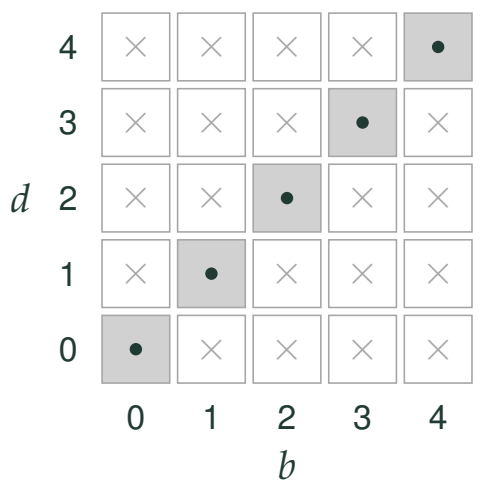
Reading the drawing
A five by five array indexes b horizontally and d vertically. The five filled cells have b equal to d. Off-diagonal cells are crossed out.
Drawing labels and data 32 labels
Read the original labels as selectable text. Tables preserve grid relationships; other short labels are grouped compactly.
- \(\times\)
- \(\times\)
- \(\times\)
- \(\times\)
- \(\times\)
- \(\times\)
- \(\times\)
- \(\times\)
- \(\times\)
- \(\times\)
- \(\times\)
- \(\times\)
- \(\times\)
- \(\times\)
- \(\times\)
- \(\times\)
- \(\times\)
- \(\times\)
- \(\times\)
- \(\times\)
- 0
- 0
- 1
- 1
- 2
- 2
- 3
- 3
- 4
- 4
- \(b\)
- \(d\)
Evidence note from the source edition
Once \(a=c=0\), the five diagonal choices \(d=b\) give all accepted points.
An obstruction you can calculate
There are \(5^4=625\) candidate \(D_3\)-points and exactly five accepted points. Over \(D_2={\mathbb F}_5[\delta]/(\delta^2)\), however, the five maps \(u=v=a\delta\) all satisfy the equations. Reduction of every accepted \(D_3\)-point gives the zero \(D_2\)-point. The four nonzero tangent directions therefore do not lift to order three.
Read this as
A point satisfies equations in a target ring. A tangent direction can exist while its next-order lift fails. The factorization theorem identifies the condition; it does not promise that every point lifts.