
Return to \(M={\operatorname{coker}}\operatorname{diag}(x,y)\) over \(R=k[x,y]\). Pull back along the diagonal \(R\to k[t]\), \(x\mapsto t\), \(y\mapsto t\). The base-changed presentation is literal:
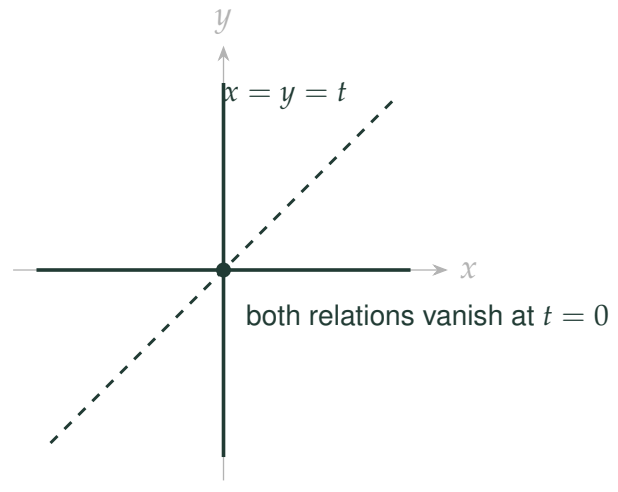
Reading the drawing
A dashed line x equals y equals t crosses the two coordinate axes at their common origin. Both presentation relations vanish at t equals zero, so both directions survive there after base change.
Drawing labels and data 4 labels
Read the original labels as selectable text. Tables preserve grid relationships; other short labels are grouped compactly.
- \(x\)
- \(y\)
- \(x=y=t\)
- both relations vanish at \(t=0\)
Both relations vanish together
The support is the origin, but the origin has fiber dimension two. Replacing \((t^2)\) by its radical \((t)\) would lose the zeroth Fitting ideal.
This map is not flat: it is the quotient by \(x-y\). The Fitting base-change theorem still applies; it does not require flatness.
Evidence note from the source edition
A real-point shadow of the diagonal slice. The double algebraic contribution is certified by the minor \(t^2\), not by the visual thickness of the intersection point.
An isomorphism changes coordinates, not occupancy
Over a field of characteristic other than two, the isomorphism
sends the Fitting ideals to \((a^2-b^2)\) and \((a,b)\). The two axes become the two lines \(a=b\) and \(a=-b\). No previously missing module vector is created by this relabeling.
An extra presentation generator changes nothing
Replacing \(\operatorname{diag}(x,y)\) by \(\operatorname{diag}(x,y,1)\) adds a generator killed by the relation \(1\). The new maximal minor is \(xy\), and the new next-size minors generate \((xy,x,y)=(x,y)\). The module and its intrinsic Fitting ideals are unchanged. This is a small visible instance of presentation independence of Fitting ideals.
Read this as
Specialization substitutes into the actual relation matrix. An isomorphism transports all the data. Neither operation may be replaced by an informal edit of the support picture.