
Keep the algebra \(T=T_+\times T_-\) from Visual 12, but compare two different \(T\)-modules:
where \(T\) acts on \(W\) through projection to its first factor. The algebra still has two maximal ideals, but only one of them is in \({\operatorname{Supp}}_T(W)\). Here \(T\) is a supplied algebra; its action on \(W\) is not assumed faithful.
Reading the drawing
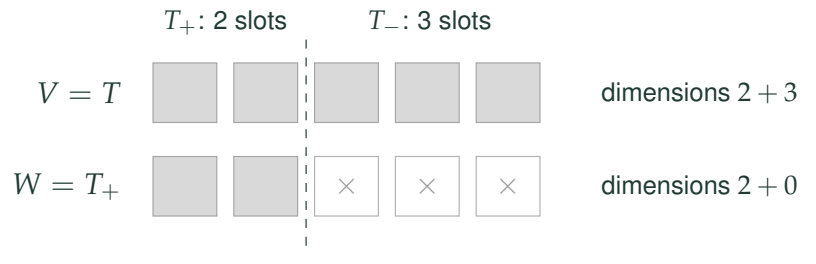
The regular module V has two slots in the plus factor and three in the minus factor. The module W retains the two plus slots and has no minus-factor basis vectors. Crossed reference slots show absent directions; they are not extra vectors in W.
Drawing labels and data 9 labels
Read the original labels as selectable text. Tables preserve grid relationships; other short labels are grouped compactly.
- \(V=T\)
- \(W=T_+\)
- \(\times\)
- \(\times\)
- \(\times\)
- \(T_+\): 2 slots
- \(T_-\): 3 slots
- dimensions \(2+3\)
- dimensions \(2+0\)
Evidence note from the source edition
Squares refer to the local bases of the regular module. Crossed reference slots are absent from \(W\); they are not additional basis vectors of \(W\).
| Measurement | regular module \(V\) | first-factor module \(W\) |
|---|---|---|
| \(\dim e_+(-)\) | 2 | 2 |
| \(\dim e_-(-)\) | 3 | 0 |
| Support | both maximal points | only the \(+\) point |
| Trace of \(e_-\) | 3 | 0 |
A generalized packet is not its residue-field fiber
At the point \(z=1\), the full local packet \(e_+V\) has dimension two, but its scalar fiber is
The packet has the basis \(1,\varepsilon\). Its scalar fiber kills \(\varepsilon\). The ordinary eigenspace is instead the kernel of multiplication by \(\varepsilon\), spanned by \(\varepsilon\). In this example the last two spaces have the same dimension, but they are obtained by different operations.
For \(W\), the fiber at \(z=-1\) is zero. At \(z=1\) it is nonzero. The field-fiber criterion detects exactly the support of the supplied module.
Read this as
A ring factor describes an available packet location. A nonzero localized module certifies occupancy there. A field fiber then specializes that module; it is not the whole generalized packet.