
Consider the complete local node
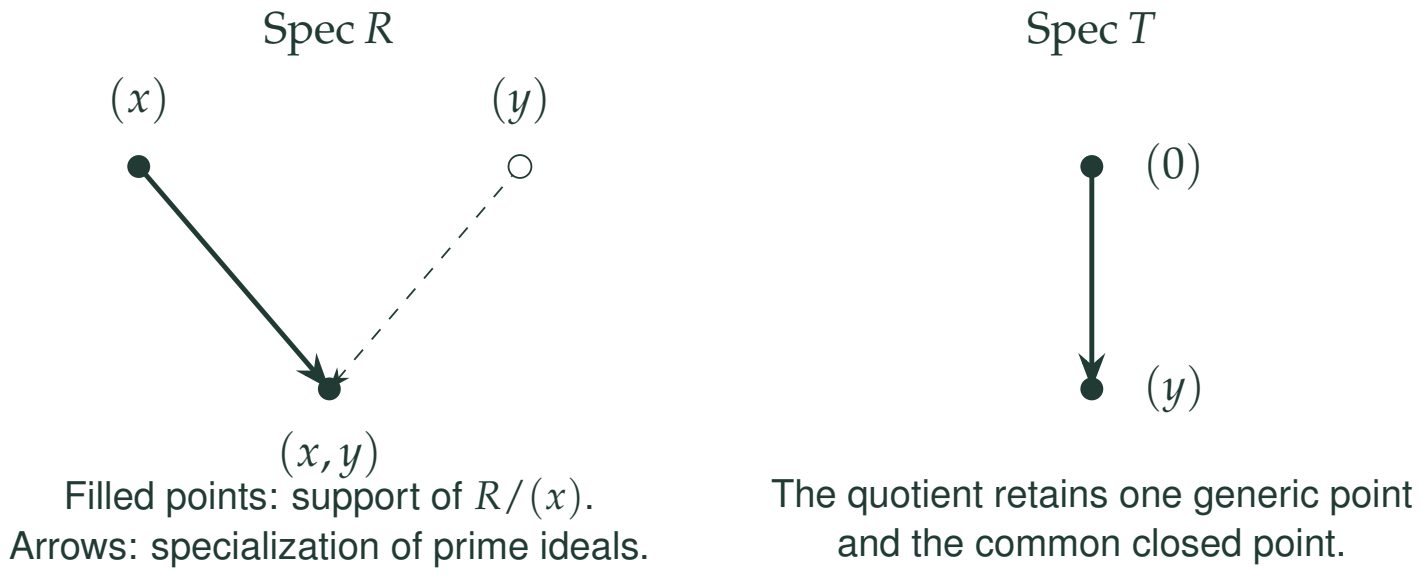
Every prime of \(R\) contains \(x\) or \(y\). Since \(k[[x]]\) and \(k[[y]]\) are discrete valuation rings, the following diagram lists all three prime ideals of \(R\) and their specialization relations.
Reading the drawing
On the left, two generic primes specialize to one closed prime. Filled points mark the support of the module quotient by x; the other generic point is open. On the right, the quotient spectrum has one generic point specializing to its closed point.
Drawing labels and data 9 labels
Read the original labels as selectable text. Tables preserve grid relationships; other short labels are grouped compactly.
- \(\operatorname{Spec}R\)
- \((x)\)
- \((y)\)
- \((x,y)\)
Filled points: support of \(R/(x)\).
Arrows: specialization of prime ideals.
- \(\operatorname{Spec}T\)
- \((0)\)
- \((y)\)
The quotient retains one generic point
and the common closed point.
What the quotient removes
As an \(R\)-module, \(T\) has annihilator \((x)\), hence
The other generic point \((y)\) is missing because it does not contain \(x\). The quotient has not created a disconnected projector summand inside the original local ring. It has changed the ring by imposing an equation.
Why no idempotent selects just this branch
In a commutative local ring, \(e^2=e\) implies \(e=0\) or \(e=1\). Indeed, \(e+(1-e)=1\) forces at least one of \(e,1-e\) to be a unit; canceling in \(e(1-e)=0\) gives the conclusion. Thus this node has no nontrivial idempotent even though it has two irreducible components.
By contrast, a product of two Artin local rings has two disjoint maximal points, with canonical idempotents \((1,0)\) and \((0,1)\). Those idempotents act on any supplied module over the product. Their two ranges are the packets studied on Visual 12.
Read this as
Intersecting local components are not product factors. Use quotient ideals and support for the node; use canonical idempotents only where an actual product decomposition exists.