
For \(B={\mathbb Z}_5[\varepsilon]/(\varepsilon^2)\), consider the finite quotient rings
A point of the limit is a single compatible choice at every level, not unrelated choices from the nonempty finite rings.
Two explicit 5-adic numbers
Choose the canonical digits
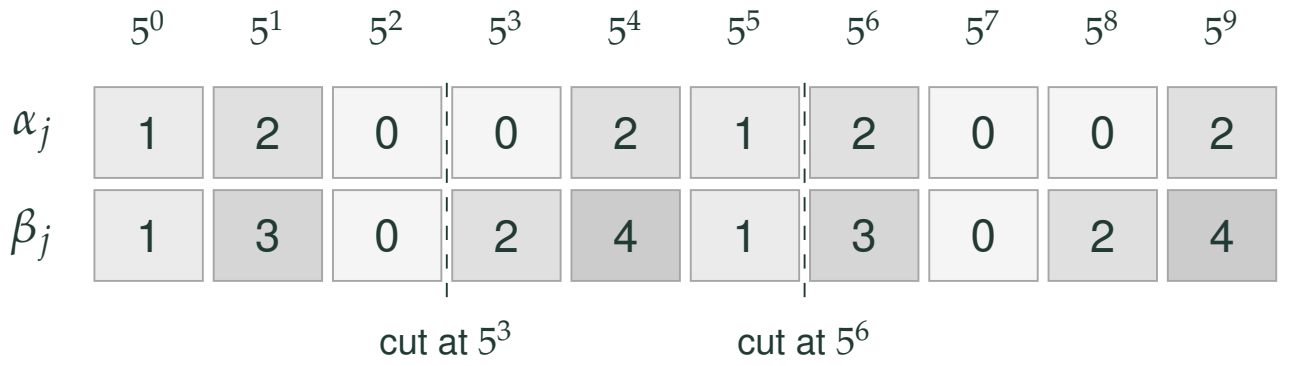
with values in \(\{0,1,2,3,4\}\). Set \(a=\sum_{j\ge0}\alpha_j5^j\) and \(b=\sum_{j\ge0}\beta_j5^j\). The element \(a+\varepsilon b\) is determined by the following coefficient array.
Reading the drawing
Two rows give ten retained coefficients, labelled alpha and beta, beneath powers of five zero through nine. Dashed cuts at the third and sixth powers mark truncation. Increasing precision retains every earlier coefficient.
Drawing labels and data 34 labels
Read the original labels as selectable text. Tables preserve grid relationships; other short labels are grouped compactly.
| Row / column | \(5^{0}\) | \(5^{1}\) | \(5^{2}\) | \(5^{3}\) | \(5^{4}\) | \(5^{5}\) | \(5^{6}\) | \(5^{7}\) | \(5^{8}\) | \(5^{9}\) |
|---|---|---|---|---|---|---|---|---|---|---|
| \(\alpha_j\) | 1 | 2 | 0 | 0 | 2 | 1 | 2 | 0 | 0 | 2 |
| \(\beta_j\) | 1 | 3 | 0 | 2 | 4 | 1 | 3 | 0 | 2 | 4 |
- cut at \(5^3\)
- cut at \(5^6\)
Evidence note from the source edition
Cutting before column \(5^n\) produces reduction modulo \(5^n\). The digit formulas define every column, including those not drawn.
| \(n\) | 1 | 2 | 3 | 4 | 5 |
|---|---|---|---|---|---|
| \(5^n\) | 5 | 25 | 125 | 625 | 3125 |
| \(a\bmod5^n\) | 1 | 11 | 11 | 11 | 1261 |
| \(b\bmod5^n\) | 1 | 16 | 16 | 266 | 2766 |
Every longer prefix reduces to the previous one; the digit formulas specify all later coefficients.
Where the topology enters
The \(5\)-adic and \((5,\varepsilon)\)-adic topologies on \(B\) agree: for every \(n\),
For the general quotient theorem, the condition ideal must be closed. A continuous map to a Hausdorff target has closed kernel: vanishing on the original generators therefore kills their closure.