
The hat in \({\mathbin{\widehat\otimes}}\) names an actual completion. For the finite family of local rings, start with the ordinary tensor and its ideal of definition:
The comparison uses the \(\mathfrak a\)-adic additive uniformity on \(S\), the image ideal topology on \(S/L\), and the closed extended ideal \(J=\overline{L\widehat S}\).
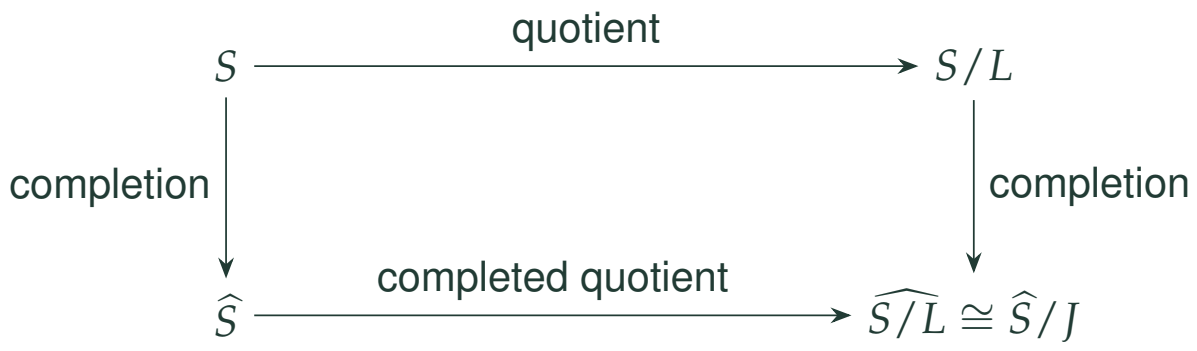
Reading the drawing
The upper arrow quotients S by L. The vertical arrows complete. The lower arrow is the completed quotient, identified with the completed ring modulo the closed ideal J. The topology and the closure are part of the construction.
Drawing labels and data 8 labels
Read the original labels as selectable text. Tables preserve grid relationships; other short labels are grouped compactly.
- \(S\)
- \(S/L\)
- \(\widehat S\)
- \(\widehat{S/L}\cong\widehat S/J\)
- quotient
- completion
- completion
- completed quotient
Evidence note from the source edition
The square names the actual quotient and completion maps. The lower identification is bicontinuous and preserves the coefficient map and every canonical factor map. The square does not assert that completion leaves \(S\) unchanged.
The explicit model revisited
For \(R_1={\mathbb Z}_5[[x]]\) and \(R_2={\mathbb Z}_5[[y]]\), the completion of their ordinary tensor in this topology is \({\mathbb Z}_5[[x,y]]\). With \(L\) generated by \(x^2,y\), the lower quotient is \({\mathbb Z}_5[\varepsilon]/(\varepsilon^2)\) with its \((5,\varepsilon)\)-adic topology. The containment on Visual 5 identifies this with its \(5\)-adic topology.
Boundary cases are part of the contract
| Case | Actual object and consequence |
|---|---|
| Empty family | \(S={\mathcal O}\) and \(\mathfrak a={\mathfrak m}_{\mathcal O}\). The scalar adic topology remains; an empty sum of factor ideals does not erase it. |
| All \(I_i=0\) | \(J=0\); the comparison returns the completed tensor itself. |
| Some \(I_i=R_i\) | \(J=\widehat S\) and both sides are the zero ring. This comparison does not give a local ring with residue field \(k\). |
For global base change, the structural map \(A\to B\) belongs to the continuous local coefficient-algebra setting. Then \(B{\mathbin{\widehat\otimes}}_A(A/J)\cong B/\overline{JB}\). For a continuous algebra point to a complete Hausdorff target, closedness of its kernel gives the factorization test. Locality of a point, when supplied, passes to its unique quotient factor.
Read this as
Closure and topology are structural data. A list of equations in a finite model illustrates the quotient but does not replace the actual completed comparison.