
Suppose a known semisimple carrier is a sum of two known constituents with multiplicities \(m_1,m_2\). Consider the independent trace functions
At the two sample points \(\omega=1,-1\), their evaluation matrix is
It is invertible over \({\mathbb Q}\). If the measured trace vector is \((5,1)\), solve
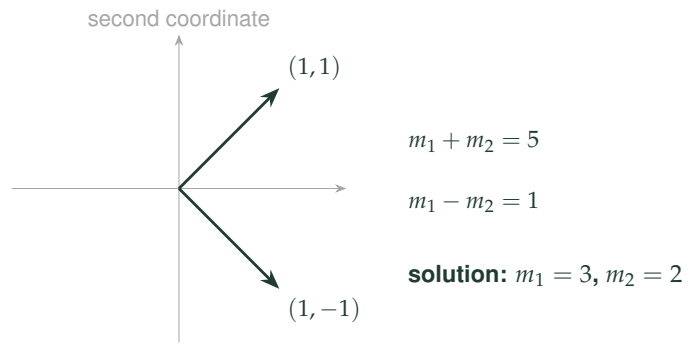
Reading the drawing
Two arrows from the origin represent the vectors one-one and one-minus-one. Their equations are m one plus m two equals five, and m one minus m two equals one. The retained solution is three and two; the source requires a known semisimple carrier.
Drawing labels and data 6 labels
Read the original labels as selectable text. Tables preserve grid relationships; other short labels are grouped compactly.
- second coordinate
- \((1,1)\)
- \((1,-1)\)
- \(m_1+m_2=5\)
- \(m_1-m_2=1\)
- solution: \(m_1=3\), \(m_2=2\)
Evidence note from the source edition
The vectors \((1,1)\) and \((1,-1)\) are the two independent rows of the exact evaluation matrix. The coefficients \(3,2\) are recovered by the displayed linear equations. This illustration uses functions on \({\mathbb Q}\), not a newly constructed arithmetic Frobenius set.
Why finitely many evaluations suffice in general
Independent functions \(t_1,\ldots,t_r\) on \(\Omega\) have evaluation vectors spanning \(E'^r\). Otherwise an annihilating nonzero linear functional would give a forbidden relation among the functions. Choosing \(r\) independent evaluations gives an invertible matrix that recovers coefficients in their known sum.
Two checks before using this in arithmetic
The trace functions must be independent on the permitted Frobenius set; the carrier must already be semisimple with the stated constituents. Arbitrary samples supply neither premise. Nonnegative integral multiplicities come from representation data, not every rational linear-system solution.
The coefficient field matters again
The displayed integer matrix reduces modulo two to a matrix with determinant zero and two coincident rows. Those residual samples cannot recover the two coefficients. This matches the trace caution on Visual 14: characteristic-zero trace detection cannot be silently transported to residue characteristic two.
Read this as
A finite separator reconstructs coefficients in supplied independent trace data. It is not a construction of the constituents, their compatible systems, or automorphic realizations.