10 Compatible systems and companion completion
On this page · Permalink · Source line 1416
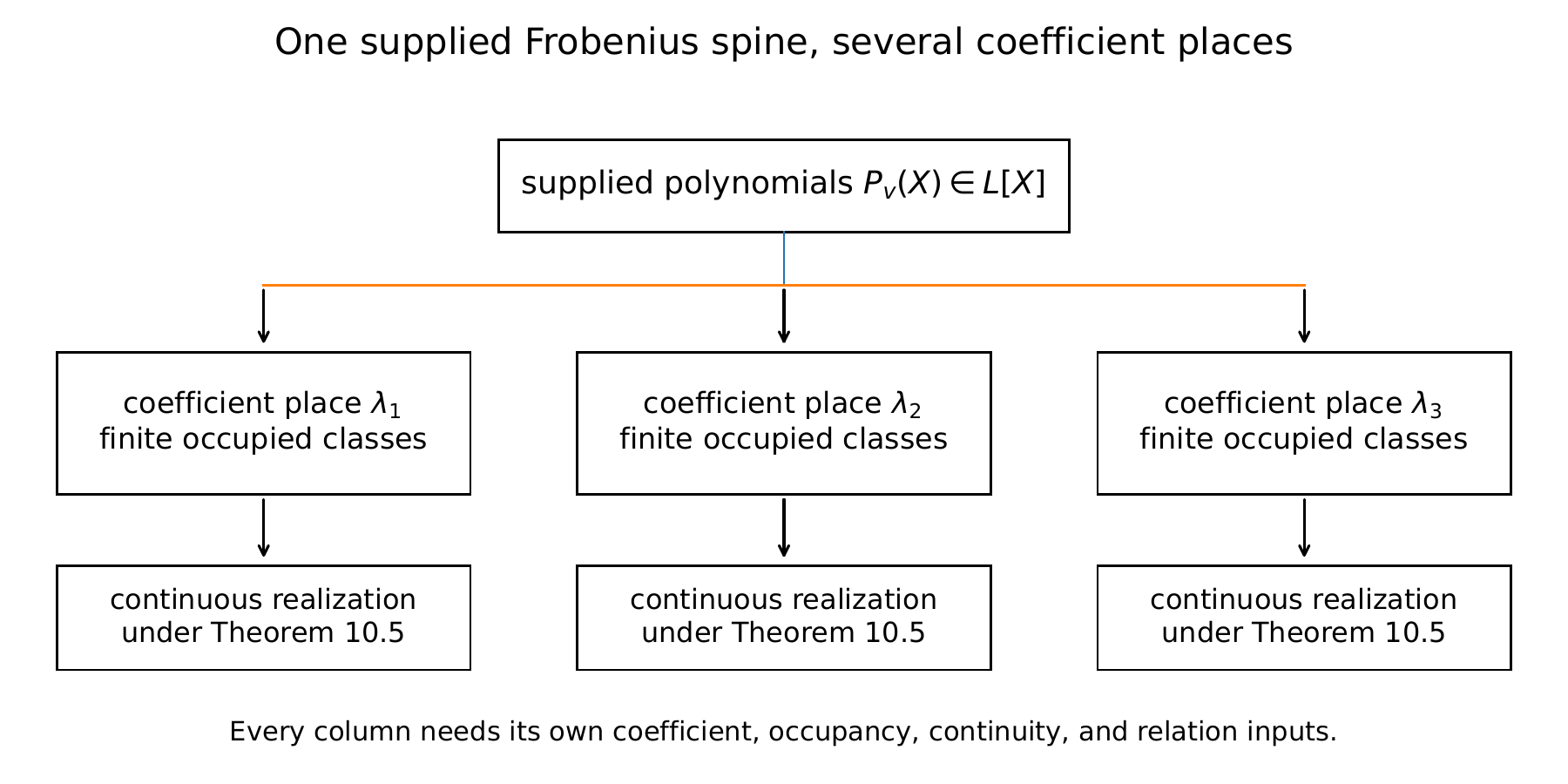
Pointwise automorphy at one coefficient place and existence of companions at other coefficient places are different statements. They meet only after a common algebraic Frobenius spine has been fixed.
Definition 10.1: Algebraic Frobenius spine
An algebraic Frobenius spine consists of a number field \(L\), a finite set of places \(S\) of \(F\), and polynomials
for every finite place \(v\notin S\), together with any additional local labels required by the declared compatibility problem.
Permalink · Source line 1420 · Claim record · Lean coverage · Code · Worked examples
Definition 10.2: Finite companion forest
Fix a coefficient place \(\lambda\) of \(L\). A finite companion forest for the spine is an inverse system of finite sets
whose points are admissible realizations modulo \(\lambda^m\), with edges given by reduction. A complete realization is admissible for this forest when all its finite reductions belong to the displayed levels; the empty level obstruction below concerns this declared admissibility problem.
Permalink · Source line 1428 · Claim record · Lean coverage · Code · Worked examples
Theorem 10.3: Companion branch criterion
Suppose every level \(X_{\lambda,m}\) is finite and nonempty, and every point reduces along the displayed forest to the fixed residual root. Then
Read proof · Visual guide: A finite forest selects a branch · Read statement and proof side by side · Permalink · Source line 1441 · Claim record · Lean coverage · Code · Worked examples
Proof of Theorem 10.3
The disjoint union of the levels is an infinite rooted tree. It is locally finite because every level is finite. It contains a vertex at every depth. König's infinity lemma gives an infinite branch [10]. That branch is a point of the inverse limit.
Back to statement · Read statement and proof side by side · Permalink · Source line 1451 · Claim record · Lean coverage · Code · Worked examples
Corollary 10.4: Empty finite companion obstruction
If \(X_{\lambda,m}=\varnothing\) for some \(m\), then no complete \(\lambda\) adic realization admissible for this forest exists.
Read proof · Visual guide: A finite forest selects a branch · Read statement and proof side by side · Permalink · Source line 1455 · Claim record · Lean coverage · Code · Worked examples
Proof of Corollary 10.4
A complete realization would reduce to a point at every finite level.
Back to statement · Read statement and proof side by side · Permalink · Source line 1459 · Claim record · Lean coverage · Code · Worked examples
Finite forests alone give compatible classes. To obtain actual continuous representations, we use the following explicit coefficient and admissibility data. They also delimit the meaning of completion in the next theorem.
Fix a topological group \(\Gamma\), a finite matrix index set \(D\), and a set \(\Lambda\) of coefficient indices. For each \(\lambda\), let \({\mathcal O}_\lambda\) be a commutative ring, complete and separated for a finitely generated ideal \(I_\lambda\), with finite residue ring \({\mathcal O}_\lambda/I_\lambda\). Give \({\mathcal O}_\lambda\) its ideal adic topology and every quotient its discrete topology. Let
be supplied ring homomorphisms, where \(L\) and \(K_\lambda\) are fields, \(K_\lambda\) has a declared topology, and \(i_\lambda\) is continuous.
For every positive integer \(n\), let \(X_{\lambda,n}\) be a finite nonempty set of conjugacy classes of actual continuous representations
Conjugacy means change of basis by an invertible matrix over that quotient. Assume reduction preserves these sets and that \(X_{\lambda,1}\) consists of the declared residual class. Each admissible class must have a continuous representative. The auxiliary level zero is the unique class over the trivial quotient and imposes no extra occupancy hypothesis.
Choose elements \(\gamma_v\in\Gamma\) on a sample set \(\Omega\), with declared good subsets \(\Omega_\lambda\subseteq\Omega\). In the arithmetic application these are the chosen Frobenius elements at the permitted places. For each \(v\in\Omega_\lambda\), supply an integral polynomial \(P_{\lambda,v}\in{\mathcal O}_\lambda[X]\) such that
Here and below a ring homomorphism applied to a polynomial acts on its coefficients. Assume every representative of every class in \(X_{\lambda,n}\) has characteristic polynomial \(P_{\lambda,v}\bmod I_\lambda^n\) at \(\gamma_v\). Also supply a subgroup \(H_\lambda\leq\Gamma\) on which all these finite representations are trivial. This is an inertia condition when \(H_\lambda\) is the specified inertia subgroup.
Finally, put
For each declared local condition index \(u\), supply an ideal \(J_{\lambda,u}\subseteq B_\lambda\). Evaluation at a representation sends \(x_{g,a,b}\) to its \((a,b)\) matrix entry at \(g\). Assume that evaluation at every admissible finite representative kills \(J_{\lambda,u}\), with polynomial coefficients reduced modulo \(I_\lambda^n\). For this class based theorem, the equations must hold in every admissible frame. A condition imposed only in one chosen frame needs a separate compatible frame argument. No arbitrary arithmetic condition is identified with such an ideal without a separate argument.
Theorem 10.5: Conditional simultaneous companion completion
Under the coefficient and finite admissibility hypotheses above, one can choose continuous representations
whose reduction class belongs to \(X_{\lambda,n}\) for every positive \(n\). They retain the declared residual class. After applying \(i_\lambda\), they are continuous, trivial on \(H_\lambda\), and satisfy
Their integral evaluation points factor through every actual quotient \(B_\lambda/J_{\lambda,u}\).
Read proof · Visual guide: Completion retains every precision · Visual guide: Classes are not matrix frames · Visual guide: Equations survive every precision · Read statement and proof side by side · Permalink · Source line 1490 · Claim record · Lean coverage · Code · Worked examples
Proof of Theorem 10.5
The finitely generated ideal and finite residue ring give finite coefficient quotients at every precision. An individual conjugacy class has finitely many frames because the group of invertible basis matrices over each quotient is finite. Thus the finitely many admissible classes give a finite nonempty set of actual continuous representations at each positive level. Continuity is invariant under conjugation. Reduction gives total maps between these sets. Compactness, as in Theorem 10.3, selects strictly compatible representatives. This step neither assumes transition surjectivity nor lifts a prescribed conjugating matrix.
Completeness and separatedness identify \({\operatorname{GL}}_D({\mathcal O}_\lambda)\) with the compatible inverse limit of the quotient matrix groups. Lift entries and inverse entries to construct this identification. The two reduction and reconstruction identities hold entrywise. Finite quotient continuity implies continuity for the ideal adic topology, including the matrix inverse, so the reconstructed representation is continuous.
Each coefficient of its characteristic polynomial agrees with the prescribed integral coefficient modulo every positive power of \(I_\lambda\). Separatedness gives equality of the full polynomials. The same argument applied to the matrix entries of \(\rho_\lambda(g)-1\) gives triviality on \(H_\lambda\). Continuous coefficient change and the matching equations for \(P_{\lambda,v}\) give the asserted common spine over the local fields.
For \(p\in J_{\lambda,u}\), evaluation commutes with reduction. Its value is zero modulo every positive power of \(I_\lambda\), hence is zero integrally by separatedness. Therefore the evaluation homomorphism kills the whole ideal and factors uniquely through \(B_\lambda/J_{\lambda,u}\). Choose a realization for each \(\lambda\).
Back to statement · Read statement and proof side by side · Permalink · Source line 1504 · Claim record · Lean coverage · Code · Worked examples
The quotient conclusion is a proved effectivity statement for the declared polynomial relations. For local conditions presented by continuous maps from represented local rings, Corollary 3.2 also accounts for the closed ideal generated by their defining ideals. Neither statement constructs a deformation ring for a condition that has not been shown representable. Hodge conditions, Weil–Deligne conditions, integral lifts of arbitrary Frobenius polynomials, and the finite occupancy hypotheses still require their own arithmetic inputs. The theorem retains a residual conjugacy class, not a prescribed residual matrix frame, and asserts no uniqueness up to integral conjugacy.
Standard fact 10.6: Strict compatibility and one member determination
A strictly compatible semisimple system is determined at every coefficient place by its common unramified characteristic polynomials. If an automorphic representation gives a compatible system with the same polynomials, then Chebotarev density and Brauer Nesbitt identify the two systems member by member after semisimplification [23], [3].
Permalink · Source line 1516 · Claim record · Lean coverage · Code · Worked examples
Theorem 10.7: One member propagation in a fixed system
Let
be a semisimple strictly compatible system with Frobenius spine \((P_v)\). Suppose that for one coefficient place \(\lambda_0\), the representation \(\rho_{\lambda_0}\) is identified with the Galois representation attached to an automorphic representation \(\pi\). Assume that the compatible system attached to \(\pi\) has the same polynomials \(P_v(X)\). Then for every \(\lambda\in\Lambda\),
Read proof · Read statement and proof side by side · Permalink · Source line 1521 · Claim record · Lean coverage · Code · Worked examples
Proof of Theorem 10.7
For every \(\lambda\), the two semisimple representations have the same unramified characteristic polynomials at all places outside one finite set. Apply Standard fact 9.2.
Back to statement · Read statement and proof side by side · Permalink · Source line 1536 · Claim record · Lean coverage · Code · Worked examples
Remark 10.8
The theorem propagates automorphy inside a compatible system that already exists. It does not construct a missing coefficient place member and does not prove universal companion existence.
Proposition 10.9: Finite Frobenius separator
Let \(t_1,\ldots,t_r\) be linearly independent functions on a set \(\Omega\) with values in a field \(E'\). Then there are points \(\omega_1,\ldots,\omega_r\in\Omega\) such that the matrix
is invertible. In particular, when the trace functions of finitely many compatible constituents are linearly independent on the unramified Frobenius set, finitely many Frobenius traces recover their multiplicities in any known semisimple carrier.
Read proof · Visual guide: Recover multiplicities from traces · Read statement and proof side by side · Permalink · Source line 1544 · Claim record · Lean coverage · Code · Worked examples
Proof of Proposition 10.9
Let
If \(W\neq E'^r\), a nonzero linear functional on \(E'^r\) would vanish on every evaluation vector, giving a nontrivial linear relation among the functions. Thus \(W=E'^r\). Choose \(r\) evaluation vectors forming a basis.
Back to statement · Read statement and proof side by side · Permalink · Source line 1553 · Claim record · Lean coverage · Code · Worked examples