
A finite nonempty set at every precision, with total reduction maps, can select a compatible branch even when some nodes have no deeper lift. Here is an explicit system:
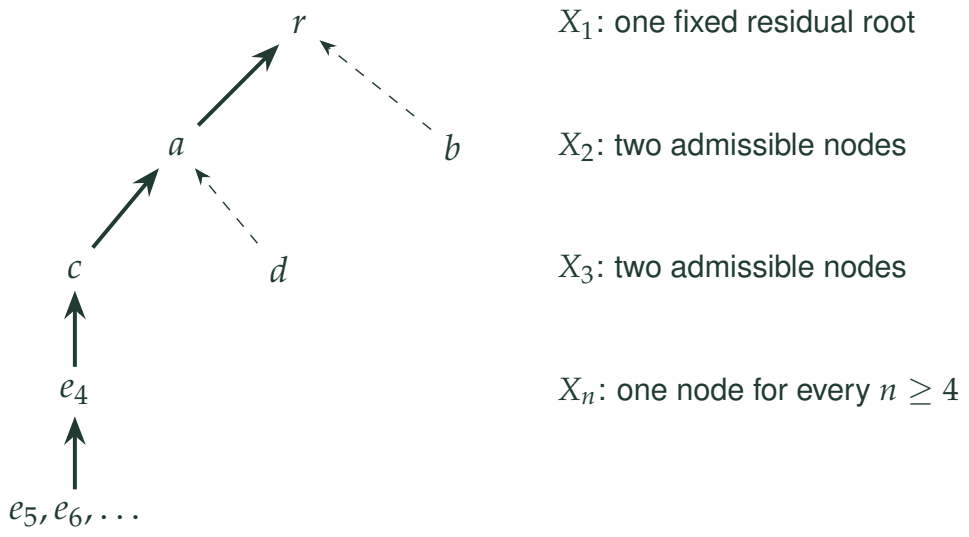
Both \(a,b\) reduce to \(r\); both \(c,d\) reduce to \(a\); \(e_4\) reduces to \(c\); and \(e_{n+1}\) reduces to \(e_n\) for every \(n\ge4\).
Reading the drawing
Arrows point toward earlier levels. The root has two possible children, while the next level has two children over only one of them. A solid continuing branch passes through c and a to the root; the extra branches terminate. Every later level has one node.
Drawing labels and data 11 labels
Read the original labels as selectable text. Tables preserve grid relationships; other short labels are grouped compactly.
- \(r\)
- \(a\)
- \(b\)
- \(c\)
- \(d\)
- \(e_4\)
- \(e_5,e_6,\ldots\)
- \(X_1\): one fixed residual root
- \(X_2\): two admissible nodes
- \(X_3\): two admissible nodes
- \(X_n\): one node for every \(n\ge4\)
Evidence note from the source edition
Every displayed edge is an actual reduction map. The formula specifies the infinite continuation. The chosen branch is \(r,a,c,e_4,e_5,\ldots\). The nodes \(b,d\) are admissible at their own precision and have no successor.
What the compactness argument proves
For general finite levels, the reduction forest is a locally finite rooted tree with vertices at every depth. An infinite branch exists. Surjectivity is sufficient but is not necessary: the map \(X_3\to X_2\) above misses \(b\), and \(X_4\to X_3\) misses \(d\).
Finite occupancy does not guarantee a branch through a prescribed higher-level node. It also does not prove arithmetic occupancy of the finite sets. Those sets must already have been supplied as admissible realizations of the declared spine and residual root.
Why the vector-space counterexample is consistent with this
The nilpotent system on Visual 15 has a compatible sequence: the zero sequence. Its finite levels are nonempty sets because they contain zero. The question there is whether the inverse limit contains a nonzero vector, which needs stable-core data. Here the question is nonemptiness of an inverse limit of admissible finite sets. Different conclusions require different hypotheses.
Read this as
Finite set compactness chooses a branch among existing admissible nodes. It neither extends every node nor produces an arithmetic node absent from the finite forest.