
Now change models. Let \(R=k[x,y]\) for a field \(k\), and present a module by
The relations are \(xe_1=0\) and \(ye_2=0\), so \(M\cong R/(x)\oplus R/(y)\).
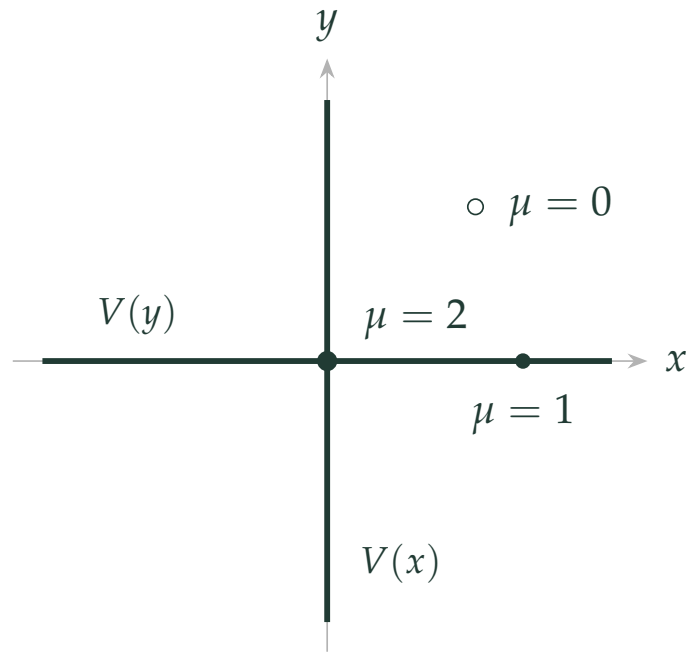
Reading the drawing
The two axes are the real closed-point shadow of the support. The origin has fiber dimension two, a nonzero point on one axis has dimension one, and an off-axis point has dimension zero. This sketch does not enumerate the entire prime spectrum.
Drawing labels and data 7 labels
Read the original labels as selectable text. Tables preserve grid relationships; other short labels are grouped compactly.
- \(\mu=2\)
- \(\mu=1\)
- \(\mu=0\)
- \(V(x)\)
- \(V(y)\)
- \(x\)
- \(y\)
The minor calculation
At a prime \({\mathfrak p}\), reduce the matrix to its residue field:
Two independent relations disappear at the origin. Only one disappears along either punctured axis.
Evidence note from the source edition
For the drawing, take \(k={\mathbb R}\). It shows real closed points, not every point of \({\operatorname{Spec}} R\). The displayed ideals and rank criterion describe the full algebraic loci over any field.
| Position | Matrix rank | Fiber dimension | What survives |
|---|---|---|---|
| \(x\ne0\), \(y\ne0\) | 2 | 0 | neither generator |
| \(x=0\), \(y\ne0\) | 1 | 1 | the \(e_1\) direction |
| \(x\ne0\), \(y=0\) | 1 | 1 | the \(e_2\) direction |
| \(x=y=0\) | 0 | 2 | both directions |
Thus \({\operatorname{Supp}}(M)=V(xy)=V(x)\cup V(y)\), whereas the locus where the fiber needs at least two generators is \(V(x,y)\). The latter is a higher Fitting stratum. For \(r>2\), the locus \(\mu_{{\mathfrak p}}(M)\ge r\) is empty, corresponding to the unit Fitting ideal.
Read this as
Support asks whether any direction survives. Higher Fitting strata ask how many generators the residue-field fiber needs. This is not an automorphic multiplicity formula.