
Over \(k={\mathbb F}_7\), the standard representation of \(S_3\) has matrices
All entries and calculations on this page are modulo seven. Direct multiplication gives \(s^2=t^3=I\) and \(sts=t^{-1}\). Their eigenvalues are \(\{-1,1\}\) and \(\{2,4\}\). Distinct eigenvalues allow an exact projector formula
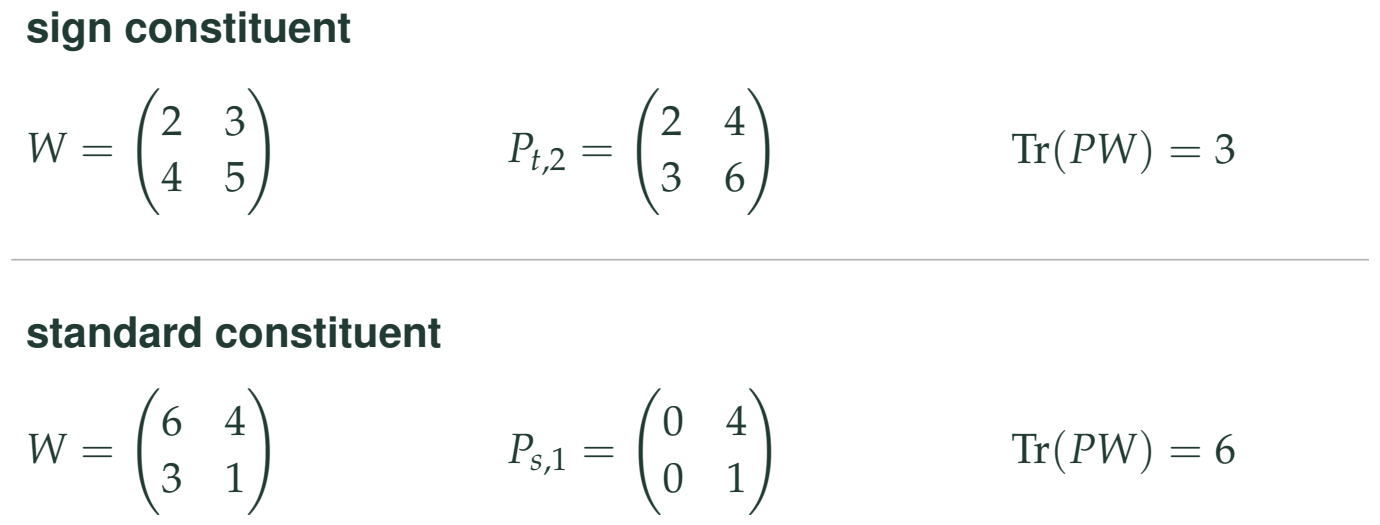
Reading the drawing
The upper row gives a witness matrix and an idempotent for the sign constituent, with trace pairing three. The lower row gives the corresponding standard-constituent matrices, with pairing six. The displayed finite calculation has the source theorem’s stated residual-image inputs.
Drawing labels and data 8 labels
Read the original labels as selectable text. Tables preserve grid relationships; other short labels are grouped compactly.
- sign constituent
\(W=\begin{pmatrix}2&3\\4&5\end{pmatrix}\)
- \(\operatorname{Tr}(PW)=3\)
- standard constituent
\(W=\begin{pmatrix}6&4\\3&1\end{pmatrix}\)
- \(\operatorname{Tr}(PW)=6\)
Evidence note from the source edition
Each row displays the supplied matrix, an actual canonical eigenprojector and its nonzero trace pairing. It detects that stated adjoint constituent; it does not create a global automorphic carrier.
Write \(W(a,b,c)=\left(\begin{smallmatrix}a&b\\c&-a\end{smallmatrix}\right)\). The manuscript exhibits \(Z=W(2,3,4)\), \(A=W(1,1,2)\) and \(B=W(1,5,6)\); their coordinate determinant is \(3\). Thus they are a basis of the trace-zero adjoint. Conjugation splits this space as \(\operatorname{sgn}\oplus V\). In the drawing the standard witness is \(W(6,4,3)=3A+3B\).
Why the cohomology argument is uniform in the module
Since \(|S_3|=6\) is a unit in \({\mathbb F}_7\), a cocycle \(f:S_3\to M\) is a coboundary: set \(u=-6^{-1}\sum_h f(h)\) and sum \(f(gh)=g f(h)+f(g)\) to obtain \(gu-u=f(g)\). This proves \(H^1(S_3,M)=0\) for every \({\mathbb F}_7[S_3]\)-module \(M\). The printed invariant calculation separately proves \(H^0(S_3,\operatorname{ad}^0V)=0\).
What makes this a finite certificate
The manuscript also checks absolute irreducibility and projector detection on every irreducible adjoint submodule. In this example \(7\nmid2\), and every group element's eigenvalues lie in \({\mathbb F}_7\), as required by the stated convention. The two displayed pairings alone are a worked part of that complete certificate.
Read this as
The calculation is exact for \(S_3/{\mathbb F}_7\). Applying an automorphy lifting theorem still requires its actual residual image hypotheses and residual occupancy. No coefficient-prime-two adequacy theorem follows from this picture.