7 Transport through an isomorphism \(R\cong{\mathbb T}\)
On this page · Permalink · Source line 916
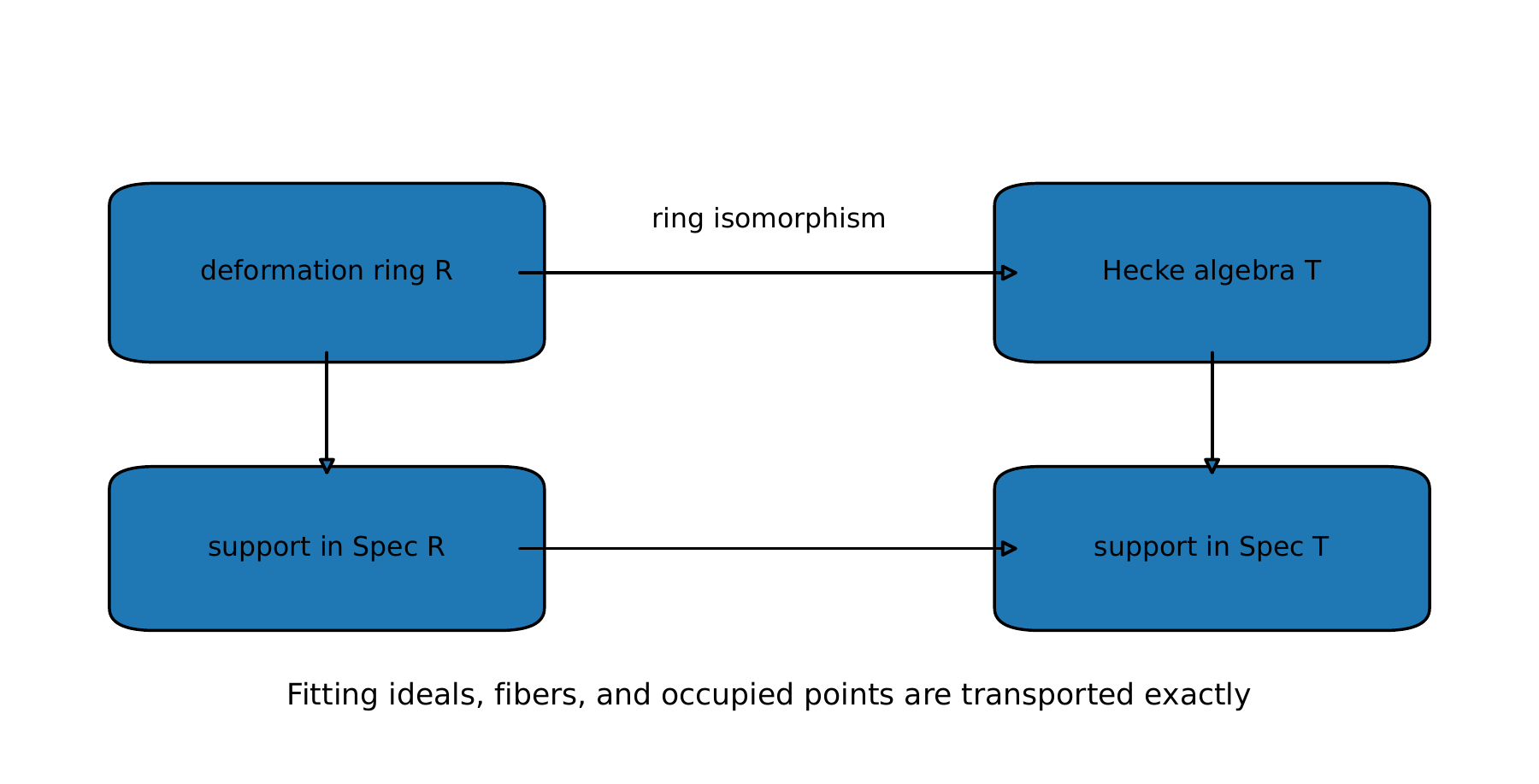
An isomorphism between a deformation ring and a Hecke algebra is an exact coordinate change. It transports support and finite presentation data, but it does not create a supported module.
Theorem 7.1: Support and Fitting transport
Let \(\varphi:R\to{\mathbb T}\) be an isomorphism of Noetherian rings. Let \(M\) be a finite \({\mathbb T}\) module, viewed as an \(R\) module through \(\varphi\). Then the homeomorphism
satisfies
For every \(j\geq0\),
Read proof · Visual guide: Base change is an algebraic pullback · Read statement and proof side by side · Permalink · Source line 920 · Claim record · Lean coverage · Code · Worked examples
Proof of Theorem 7.1
Localization commutes with transport along an isomorphism, so a localization of \(M\) vanishes on one side exactly when the corresponding localization vanishes on the other. This proves the support identity. A finite presentation matrix over \(R\) is carried entry by entry to a presentation matrix over \({\mathbb T}\). The minors generating each Fitting ideal are therefore carried to the corresponding minors.
Back to statement · Read statement and proof side by side · Permalink · Source line 946 · Claim record · Lean coverage · Code · Worked examples
Corollary 7.2: Full support is invariant under \(R\cong{\mathbb T}\)
In the setting of Theorem 7.1, \(M\) has full \(R\) support if and only if it has full \({\mathbb T}\) support.
Read proof · Read statement and proof side by side · Permalink · Source line 950 · Claim record · Lean coverage · Code · Worked examples
Proof of Corollary 7.2
Apply the support homeomorphism in Theorem 7.1.
Back to statement · Read statement and proof side by side · Permalink · Source line 954 · Claim record · Lean coverage · Code · Worked examples
Proposition 7.3: A quotient can erase a component
Let
and let
Viewed as an \(R\) module, \({\mathbb T}\) has support \(V(x)\), which misses the generic point \((y)\) of the other irreducible component. Thus a surjection \(R\twoheadrightarrow{\mathbb T}\) does not by itself imply full component occupancy.
Read proof · Visual guide: A branch is not an Artin packet · Read statement and proof side by side · Permalink · Source line 958 · Claim record · Lean coverage · Code · Worked examples
Proof of Proposition 7.3
The annihilator of the \(R\) module \({\mathbb T}\) is \((x)\). Hence its support is \(V(x)\) by Theorem 6.2. The prime \((y)\) does not contain \(x\), so it is not in this support.
Back to statement · Read statement and proof side by side · Permalink · Source line 970 · Claim record · Lean coverage · Code · Worked examples
Theorem 7.4: Field fiber criterion
Let \(R\) be a commutative ring, let \(M\) be a finite \(R\) module, and let \(x:R\to E'\) be a homomorphism to a field. Put \({\mathfrak p}=\ker x\). Then
Read proof · Visual guide: A possible packet can still be empty · Read statement and proof side by side · Permalink · Source line 974 · Claim record · Lean coverage · Code · Worked examples
Proof of Theorem 7.4
The map \(x\) factors through the local ring \(R_{{\mathfrak p}}\) and then through an embedding of the residue field \(\kappa({\mathfrak p})\) into \(E'\). Since \(M\) is finite, Nakayama's lemma gives
Extension of scalars from \(\kappa({\mathfrak p})\) to \(E'\) preserves nonzero vector spaces.
Back to statement · Read statement and proof side by side · Permalink · Source line 986 · Claim record · Lean coverage · Code · Worked examples
Corollary 7.5: Supported deformation points give nonzero Hecke fibers
Let \(R\cong{\mathbb T}\), and let \(M\) be a finite Hecke module. If a point \(x:R\to E'\) lies in \({\operatorname{Supp}}_R(M)\), then the corresponding Hecke fiber
is nonzero.
Read proof · Read statement and proof side by side · Permalink · Source line 996 · Claim record · Lean coverage · Code · Worked examples
Proof of Corollary 7.5
Transport the support through Theorem 7.1, then apply Theorem 7.4.
Back to statement · Read statement and proof side by side · Permalink · Source line 1005 · Claim record · Lean coverage · Code · Worked examples