8 Finite Hecke packets and infinite occupancy
On this page · Permalink · Source line 1017
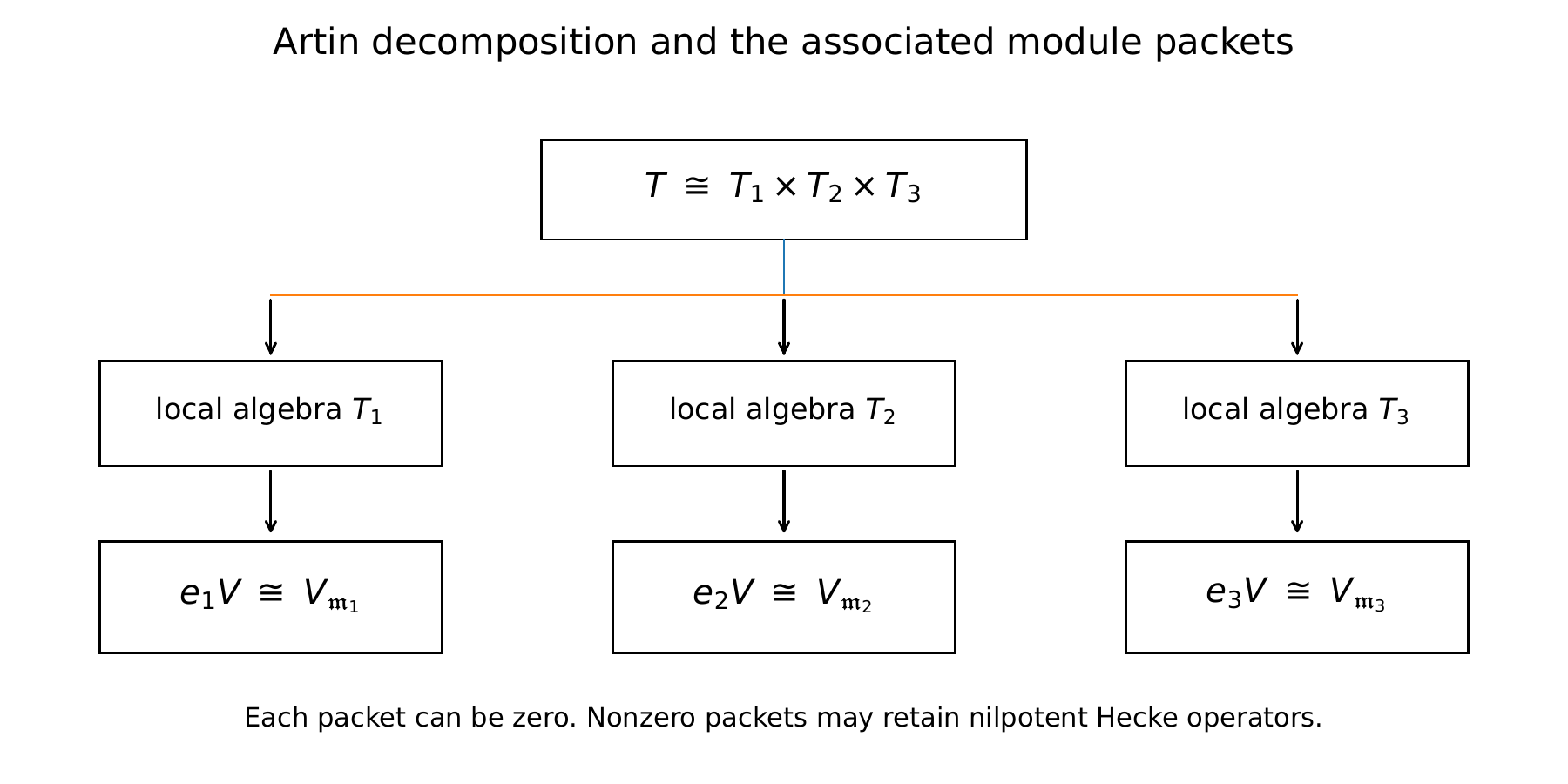
Finite Hecke carriers admit canonical packets even when the Hecke action is not semisimple. The packets come from the Artin local factors of the finite commutative Hecke algebra.
Standard fact 8.1: Artin decomposition
Let \(E'\) be a field and let \({\mathbb T}\) be a finite dimensional commutative \(E'\) algebra. Then
Each factor is an Artin local algebra. Equivalently, there is a unique complete family of central idempotents \((e_{{\mathfrak m}})\) such that
and \(e_{{\mathfrak m}}{\mathbb T}\cong{\mathbb T}_{{\mathfrak m}}\) [2], [15].
Permalink · Source line 1021 · Claim record · Lean coverage · Code · Worked examples
Theorem 8.2: Canonical Hecke packet decomposition
Let \({\mathbb T}\) be a finite dimensional commutative algebra over a field \(E'\), and let \(V\) be a finite \({\mathbb T}\) module. Then
For every maximal ideal \({\mathfrak m}\), the canonical map gives
The packet \(e_{{\mathfrak m}}V\) is nonzero exactly when \({\mathfrak m}\in{\operatorname{Supp}}_{{\mathbb T}}(V)\).
Read proof · Visual guide: A packet contains an entire Jordan chain · Visual guide: A possible packet can still be empty · Read statement and proof side by side · Permalink · Source line 1041 · Claim record · Lean coverage · Code · Worked examples
Proof of Theorem 8.2
The idempotent relations in Standard fact 8.1 give the direct sum decomposition. Localization at \({\mathfrak m}\) kills every factor except the \({\mathfrak m}\) factor, where \(e_{{\mathfrak m}}\) becomes one. Thus the localization map identifies \(e_{{\mathfrak m}}V\) with \(V_{{\mathfrak m}}\). The final statement is the definition of support.
Back to statement · Read statement and proof side by side · Permalink · Source line 1058 · Claim record · Lean coverage · Code · Worked examples
Corollary 8.3: Simultaneous generalized eigenspaces
Assume that \(E'\) is algebraically closed and that \({\mathbb T}\) is generated by commuting operators \(T_1,\ldots,T_d\) on \(V\). For a maximal ideal
there is an integer \(N\geq1\) such that
Thus the canonical Artin packet is the simultaneous generalized eigenspace.
Read proof · Visual guide: A packet contains an entire Jordan chain · Read statement and proof side by side · Permalink · Source line 1062 · Claim record · Lean coverage · Code · Worked examples
Proof of Corollary 8.3
The maximal ideal of the Artin local algebra \({\mathbb T}_{{\mathfrak m}}\) is nilpotent. Hence a common power of every \(T_i-\lambda_i\) kills the local packet. On every other local factor, at least one \(T_i-\lambda_i\) is a unit, so no nonzero vector can satisfy all the displayed nilpotence conditions.
Conversely, suppose every \((T_i-\lambda_i)^N\) kills \(v\). Every monomial of total degree greater than \(d(N-1)\) contains one factor to exponent at least \(N\). Therefore a power of \({\mathfrak m}\) kills \(v\), which places \(v\) in the \({\mathfrak m}\) primary packet.
Back to statement · Read statement and proof side by side · Permalink · Source line 1084 · Claim record · Lean coverage · Code · Worked examples
Corollary 8.4: Rank and trace detection in characteristic zero
Assume that \(E'\) has characteristic zero. For every maximal Hecke packet,
In particular, the packet is occupied exactly when its projector has positive rank, equivalently nonzero trace.
Read proof · Visual guide: A possible packet can still be empty · Read statement and proof side by side · Permalink · Source line 1090 · Claim record · Lean coverage · Code · Worked examples
Proof of Corollary 8.4
An idempotent linear map has minimal polynomial dividing \(X(X-1)\), which has distinct roots. It is diagonalizable with eigenvalues zero and one. Its trace and rank both equal the multiplicity of the eigenvalue one. A positive integer is nonzero in characteristic zero.
Back to statement · Read statement and proof side by side · Permalink · Source line 1104 · Claim record · Lean coverage · Code · Worked examples
Remark 8.5
The trace criterion can fail in positive characteristic when the packet dimension is divisible by the characteristic. The rank and localization criteria remain valid.
Visual guide: At two, division is the obstruction · Permalink · Source line 1108
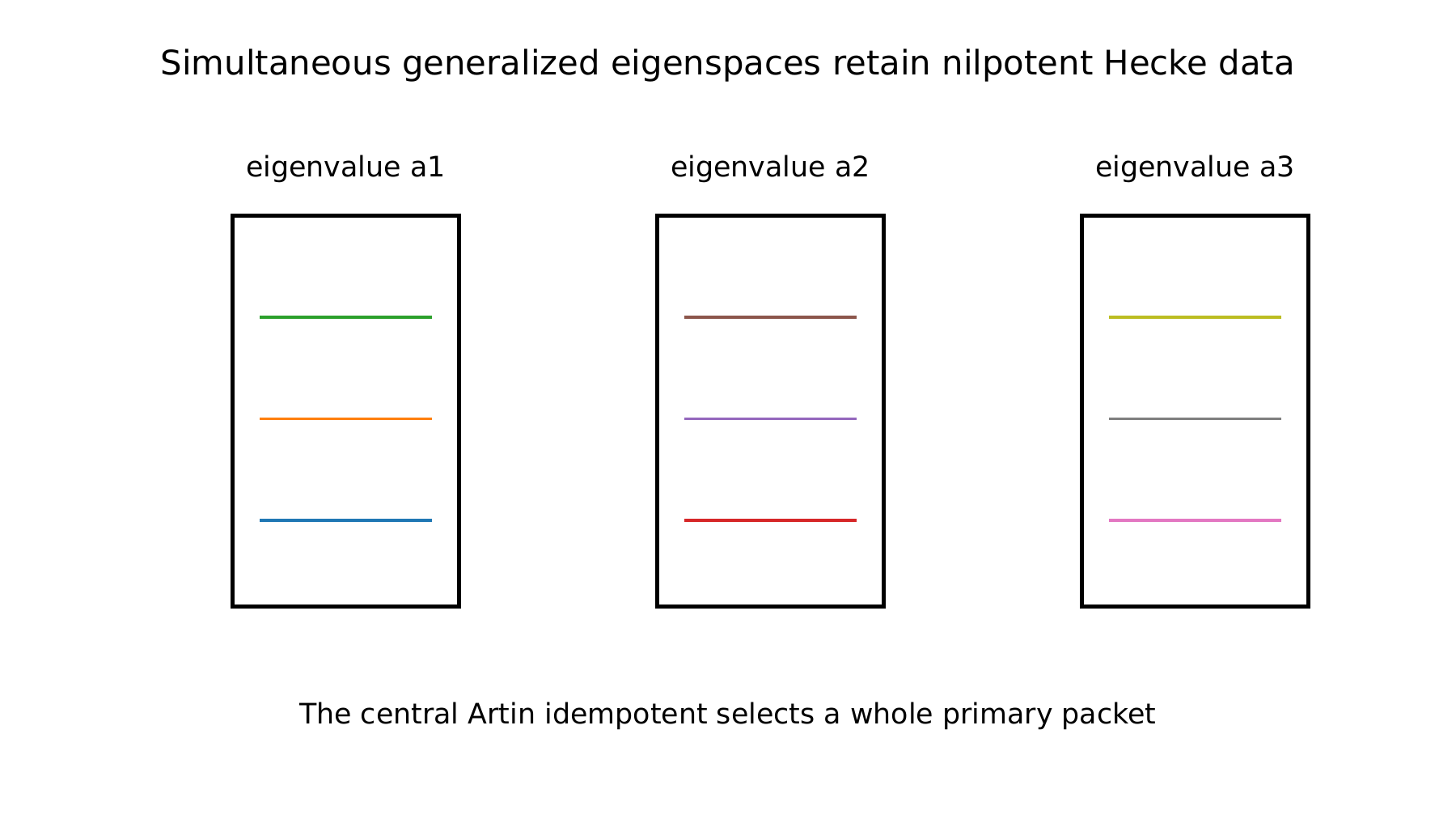
Example 8.6: A nonsemisimple Hecke packet
Let
and let \(V={\mathbb T}\) be the regular module. The two canonical central idempotents split
with dimensions two and three. Multiplication by \(u\) is nilpotent on \(V_u\), and multiplication by \(v\) is nilpotent on \(V_v\). Neither local factor is semisimple, but the two maximal Hecke packets are isolated exactly by the Artin idempotents.
Visual guide: A packet contains an entire Jordan chain · Permalink · Source line 1126
Proof
The product decomposition gives the two central idempotents \((1,0)\) and \((0,1)\). Their ranges are the two local factors. The classes of \(u\) and \(v\) are nilpotent of orders two and three, respectively.
The next two theorems distinguish a fixed finite carrier from a sequence of changing carriers.
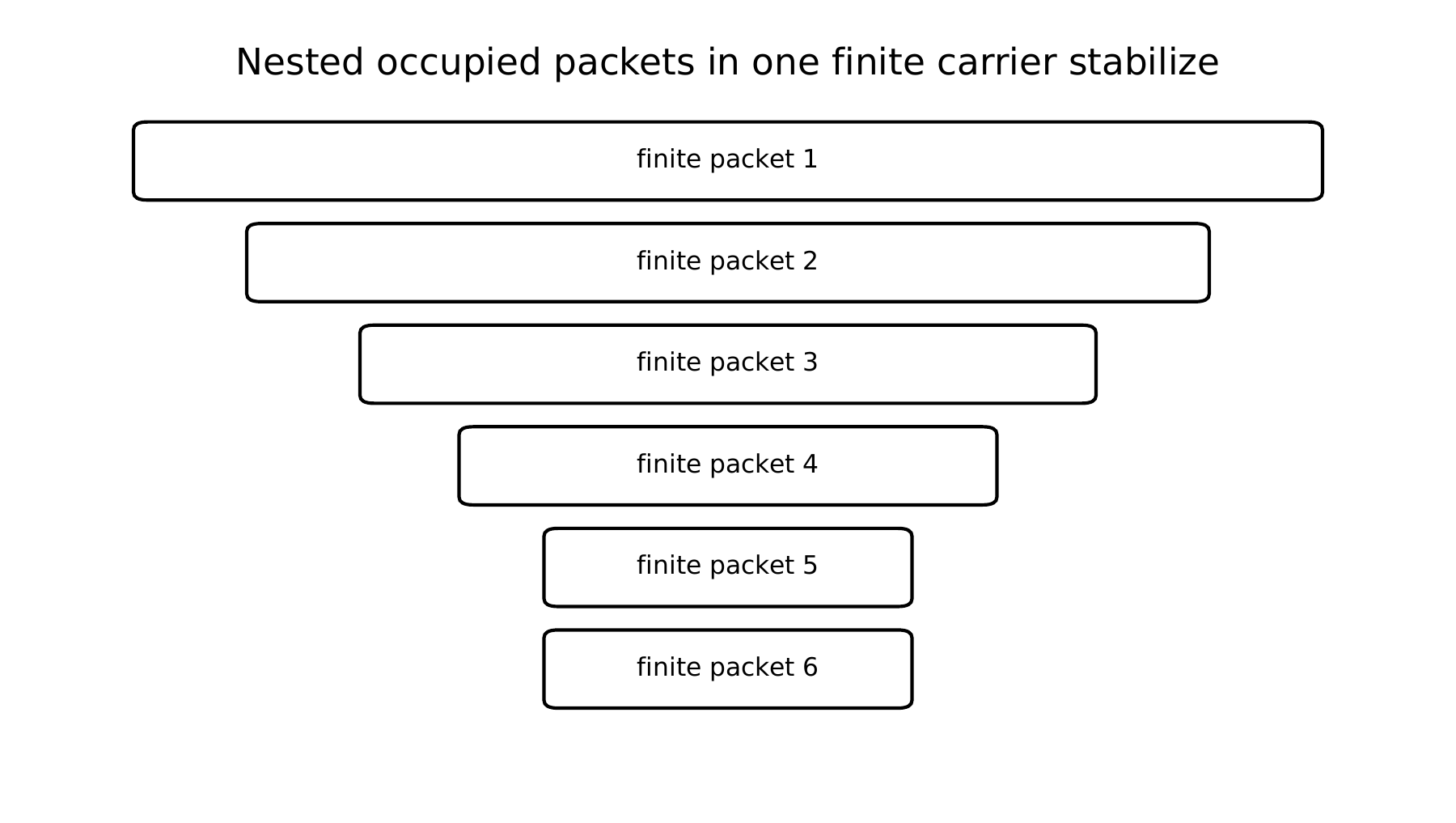
Theorem 8.7: Nested packets in one finite carrier
Let \(V\) be a finite dimensional vector space. Let \(e_1,e_2,\ldots\) be idempotents such that
for every \(m\). If \(e_mV\neq0\) for every \(m\), then the descending chain stabilizes and
Read proof · Visual guide: Finite dimension prevents tail escape · Read statement and proof side by side · Permalink · Source line 1148 · Claim record · Lean coverage · Code · Worked examples
Proof of Theorem 8.7
The displayed relations give
The nonnegative dimensions form a nonincreasing sequence of positive integers, so they eventually become constant. Once two consecutive dimensions agree, the corresponding inclusion is equality. Thus the ranges stabilize at a nonzero subspace, which is their intersection.
Back to statement · Read statement and proof side by side · Permalink · Source line 1162 · Claim record · Lean coverage · Code · Worked examples
Corollary 8.8: Finite witness of incompatibility
Under the hypotheses of Theorem 8.7, if
then \(e_mV=0\) for some finite \(m\).
Read proof · Visual guide: Finite dimension prevents tail escape · Read statement and proof side by side · Permalink · Source line 1170 · Claim record · Lean coverage · Code · Worked examples
Proof of Corollary 8.8
This is the contrapositive of Theorem 8.7.
Back to statement · Read statement and proof side by side · Permalink · Source line 1178 · Claim record · Lean coverage · Code · Worked examples
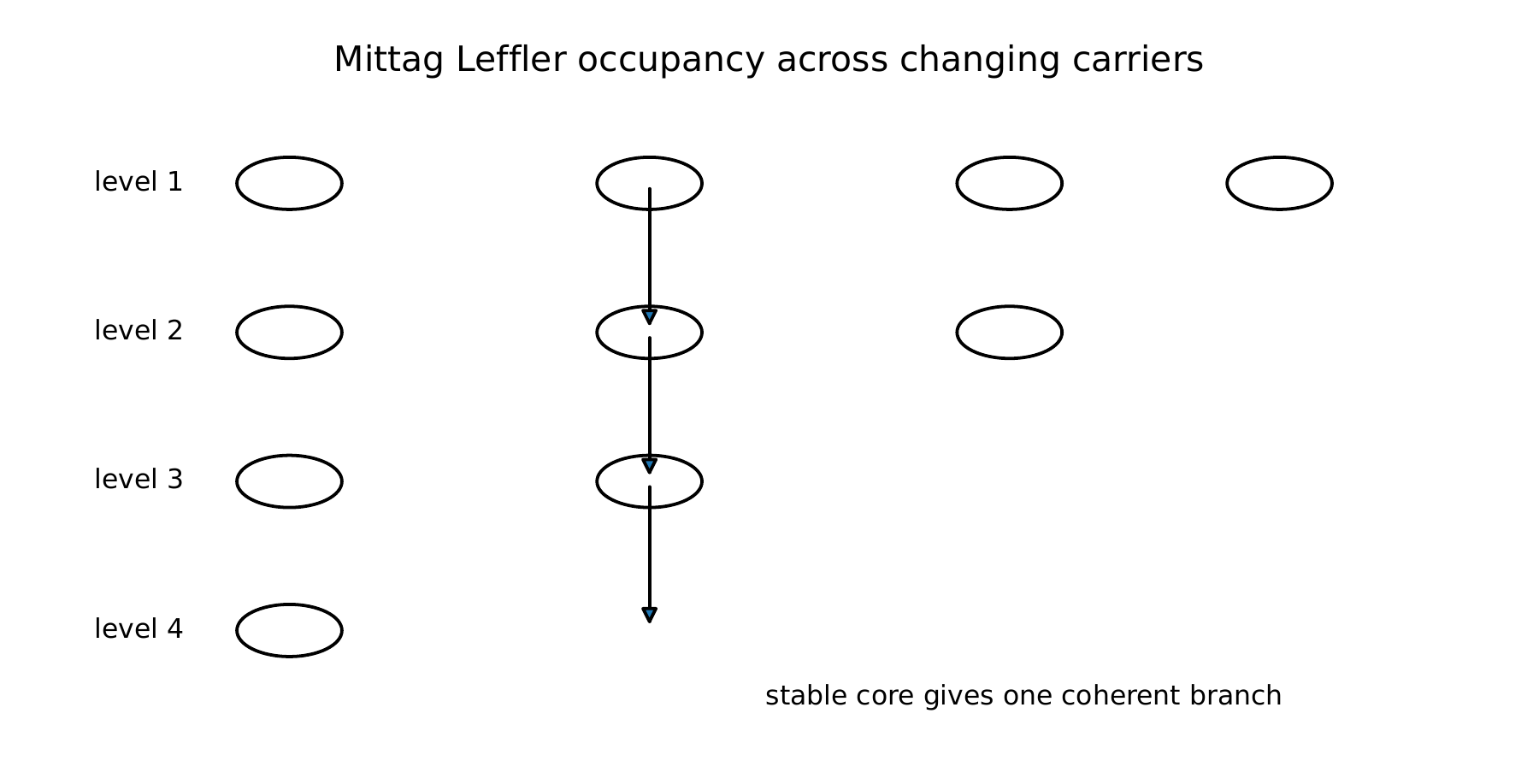
Definition 8.9: Stable core
Let
be an inverse system of finite dimensional vector spaces. For \(n\geq m\), write \(f_{n,m}:V_n\to V_m\). The stable core at level \(m\) is
Visual guide: Nonzero at every level is not enough · Permalink · Source line 1189 · Claim record · Lean coverage · Code · Worked examples
Lemma 8.10: Surjectivity on stable cores
For every \(m\), the transition map \(V_{m+1}\to V_m\) induces a surjection
Read proof · Visual guide: Nonzero at every level is not enough · Read statement and proof side by side · Permalink · Source line 1203 · Claim record · Lean coverage · Code · Worked examples
Proof of Lemma 8.10
Fix \(y\in Y_m\). For \(n\geq m+1\), let
Each \(A_n\) is a nonempty affine subspace of \(V_{m+1}\), and the sequence \((A_n)\) is descending. A descending sequence of affine subspaces in a finite dimensional vector space stabilizes whenever every term is nonempty. Choose an element in its stable value. It lies in \(Y_{m+1}\) and maps to \(y\).
Back to statement · Read statement and proof side by side · Permalink · Source line 1212 · Claim record · Lean coverage · Code · Worked examples
Theorem 8.11: Nonzero stable core criterion
Let \((V_m)\) be an inverse system of finite dimensional vector spaces. If
for every \(m\), then
More precisely, the inverse limit contains a compatible sequence whose first coordinate is any prescribed nonzero element of \(Y_1\).
Read proof · Visual guide: Nonzero at every level is not enough · Read statement and proof side by side · Permalink · Source line 1226 · Claim record · Lean coverage · Code · Worked examples
Proof of Theorem 8.11
Choose \(0\neq y_1\in Y_1\). By Lemma 8.10, choose recursively \(y_{m+1}\in Y_{m+1}\) mapping to \(y_m\). Every \(y_m\) is nonzero because it maps to the nonzero vector \(y_1\). The sequence \((y_m)\) is a nonzero element of the inverse limit.
Back to statement · Read statement and proof side by side · Permalink · Source line 1241 · Claim record · Lean coverage · Code · Worked examples
Corollary 8.12: Surjective systems
If every transition map \(V_{m+1}\to V_m\) is surjective and every \(V_m\) is nonzero, then the inverse limit is nonzero.
Read proof · Read statement and proof side by side · Permalink · Source line 1246 · Claim record · Lean coverage · Code · Worked examples
Proof of Corollary 8.12
Surjectivity gives \(Y_m=V_m\). Apply Theorem 8.11.
Back to statement · Read statement and proof side by side · Permalink · Source line 1250 · Claim record · Lean coverage · Code · Worked examples
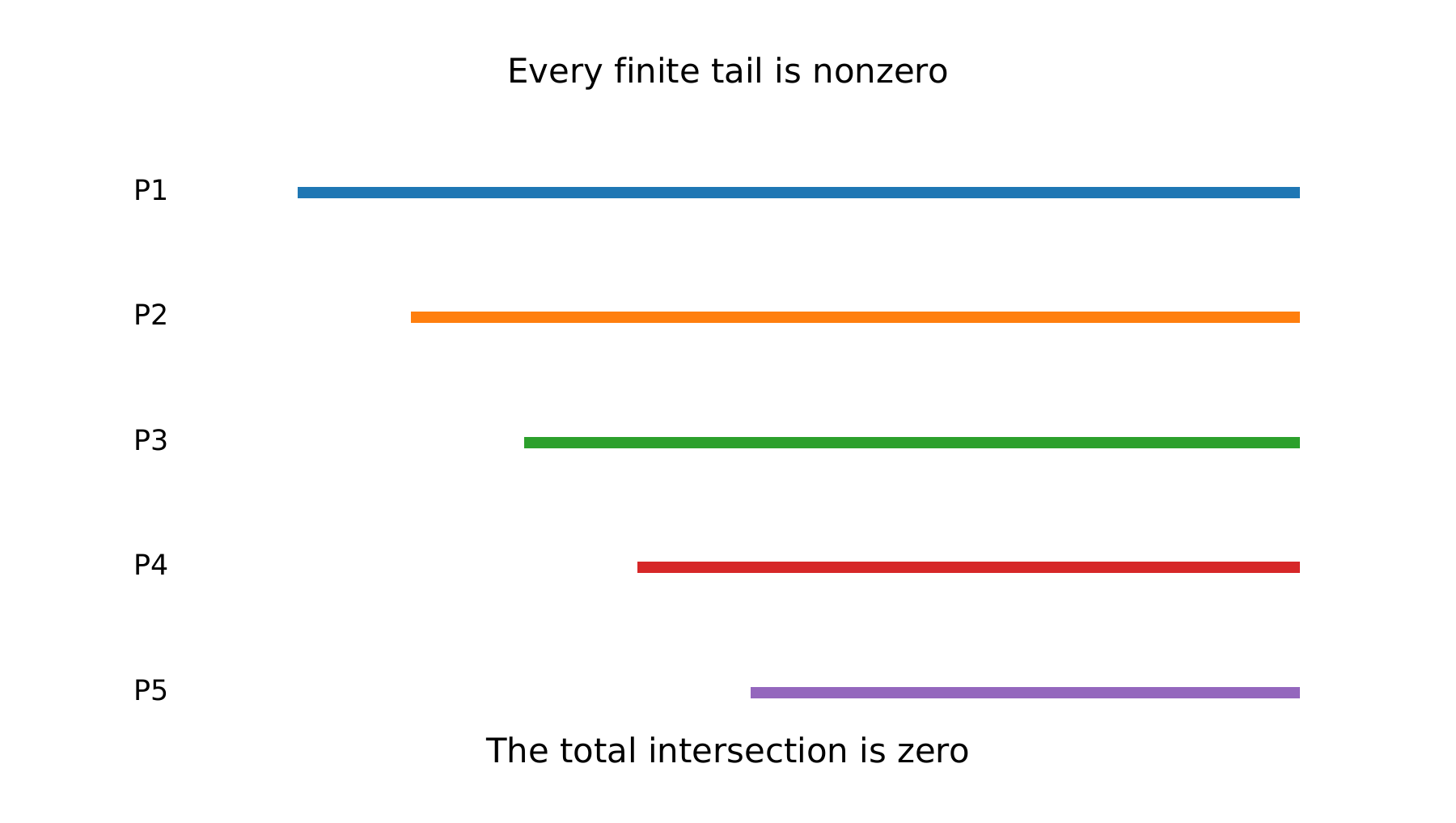
Example 8.13: Tail escape in an infinite carrier
Let \(V=\ell^2({\mathbb N})\), and let \(P_m\) be the orthogonal projection onto the closed span of
Every range \(P_mV\) is nonzero and the ranges are nested, but
Thus the finite carrier hypothesis in Theorem 8.7 cannot be removed.
Visual guide: Finite dimension prevents tail escape · Permalink · Source line 1254
Proof
A vector in every tail range has its first \(m-1\) coordinates equal to zero for every \(m\). All of its coordinates vanish.