
6 Ordinary and derived patching support
On this page · Permalink · Source line 569
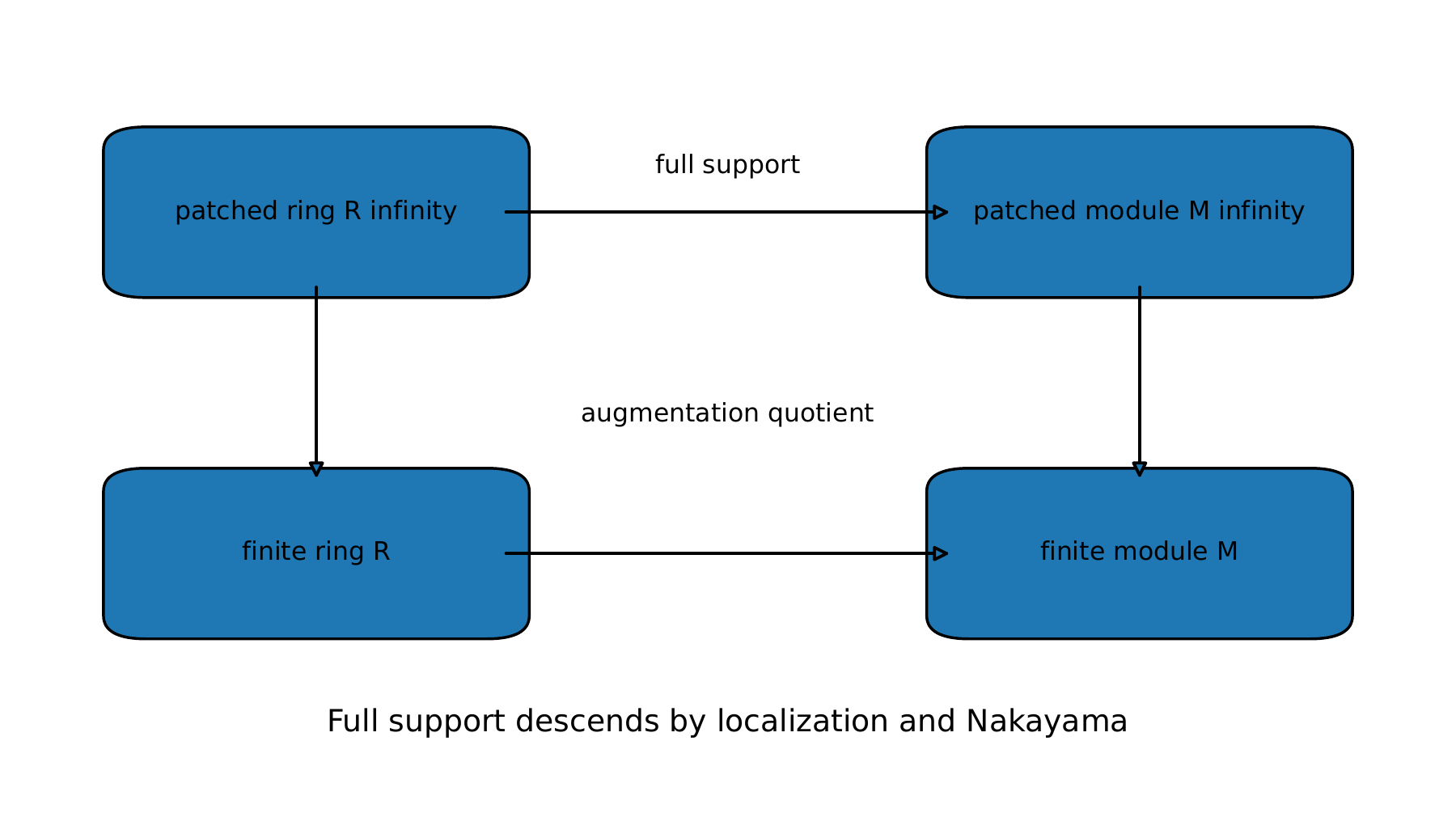
The algebraic conclusion supplied by a patching argument is most naturally stated through support. This section isolates the commutative algebra needed to descend that conclusion from a patched object to finite level.
Definition 6.1: Support and near faithfulness
Let \(R\) be a commutative ring and let \(M\) be an \(R\) module. Its support is
If \(R\) is Noetherian and \(M\) is finite, then \(M\) is nearly faithful when \({\operatorname{Ann}}_R(M)\) is a nilpotent ideal.
Permalink · Source line 573 · Claim record · Lean coverage · Code · Worked examples
Theorem 6.2: Finite module support
Let \(R\) be a commutative ring and let \(M\) be a finite \(R\) module. Then
Read proof · Visual guide: A matrix becomes a support locus · Read statement and proof side by side · Permalink · Source line 583 · Claim record · Lean coverage · Code · Worked examples
Proof of Theorem 6.2
Let \({\mathfrak p}\in{\operatorname{Spec}} R\). If \({\operatorname{Ann}}_R(M)\not\subseteq{\mathfrak p}\), choose \(a\in{\operatorname{Ann}}_R(M)\setminus{\mathfrak p}\). The element \(a\) becomes a unit in \(R_{{\mathfrak p}}\), so \(M_{{\mathfrak p}}=0\).
Conversely, suppose \(M_{{\mathfrak p}}=0\). Choose generators \(m_1,\ldots,m_d\) of \(M\). For each \(i\), there is an element \(s_i\notin{\mathfrak p}\) such that \(s_im_i=0\). The product \(s=s_1\cdots s_d\) lies outside \({\mathfrak p}\) and annihilates every generator. Thus \(s\in{\operatorname{Ann}}_R(M)\setminus{\mathfrak p}\). This proves the equality.
Back to statement · Read statement and proof side by side · Permalink · Source line 594 · Claim record · Lean coverage · Code · Worked examples
Theorem 6.3: Fitting support criterion
Let \(R\) be Noetherian and let \(M\) be a finite \(R\) module. Then
Read proof · Visual guide: A matrix becomes a support locus · Visual guide: The same support can hide more algebra · Read statement and proof side by side · Permalink · Source line 606 · Claim record · Lean coverage · Code · Worked examples
Proof of Theorem 6.3
If \(M=0\), the statement follows from the usual convention \({\operatorname{Fitt}}_0(0)=R\). Assume \(M\neq0\), and choose a finite presentation
with \(n\geq1\). The zeroth Fitting ideal is generated by the \(n\) by \(n\) minors of \(A\). After localization at a prime \({\mathfrak p}\), the module \(M_{{\mathfrak p}}\) vanishes exactly when \(A_{{\mathfrak p}}\) is surjective. A map onto the free module \(R_{{\mathfrak p}}^n\) is surjective exactly when one maximal minor is a unit. Thus \(M_{{\mathfrak p}}=0\) exactly when \({\operatorname{Fitt}}_0^R(M)\not\subseteq{\mathfrak p}\).
Back to statement · Read statement and proof side by side · Permalink · Source line 617 · Claim record · Lean coverage · Code · Worked examples
Theorem 6.4: Higher Fitting strata
Let \(R\) be Noetherian and let \(M\) be finite. For \(r\geq1\), put
Then
Read proof · Visual guide: A matrix becomes a support locus · Visual guide: The same support can hide more algebra · Read statement and proof side by side · Permalink · Source line 626 · Claim record · Lean coverage · Code · Worked examples
Proof of Theorem 6.4
Use a finite presentation with target rank \(n\). If \(r>n\), every fiber has dimension at most \(n\), so the left hand locus is empty. The convention \({\operatorname{Fitt}}_{r-1}(M)=R\) for \(r-1\geq n\) makes the right hand locus empty as well. It remains to consider \(1\leq r\leq n\). At \({\mathfrak p}\), the fiber dimension is
It is at least \(r\) exactly when the rank is at most \(n-r\), which is equivalent to the vanishing of every minor of size \(n-r+1\). Those minors generate \({\operatorname{Fitt}}_{r-1}^R(M)\).
Back to statement · Read statement and proof side by side · Permalink · Source line 647 · Claim record · Lean coverage · Code · Worked examples
Proposition 6.5: Fitting ideals and base change
Let \(R\to S\) be a ring map and let \(M\) be a finitely presented \(R\) module. Then for every \(j\geq0\),
Read proof · Visual guide: Base change is an algebraic pullback · Read statement and proof side by side · Permalink · Source line 655 · Claim record · Lean coverage · Code · Worked examples
Proof of Proposition 6.5
Base change carries a finite presentation matrix for \(M\) to a presentation matrix for \(M\otimes_RS\). Every defining minor is carried to the corresponding minor over \(S\).
Back to statement · Read statement and proof side by side · Permalink · Source line 666 · Claim record · Lean coverage · Code · Worked examples
Remark 6.6
Support records nonvanishing. The higher Fitting strata record lower bounds on the number of generators in each fiber. They should not be confused with automorphic multiplicity formulas, which require additional representation theoretic input.
Theorem 6.7: Near faithfulness is full support
Let \(R\) be Noetherian and let \(M\) be a finite \(R\) module. The following conditions are equivalent.
\(M\) is nearly faithful.
\({\operatorname{Supp}}_R(M)={\operatorname{Spec}} R\).
\({\operatorname{Ann}}_R(M)\subseteq{\operatorname{Nil}}(R)\).
If \(R\) is reduced, these conditions are equivalent to faithfulness.
Read proof · Visual guide: Free over what? Supported where? · Read statement and proof side by side · Permalink · Source line 674 · Claim record · Lean coverage · Code · Worked examples
Proof of Theorem 6.7
By Theorem 6.2, full support is equivalent to
This holds exactly when \({\operatorname{Ann}}_R(M)\) is contained in every prime ideal, hence in the nilradical. Because \(R\) is Noetherian, the ideal \({\operatorname{Ann}}_R(M)\) is finitely generated. An ideal generated by finitely many nilpotent elements is nilpotent. This proves the equivalence of the first three conditions. If \(R\) is reduced, its nilradical is zero.
Back to statement · Read statement and proof side by side · Permalink · Source line 684 · Claim record · Lean coverage · Code · Worked examples
Corollary 6.8: Support on every irreducible component
Under the hypotheses of Theorem 6.7, a nearly faithful module is nonzero at the generic point of every irreducible component of \({\operatorname{Spec}} R\).
Read proof · Read statement and proof side by side · Permalink · Source line 692 · Claim record · Lean coverage · Code · Worked examples
Proof of Corollary 6.8
Every generic point is a prime of \(R\), and full support contains every prime.
Back to statement · Read statement and proof side by side · Permalink · Source line 696 · Claim record · Lean coverage · Code · Worked examples
Theorem 6.9: Support after a quotient
Let \(R\) be Noetherian, let \(I\subseteq R\) be an ideal, and let \(M\) be a finite \(R\) module. Under the canonical identification
one has
Read proof · Visual guide: Free over what? Supported where? · Read statement and proof side by side · Permalink · Source line 700 · Claim record · Lean coverage · Code · Worked examples
Proof of Theorem 6.9
Let \({\mathfrak p}\supseteq I\). Localizing gives
If \(M_{{\mathfrak p}}=0\), the quotient is zero. If \(M_{{\mathfrak p}}\neq0\), then \(I_{{\mathfrak p}}\) lies in the maximal ideal of the local ring \(R_{{\mathfrak p}}\). Nakayama's lemma shows that \(M_{{\mathfrak p}}/I_{{\mathfrak p}}M_{{\mathfrak p}}\neq0\). The stated equality follows.
Back to statement · Read statement and proof side by side · Permalink · Source line 715 · Claim record · Lean coverage · Code · Worked examples
Definition 6.10: Ordinary patching datum
An ordinary patching datum consists of a Noetherian ring \(R_\infty\), an ideal \({\mathfrak a}\subseteq R_\infty\), a finite \(R_\infty\) module \(M_\infty\), and identifications
In automorphy lifting applications, \(R_\infty\) is a patched deformation ring and \(M_\infty\) is a patched automorphic module. The definition itself contains no automorphy assertion.
Permalink · Source line 727 · Claim record · Lean coverage · Code · Worked examples
Theorem 6.11: Ordinary patching support descent
Let \((R_\infty,{\mathfrak a},M_\infty,R,M)\) be an ordinary patching datum. If
then
Equivalently, if \(M_\infty\) is nearly faithful, then \(M\) is nearly faithful. If \(R\) is reduced, then \(M\) is faithful.
Read proof · Visual guide: Free over what? Supported where? · Read statement and proof side by side · Permalink · Source line 738 · Claim record · Lean coverage · Code · Worked examples
Proof of Theorem 6.11
Apply Theorem 6.9 with \(I={\mathfrak a}\). The support of the quotient is
which identifies with \({\operatorname{Spec}} R\). The remaining statements follow from Theorem 6.7.
Back to statement · Read statement and proof side by side · Permalink · Source line 752 · Claim record · Lean coverage · Code · Worked examples
Corollary 6.12: Componentwise finite level occupancy
In the setting of Theorem 6.11, every irreducible component of \({\operatorname{Spec}} R\) is contained in the support of \(M\). In particular, no component of the finite level deformation ring is erased by the quotient from the patched level.
Read proof · Read statement and proof side by side · Permalink · Source line 761 · Claim record · Lean coverage · Code · Worked examples
Proof of Corollary 6.12
The module \(M\) has full support by Theorem 6.11.
Back to statement · Read statement and proof side by side · Permalink · Source line 766 · Claim record · Lean coverage · Code · Worked examples
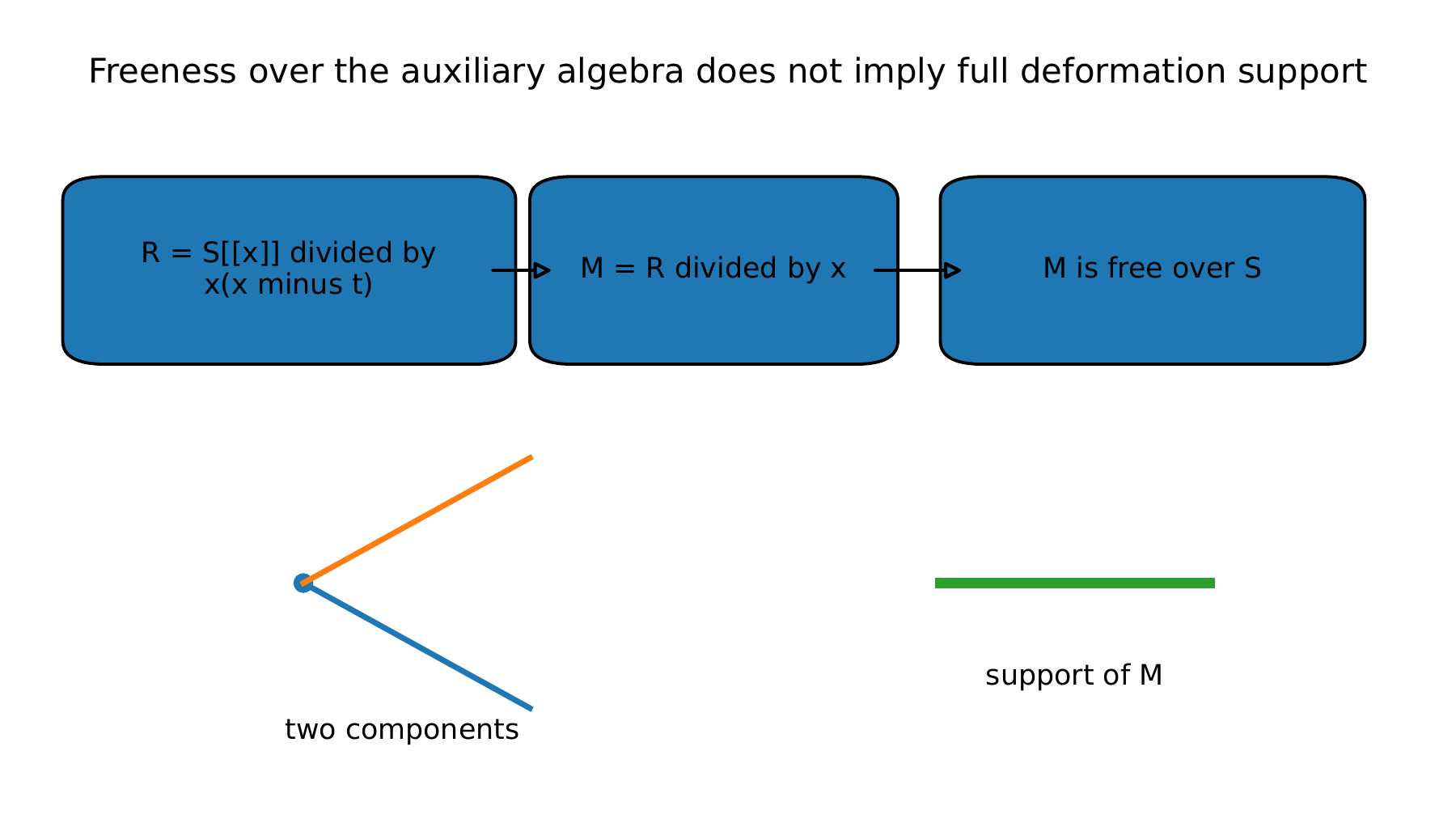
Example 6.13: Freeness over auxiliary variables is not enough
Let \(k\) be a field, let \(S=k[[t]]\), and put
The ring \(R\) is reduced and has two irreducible components. Let
Then \(M\) is free of rank one over \(S\), but
is only one component of \({\operatorname{Spec}} R\). Thus freeness over the auxiliary power series ring does not imply full support over the deformation ring.
Visual guide: Free over what? Supported where? · Permalink · Source line 770
Proof
The two nonassociate prime factors \(x\) and \(x-t\) occur with multiplicity one, so the principal quotient is reduced. The displayed isomorphism makes \(M\) free over \(S\). Its annihilator as an \(R\) module is \((x)\), hence
by Theorem 6.2. The generic point \((x-t)\) of the other component does not contain \(x\), so it is not in the support.
Derived patching replaces one module by a perfect complex. The correct support is detected after derived specialization.
Definition 6.14: Derived support
Let \(R\) be a commutative ring and let \(C\) be a perfect complex of \(R\) modules. Its derived support is
Visual guide: A vanishing differential changes the fiber · Permalink · Source line 810 · Claim record · Lean coverage · Code · Worked examples
Standard fact 6.15: Cohomological description of derived support
If \(R\) is Noetherian and \(C\) is perfect, then
In particular, derived support is closed and is empty exactly when \(C\simeq0\) [26], [11].
Permalink · Source line 823 · Claim record · Lean coverage · Code · Worked examples
Theorem 6.16: Derived quotient support
Let \(R\) be a commutative ring, let \(I\subseteq R\) be an ideal, and let \(C\) be a perfect complex over \(R\). Under \({\operatorname{Spec}}(R/I)\cong V(I)\), one has
Read proof · Visual guide: A vanishing differential changes the fiber · Read statement and proof side by side · Permalink · Source line 833 · Claim record · Lean coverage · Code · Worked examples
Proof of Theorem 6.16
Choose a bounded complex \(P\) of finite projective \(R\) modules representing \(C\). Scalar extension to a commutative \(R\) algebra \(S\) is computed degree by degree as \(S\otimes_RP\); the canonical symmetry of tensor products gives the displayed order \(C\otimes_R^{\mathbf L}S\). Scalar extension preserves the bounds, finite generation, and projectivity of the terms. A derived isomorphism between two such projective models lifts to a homotopy equivalence, which scalar extension preserves. The resulting derived object and its residue field fibers are therefore independent of the chosen model.
Let \(q\in{\operatorname{Spec}}(R/I)\), and let \({\mathfrak p}\) be its inverse image in \(R\). The composite point \(R\to R/I\to\kappa(q)\) has kernel \({\mathfrak p}\), so it factors through a field embedding \(\kappa({\mathfrak p})\to\kappa(q)\). The ordinary tensor associator in every degree gives an isomorphism of complexes
Extension of fields is faithfully flat. It preserves and reflects exactness in each degree, hence also acyclicity. The left hand complex is thus nonzero in the derived category exactly when the residue field fiber of \(C\) at \({\mathfrak p}\) is nonzero. This proves the support identity on corresponding primes. The image of \({\operatorname{Spec}}(R/I)\to{\operatorname{Spec}} R\) is exactly \(V(I)\), giving the stated ambient spectrum equality, including the case \(I=R\).
Back to statement · Read statement and proof side by side · Permalink · Source line 848 · Claim record · Lean coverage · Code · Worked examples
Definition 6.17: Derived patching datum
A derived patching datum consists of a Noetherian ring \(R_\infty\), an ideal \({\mathfrak a}\), a perfect complex \(C_\infty\) over \(R_\infty\), and identifications
Permalink · Source line 861 · Claim record · Lean coverage · Code · Worked examples
Theorem 6.18: Derived patching support descent
Let \((R_\infty,{\mathfrak a},C_\infty,R,C)\) be a derived patching datum. If
then
For every point \(x:R\to E'\) to a field, the derived fiber
is nonzero.
Read proof · Read statement and proof side by side · Permalink · Source line 873 · Claim record · Lean coverage · Code · Worked examples
Proof of Theorem 6.18
Apply Theorem 6.16 to the patched complex and use the actual ring identification \(R\cong R_\infty/{\mathfrak a}\). Full patched support restricts to \(V({\mathfrak a})\), which corresponds to all of \({\operatorname{Spec}} R\). The supplied derived isomorphism with \(C\) preserves this support by the projective model argument in that theorem.
For a field valued point \(x:R\to E'\), put \({\mathfrak p}=\ker x\). The point factors as \(R\to\kappa({\mathfrak p})\to E'\), where the second map is a field embedding. Tensor association on a projective model identifies the fiber at \(x\) with the extension to \(E'\) of the fiber at \({\mathfrak p}\). The latter is nonzero by full support. Faithful flatness of the field extension reflects exactness in every degree, so the fiber at \(x\) is nonzero as well. This applies to every field valued point, with no closed point restriction.
Back to statement · Read statement and proof side by side · Permalink · Source line 891 · Claim record · Lean coverage · Code · Worked examples
Corollary 6.19: A nonzero cohomological degree survives
Under the hypotheses of Theorem 6.18, for every field valued point \(x:R\to E'\), there is an integer \(i\) such that
Read proof · Read statement and proof side by side · Permalink · Source line 897 · Claim record · Lean coverage · Code · Worked examples
Proof of Corollary 6.19
The derived fiber is nonzero by Theorem 6.18. If every cohomology object vanished, a cochain model of that fiber would be acyclic. Its image in the derived category would then be zero, a contradiction. Hence some integer degree has nonzero cohomology.
Back to statement · Read statement and proof side by side · Permalink · Source line 908 · Claim record · Lean coverage · Code · Worked examples
Remark 6.20
The support theorem does not decide the cohomological degree in which the point occurs. It also does not prove that the surviving class is classical. Those are separate arithmetic inputs.