
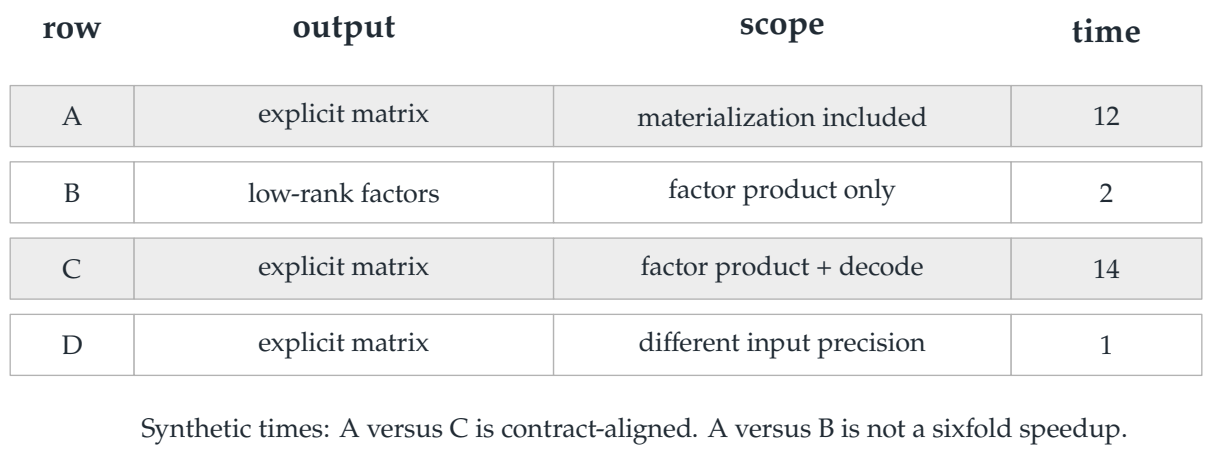
Consider four synthetic timing rows for a product. Row B returns factors, while row A returns an explicit matrix. A ratio \(12/2=6\) does not compare two implementations of the same returned object. Adding the decoding cost changes the candidate to row C.
Reading the drawing
Each route identifies the object it returns. A timing comparison requires the same requested output, validation target and measurement conditions.
Drawing labels and data 21 labels
Read the original labels as selectable text. Tables preserve grid relationships; other short labels are grouped compactly.
- row
- output
- scope
- time
- A
- explicit matrix
- materialization included
- 12
- B
- low-rank factors
- factor product only
- 2
- C
- explicit matrix
- factor product + decode
- 14
- D
- explicit matrix
- different input precision
- 1
Synthetic times: A versus C is contract-aligned. A versus B is not a sixfold speedup.
What a fair match retains
The input values, dimensions, layout, source precision, correctness reference, returned output, and timing scope must agree. Row D changes the input precision; that can be a useful accuracy tradeoff, but it is not the same case merely because the output has the same shape.
If a downstream task consumes factors directly, row B has a valid compressed-output contract. It should be compared with another method that supplies that downstream result, not forced to materialize an unused array. Fairness does not mean every algorithm must use the same internal representation.
How the original measurements are treated here
The preserved manuscript contains its historical CPU/GPU corpus. Replaying its figure generator redraws those saved observations. It does not rerun the recorded device, establish present hardware performance, or transform logical avoided work into physically executed floating-point operations. No new GPU timing is added by this guide.
Exact representation gains, device gains, kernel gains, and amortization gains can be isolated only through appropriately matched rows. A total ratio that mixes them is still an observation, but not a decomposition theorem.
Read this as
A timing number without its case and scope is incomplete data. Preserve the mathematical output contract before claiming a speedup.