
Choose the isometry
Set \(L=Q_LR_L\) and \(R=R_R\). The two equal columns of \(L\) do not create a third range direction. In contrast, \(R\) has rank three.
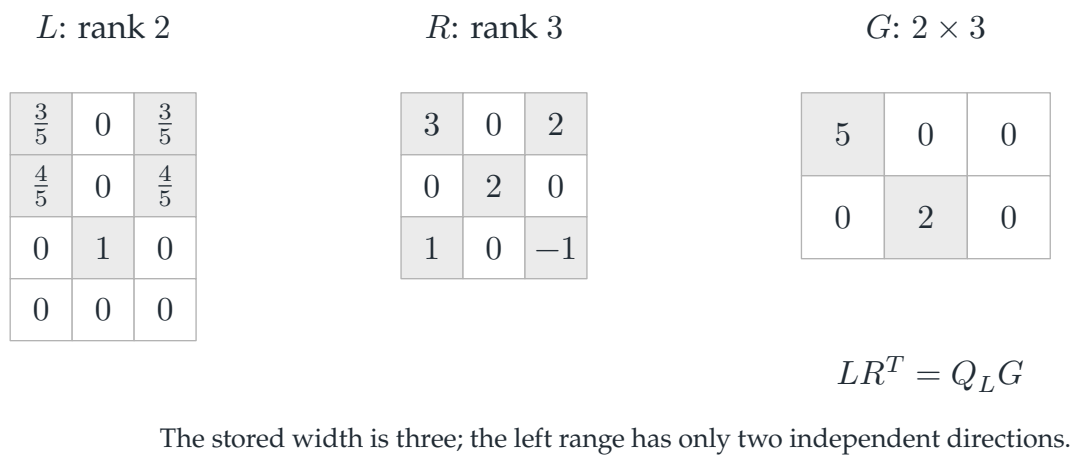
Reading the drawing
The outer range factors carry a smaller core into the ambient space. The displayed dimensions distinguish redundant inner coordinates from the actual range dimensions.
Drawing labels and data 32 labels
Read the original labels as selectable text. Tables preserve grid relationships; other short labels are grouped compactly.
- \(L\): rank \(2\)
| Row / column | Column 1 | Column 2 | Column 3 |
|---|---|---|---|
| Row 1 | \(\frac{3}{5}\) | \(0\) | \(\frac{3}{5}\) |
| Row 2 | \(\frac{4}{5}\) | \(0\) | \(\frac{4}{5}\) |
| Row 3 | \(0\) | \(1\) | \(0\) |
| Row 4 | \(0\) | \(0\) | \(0\) |
- \(R\): rank \(3\)
| Row / column | Column 1 | Column 2 | Column 3 |
|---|---|---|---|
| Row 1 | \(3\) | \(0\) | \(2\) |
| Row 2 | \(0\) | \(2\) | \(0\) |
| Row 3 | \(1\) | \(0\) | \(-1\) |
- \(G\): \(2\times3\)
| Row / column | Column 1 | Column 2 | Column 3 |
|---|---|---|---|
| Row 1 | \(5\) | \(0\) | \(0\) |
| Row 2 | \(0\) | \(2\) | \(0\) |
- \(LR^T=Q_LG\)
The stored width is three; the left range has only two independent directions.
The actual core is
Its dimensions are the two actual input ranks, two and three. This is not inferred by merely discarding a column with a small norm. The range factor \(Q_L\) has orthonormal columns and reconstructs \(L\) exactly.
The preserved formal boundary
The sixth release constructs orthonormal bases of the actual column spaces. It then assumes exact ordered thin-SVD data for the core, as the manuscript instructs the reader to take an SVD. It does not assume an optimality or tail-error conclusion. Nor does it certify a floating-point QR or SVD implementation simply because those routines use similar notation.
This example has a diagonal rectangular core, so its singular directions are explicit. No iterative numerical factorization is needed to identify the two nonzero singular values, five and two.
Read this as
Compactness is a statement about actual range spaces. The number of stored factor columns can exceed the dimensions that matter for recompression.