
Reuse the signed diamond from Visual 14, now as a complete operator:
The two routes from coordinate zero to coordinate three cancel, so \(K^2=0\). Consequently
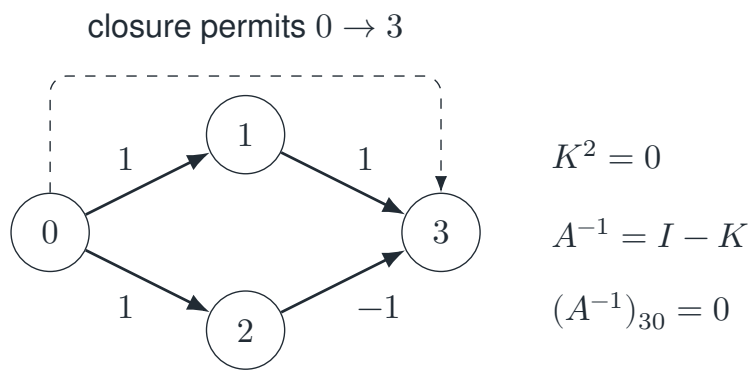
Reading the drawing
The graph has two signed routes to the final vertex. The dashed closure edge permits that address structurally, while the exact inverse entry is zero by cancellation.
Drawing labels and data 12 labels
Read the original labels as selectable text. Tables preserve grid relationships; other short labels are grouped compactly.
- \(0\)
- \(1\)
- \(2\)
- \(3\)
- \(1\)
- \(1\)
- \(1\)
- \(-1\)
- closure permits \(0\to3\)
- \(K^2=0\)
- \(A^{-1}=I-K\)
- \((A^{-1})_{30}=0\)
What the closure permits
The directed transitive closure includes \(0\to3\), because it records existence of a route rather than the signed sum of its coefficients. Nevertheless \((A^{-1})_{30}=0\). Reachability is therefore an upper envelope for inverse support, just as it is for product support.
The portable checker computes the inverse independently by rational row elimination, compares it with \(I-K\), constructs Boolean reachability, and checks every inverse entry outside that closure. It separately rejects the assertion that every reachable transfer is nonzero.
Why the general proof is broader
This example happens to have a terminating Neumann polynomial. The general finite-dimensional theorem does not require nilpotence or a small norm. For a fixed source coordinate, its reachable-coordinate subspace is invariant under \(A\). If \(A\) is invertible, the restricted map is injective. Equal finite domain and codomain dimensions make it surjective, so the inverse preserves the same subspace.
The finite-dimensional and invertibility hypotheses matter. In an infinite-dimensional space, an injective restriction can fail to be onto. A singular matrix does not have an inverse whose support can be tested at all.
Read this as
The inverse can never transmit outside the reachable subspace under the theorem's hypotheses. Inside that subspace, coefficient cancellation can still remove a structurally permitted interaction.