
Consider
The diagonal pattern is Toeplitz, not circulant. To use a circular convolution, embed it into dimension six with first column \(g=(2,3,4,0,5,-1)^T\) and pad the input with three zeros.
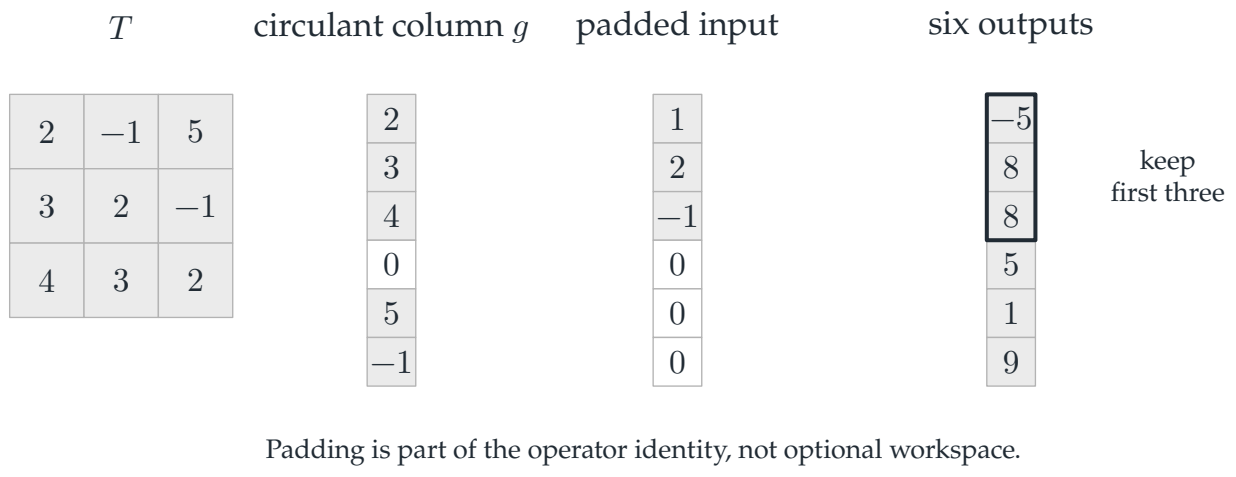
Reading the drawing
The diagonals share coefficients, while the finite input and output boundaries remain explicit. The picture does not silently replace the map by periodic convolution.
Drawing labels and data 33 labels
Read the original labels as selectable text. Tables preserve grid relationships; other short labels are grouped compactly.
- \(T\)
| Row / column | Column 1 | Column 2 | Column 3 |
|---|---|---|---|
| Row 1 | \(2\) | \(-1\) | \(5\) |
| Row 2 | \(3\) | \(2\) | \(-1\) |
| Row 3 | \(4\) | \(3\) | \(2\) |
- circulant column \(g\)
- \(2\)
- \(3\)
- \(4\)
- \(0\)
- \(5\)
- \(-1\)
- padded input
- \(1\)
- \(2\)
- \(-1\)
- \(0\)
- \(0\)
- \(0\)
- six outputs
- \(-5\)
- \(8\)
- \(8\)
- \(5\)
- \(1\)
- \(9\)
keep
first three
Padding is part of the operator identity, not optional workspace.
Read the wrapped indices
For output index \(j<3\), an input index \(k\le j\) uses the first-column coefficient \(c_{j-k}\). An input index \(k>j\) wraps to the stored first-row coefficient \(r_{k-j}\). The padded input positions contribute nothing. Keeping the first three outputs therefore gives
The remaining circular outputs are workspace consequences of the embedding, not additional components of \(Tx\).
A concrete failure mode
Using only the first column \((2,3,4)\) as a three-dimensional circulant changes the upper-triangular coefficients. That is a different matrix. The checker compares its output with \(Tx\) and rejects the unpadded shortcut.
The middle zero in \(g\) is not a discarded Toeplitz coefficient: it separates the lower and reversed upper diagonals in the chosen \(2n\) embedding. Other embeddings require their own index identities. It is not sufficient for an array merely to have the right length or to produce a plausible plot.
Read this as
Zero padding prevents the wrong circular interactions. It is an algebraic part of the operator representation, not an optional performance tweak.