
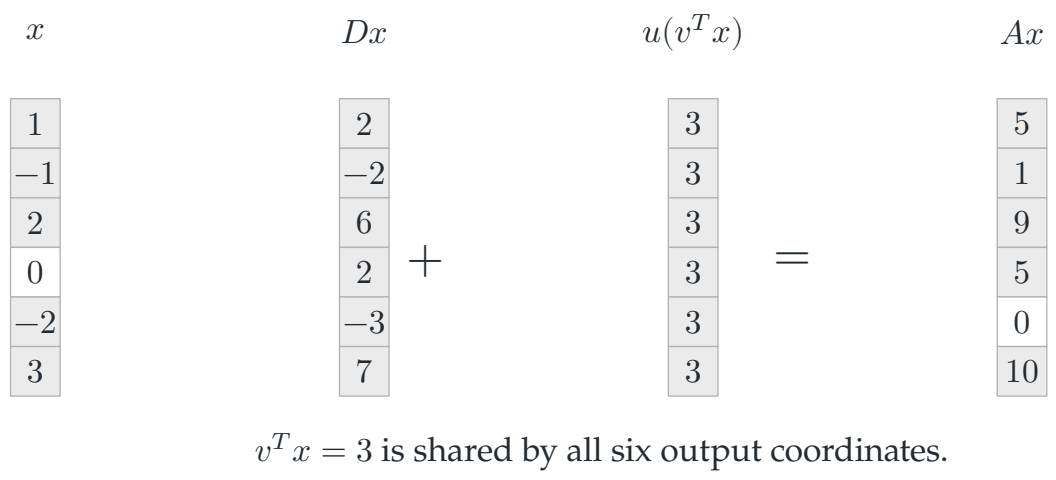
Let \(D\) have three identical blocks \({\begin{pmatrix}3&1\\1&3\end{pmatrix}}\) and put \(u=v={\mathbf{1}}\in{\mathbb Q}^6\). Then \(A=D+uv^T\) has diagonal entries four, within-block off-diagonal entries two, and every cross-block entry one. All 36 entries are nonzero.
Reading the drawing
The local block action and the low-rank correction contribute to the same output vector. The correction uses the complete input rather than independent packet-local inputs.
Drawing labels and data 31 labels
Read the original labels as selectable text. Tables preserve grid relationships; other short labels are grouped compactly.
- \(x\)
- \(1\)
- \(-1\)
- \(2\)
- \(0\)
- \(-2\)
- \(3\)
- \(Dx\)
- \(2\)
- \(-2\)
- \(6\)
- \(2\)
- \(-3\)
- \(7\)
- \(u(v^Tx)\)
- \(3\)
- \(3\)
- \(3\)
- \(3\)
- \(3\)
- \(3\)
- \(Ax\)
- \(5\)
- \(1\)
- \(9\)
- \(5\)
- \(0\)
- \(10\)
- \(+\)
- \(=\)
\(v^Tx=3\) is shared by all six output coordinates.
What was avoided?
The global part does not require 36 independent coefficients. It depends on the input through one scalar, \(v^Tx\), which is broadcast through \(u\). The diagonal part is computed by three separate local matrix products. Nothing is approximated and no channel is discarded.
The sixth output is \(7+3=10\), while the fifth is \(-3+3=0\). A zero result can arise through cancellation even when the corresponding row contains no zero coefficient. The output vector is therefore not a support map of the input matrix.
What has not been established?
This computation proves neither that the supplied factors are the cheapest representation nor that six small tasks outperform one dense kernel. For example, the repeated diagonal blocks and all-one vectors admit further special handling. The stated BDLR model deliberately treats the blocks as dense and the factors as stored vectors so that the paper's general formulas apply literally.
The checker constructs the complete matrix independently, multiplies it by \(x\), and compares all six entries with the factored route. The same input returns in the product calculation on Visual 27.
Read this as
A matrix can have full entrywise support and still admit a small exact representation. Entry sparsity and algebraic compressibility are different properties.