
Let the exact scalar factors be \((2,3,4)\) and start from \(p_0=1\). If additive errors \((1/10,1/5,1/20)\) enter after each partial multiplication, then
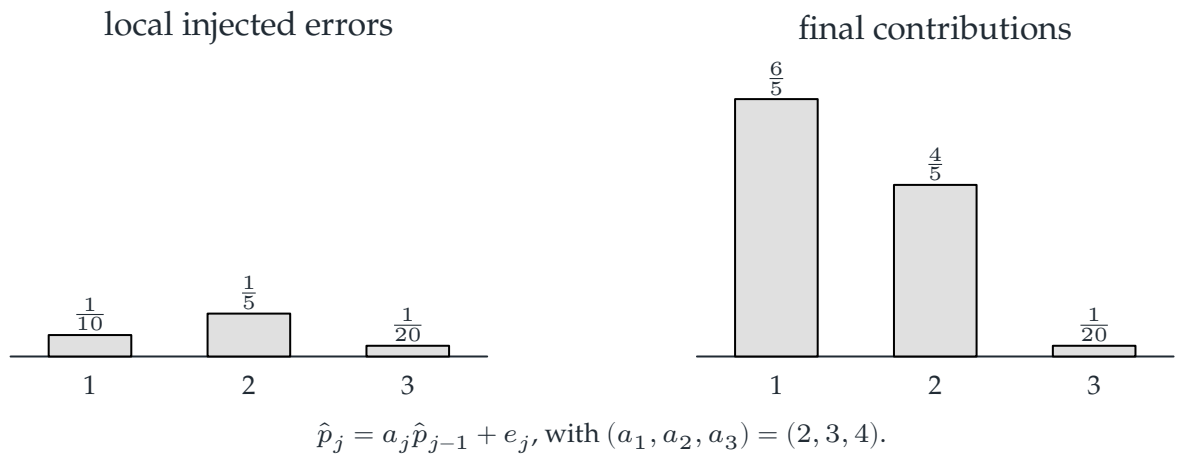
Reading the drawing
Each local error is surrounded by the factors on both sides. The displayed contributions show why a local error bound needs the later transport factors.
Drawing labels and data 15 labels
Read the original labels as selectable text. Tables preserve grid relationships; other short labels are grouped compactly.
- local injected errors
- 1
\(\frac{1}{10}\)
- 2
\(\frac{1}{5}\)
- 3
\(\frac{1}{20}\)
- final contributions
- 1
\(\frac{6}{5}\)
- 2
\(\frac{4}{5}\)
- 3
\(\frac{1}{20}\)
\(\widehat p_j=a_j\widehat p_{j-1}+e_j\), with \((a_1,a_2,a_3)=(2,3,4)\).
The same local numbers, a different model
If instead the factors themselves are perturbed, the computed product is \((4+e_3)(3+e_2)(2+e_1)\). Its error is \(402/125\), not \(41/20\). The factor-perturbation telescoping formula contains already-perturbed later factors; the additive recompression formula contains the original later factors.
The visual comparison uses the additive model. The first error is multiplied by both remaining factors. The last error is not amplified at all. Summing only the local error magnitudes gives \(7/20\), which is smaller than the actual final error and therefore not a valid bound here.
In a matrix chain
The corresponding formulas replace scalar magnitudes with operator norms and respect multiplication order. A bound can be conservative when contributions cancel, but it must not omit possible amplification. Singular-tail errors from a recompression step become useful only after they are inserted into the correct global error model.
Read this as
An error tolerance needs an entry point. A bound for perturbing factors and a bound for compressing partial products are not interchangeable.