
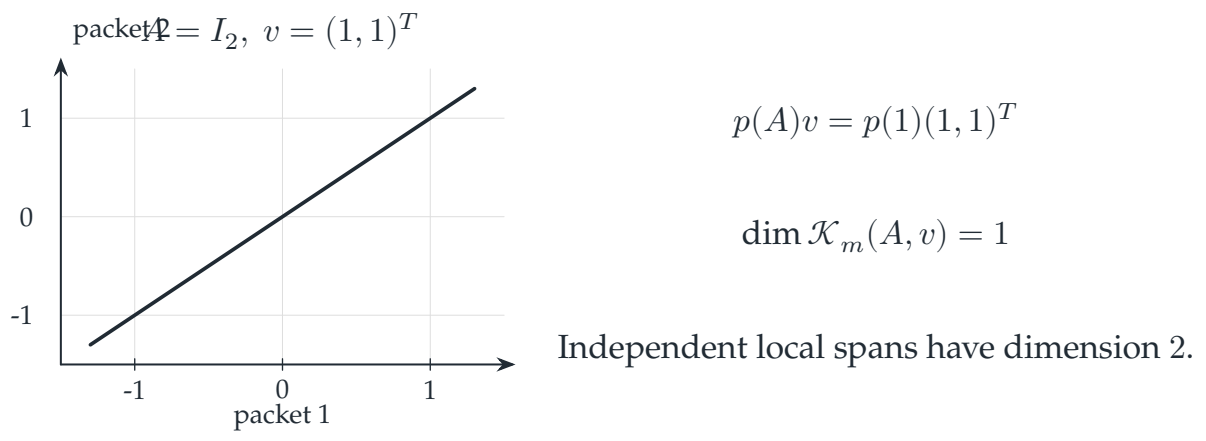
Take \(A=I_2\), split into the two coordinate packets, and start with \(v=(1,1)^T\). Every packet is invariant. Nevertheless every polynomial applies the same scalar to both coordinates:
Reading the drawing
The two spaces use different permitted operations. Invariance under one operator does not give independent access to each packet component.
Drawing labels and data 12 labels
Read the original labels as selectable text. Tables preserve grid relationships; other short labels are grouped compactly.
- -1
- 0
- 1
- -1
- 0
- 1
- packet 1
- packet 2
- \(A=I_2,\ v=(1,1)^T\)
- \(p(A)v=p(1)(1,1)^T\)
\(\dim\mathcal K_m(A,v)=1\)
- Independent local spans have dimension \(2\).
The direct sum of the two local Krylov spans is all of \({\mathbb Q}^2\). It permits independent coefficients in the two packets. The global Krylov space does not. This is why the manuscript states an inclusion, not an unconditional equality.
What breaks the linkage?
With \(A={\operatorname{diag}}(1,2)\), the vectors \(v\) and \(Av=(1,2)^T\) are independent. Two polynomial samples now distinguish the packet labels. Alternatively, allowing the packet projectors as extra address operators separates the coordinates even when \(A=I_2\). Both changes enlarge the addressing power, but in different ways.
When invariance is only approximate
If \(A=D+K\) with \(D\) packet diagonal, then
This controls departure from the decoupled iterate. It is not a claim that the dimension or numerical conditioning of a Krylov basis varies continuously. Near dependence can remain difficult even when the operator error is small.
Read this as
A single global polynomial can lock otherwise invariant packets together. Independence of subspaces is not the same as independence of the allowed actions.