
Let \(A=D_A+u_av_a^T\) be the running operator. Take \(D_B={\operatorname{diag}}(1,2,3,4,5,6)\), \(u_b=(1,0,1,0,1,0)^T\), and \(v_b=(0,1,0,1,0,1)^T\). Define \(B=D_B+u_bv_b^T\).
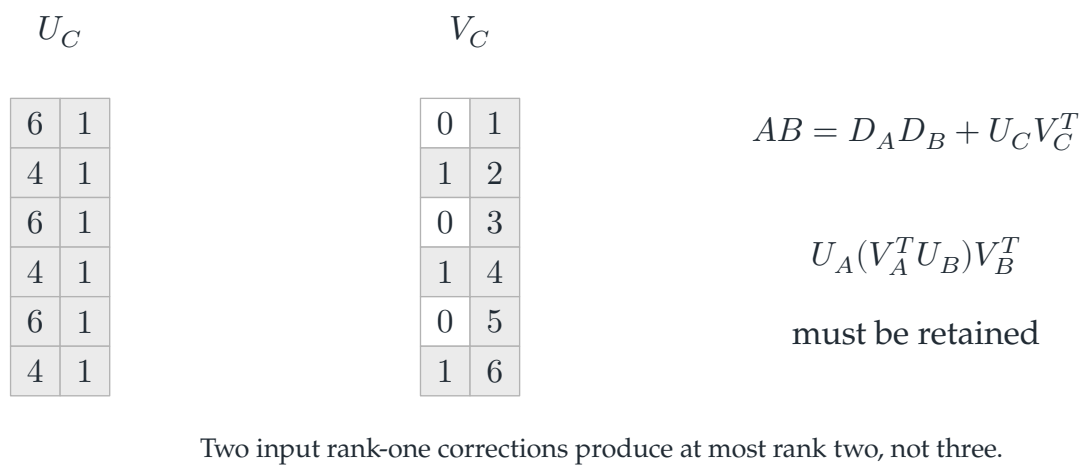
Reading the drawing
The blocks and thin factors show the local product and all correction terms. Keeping the factors avoids materializing a dense product but does not remove cross interactions.
Drawing labels and data 30 labels
Read the original labels as selectable text. Tables preserve grid relationships; other short labels are grouped compactly.
- \(U_C\)
| Row / column | Column 1 | Column 2 |
|---|---|---|
| Row 1 | \(6\) | \(1\) |
| Row 2 | \(4\) | \(1\) |
| Row 3 | \(6\) | \(1\) |
| Row 4 | \(4\) | \(1\) |
| Row 5 | \(6\) | \(1\) |
| Row 6 | \(4\) | \(1\) |
- \(V_C\)
| Row / column | Column 1 | Column 2 |
|---|---|---|
| Row 1 | \(0\) | \(1\) |
| Row 2 | \(1\) | \(2\) |
| Row 3 | \(0\) | \(3\) |
| Row 4 | \(1\) | \(4\) |
| Row 5 | \(0\) | \(5\) |
| Row 6 | \(1\) | \(6\) |
- \(AB=D_AD_B+U_CV_C^T\)
- \(U_A(V_A^TU_B)V_B^T\)
- must be retained
Two input rank-one corrections produce at most rank two, not three.
Why there are only two columns
Expanding \(AB\) gives three correction terms, but two share the right factor \(v_b^T\):
The remaining term is \(u_av_a^TD_B\). Thus \(AB=D_AD_B+U_CV_C^T\) with at most two correction directions. Counting the three expanded summands as independent ranks would overestimate this representation.
The scalar \(v_a^Tu_b\) is three. Removing the quadratic term would therefore remove \(3u_av_b^T\), which is nonzero. The checker compares the complete product to the factor construction and rejects a calculation that omits this contribution.
Before and after recompression
A rank bound on stored factors is not always the actual matrix rank. Repeated products may introduce dependent columns. Recompression can remove those dependencies exactly, or remove small singular directions approximately under an explicit error budget.
Read this as
Closure of a representation class is an algebraic statement about all product terms. It is not permission to drop an interaction merely because it is second order in the factors.