
Retain the first two coordinates of
The third coordinate is hidden. Its invertible block is \([2]\), so eliminating it produces
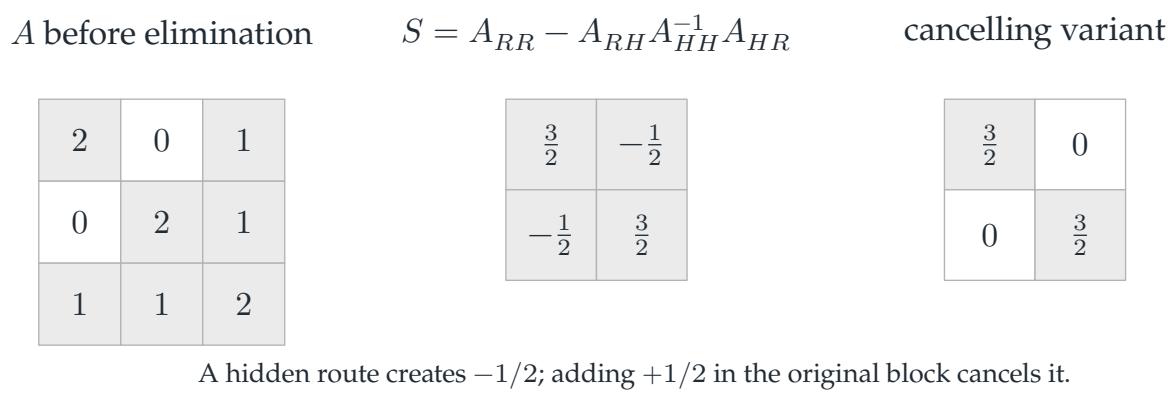
Reading the drawing
The eliminated variables connect previously separate blocks through the Schur term. Signed contributions can cancel even when the structural fill pattern permits an entry.
Drawing labels and data 21 labels
Read the original labels as selectable text. Tables preserve grid relationships; other short labels are grouped compactly.
- \(A\) before elimination
| Row / column | Column 1 | Column 2 | Column 3 |
|---|---|---|---|
| Row 1 | \(2\) | \(0\) | \(1\) |
| Row 2 | \(0\) | \(2\) | \(1\) |
| Row 3 | \(1\) | \(1\) | \(2\) |
- \(S=A_{RR}-A_{RH}A_{HH}^{-1}A_{HR}\)
| Row / column | Column 1 | Column 2 |
|---|---|---|
| Row 1 | \(\frac{3}{2}\) | \(- \frac{1}{2}\) |
| Row 2 | \(- \frac{1}{2}\) | \(\frac{3}{2}\) |
- cancelling variant
| Row / column | Column 1 | Column 2 |
|---|---|---|
| Row 1 | \(\frac{3}{2}\) | \(0\) |
| Row 2 | \(0\) | \(\frac{3}{2}\) |
A hidden route creates \(-1/2\); adding \(+1/2\) in the original block cancels it.
The hidden route has a sign
The retained coordinates had no direct coupling, yet both touch the hidden coordinate. The resulting correction couples them by \(-1/2\). This is fill: a new active retained block produced by an eliminated route.
Now change both original retained off-diagonal entries to \(+1/2\). The same hidden correction cancels them, leaving the diagonal matrix \(\frac32 I\). Thus a structural route can create or remove visible coupling depending on the direct coefficient already present.
A stronger inverse statement
For an invertible finite packet matrix, inverse support lies in the directed transitive closure. A reachable-coordinate subspace is invariant under the matrix. Injectivity of its restriction implies surjectivity in finite dimension, so the inverse preserves it as well. This proof uses finite-dimensional invertibility, not a convergent geometric series.
The checker verifies both Schur complements and, in each invertible example, equality between \(S^{-1}\) and the retained block of \(A^{-1}\).
Read this as
Removing coordinates does not remove their influence. It changes the retained operator, with possible fill, cancellation, and new conditioning constraints.