
For the running operator, each diagonal block has inverse \(\frac18{\begin{pmatrix}3&-1\\-1&3\end{pmatrix}}\). Hence \(D^{-1}u=u/4\) and
The Woodbury identity reduces the entire inverse to
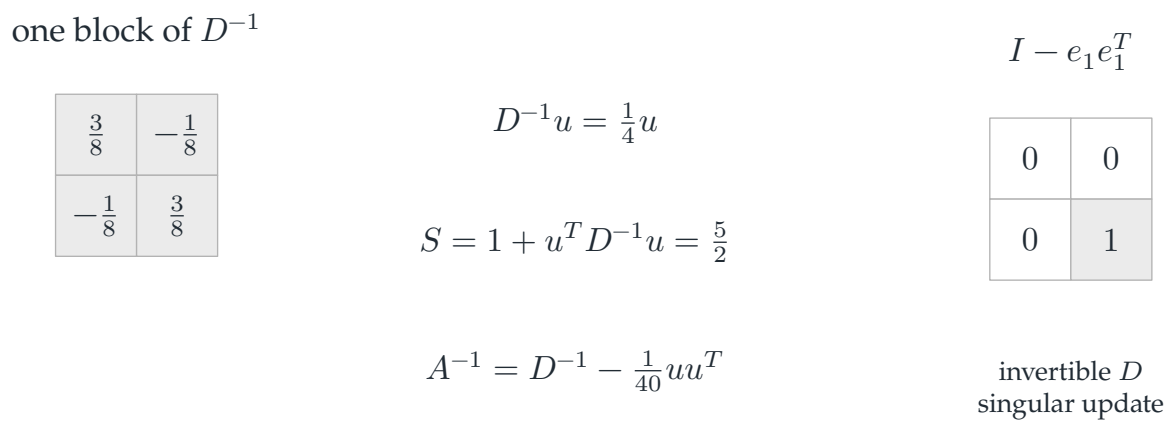
Reading the drawing
The supplied inverse conditions and thin factors identify the small system that remains. The diagram does not assert that every low-rank update is invertible.
Drawing labels and data 14 labels
Read the original labels as selectable text. Tables preserve grid relationships; other short labels are grouped compactly.
- one block of \(D^{-1}\)
| Row / column | Column 1 | Column 2 |
|---|---|---|
| Row 1 | \(\frac{3}{8}\) | \(- \frac{1}{8}\) |
| Row 2 | \(- \frac{1}{8}\) | \(\frac{3}{8}\) |
- \(D^{-1}u=\tfrac14 u\)
- \(S=1+u^TD^{-1}u=\tfrac52\)
- \(A^{-1}=D^{-1}-\tfrac1{40}uu^T\)
- \(I-e_1e_1^T\)
| Row / column | Column 1 | Column 2 |
|---|---|---|
| Row 1 | \(0\) | \(0\) |
| Row 2 | \(0\) | \(1\) |
invertible \(D\)
singular update
Two hypotheses, not one
Invertibility of \(D\) alone does not suffice. For \(D=I_2\), \(u=e_1\), and \(v=-e_1\), the update is \({\operatorname{diag}}(0,1)\). The small matrix \(S\) is zero, exactly where the correction formula would require an invalid division.
For the running model, the checker multiplies the proposed inverse by \(A\) in both orders and obtains the identity. It also checks the determinant relation \(\det A=\det D\det S\). These tests verify the actual factors and sign of the correction, not just a numerical solve residual.
Conditioning survives the reduction
A small \(S\) can still be ill-conditioned. Reducing its dimension does not bound \(\|S^{-1}\|\). The manuscript's inverse estimate keeps that term explicit, along with the norms of \(D^{-1}u\) and \(v^TD^{-1}\).
Read this as
The hidden coupling has not vanished. Its solvability and sensitivity are concentrated in a smaller operator that still has to be invertible and numerically controlled.