
The earlier compact example is real. Over \({\mathbb C}\), an isometry means \(Q^*Q=I\), with conjugation. Take the exact Gaussian-rational factors
Their product is a genuinely complex rectangular operator:
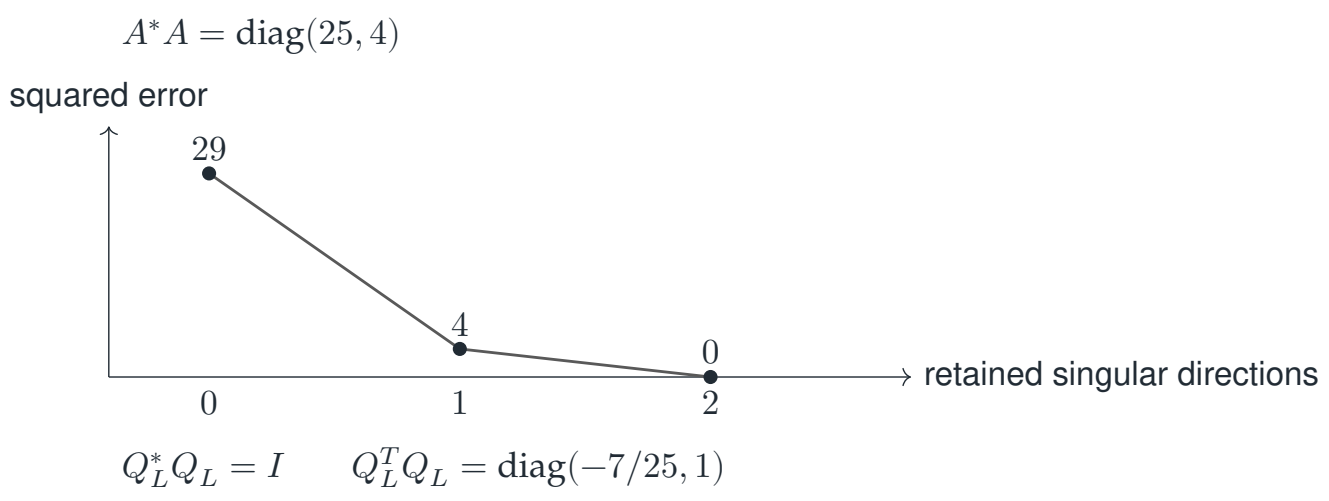
Reading the drawing
The plotted errors correspond to retaining zero, one or two singular directions. The matrix labels distinguish Hermitian isometry from an incorrect transpose convention.
Drawing labels and data 10 labels
Read the original labels as selectable text. Tables preserve grid relationships; other short labels are grouped compactly.
- \(A^*A=\operatorname{diag}(25,4)\)
- retained singular directions
- squared error
- \(0\)
- \(29\)
- \(1\)
- \(4\)
- \(2\)
- \(0\)
The small calculation exposes a wrong convention
The first column of \(Q_L\) has Hermitian squared length \(9/25+16/25=1\). Its bilinear square without conjugation is \(9/25-16/25=-7/25\). Thus \(Q_L^TQ_L\) is not the identity. The portable negative control replaces the adjoint by transpose and rejects the resulting isometry claim.
Keeping the first diagonal entry of \(G\) gives \(A_1\) with its second column zero. The residual has squared Frobenius norm four and Gram matrix \({\operatorname{diag}}(0,4)\), hence spectral norm two. Both errors agree with the discarded core singular value. Every displayed arithmetic operation occurs in \({\mathbb Q}(\mathrm i)\).
What the finite check establishes
It checks both isometries, the reconstructed ambient matrix, its Gram matrix, and the explicit rank-one residual. Global best-rank optimality still comes from the manuscript's compression and lower-bound proof; this two-column calculation is a worked instance of that argument. No existence theorem or numerical SVD routine is executed.
Read this as
Conjugation preserves the complex Euclidean norm. A transpose is correct in the vectorization identity on Visual 7, but an adjoint is required for an isometric range lift.