
With column-major vectorization, the tensor identity is
Here the transpose records index order, not a Hermitian inner product. Use the explicitly complex matrix \(A={\begin{pmatrix}1&\mathrm i\\2&-1\end{pmatrix}}\), together with \(B={\begin{pmatrix}2&1\\0&3\end{pmatrix}}\) and \(X={\begin{pmatrix}1&2\\3&4\end{pmatrix}}\).
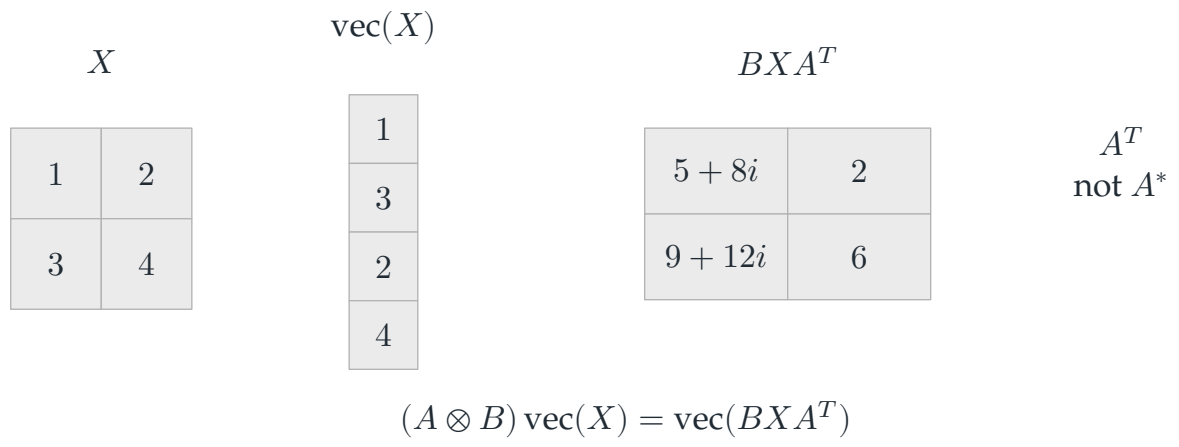
Reading the drawing
The factor matrices determine the two-sided matrix action. The vectorization convention fixes the order and the transpose in the displayed identity.
Drawing labels and data 17 labels
Read the original labels as selectable text. Tables preserve grid relationships; other short labels are grouped compactly.
- \(X\)
| Row / column | Column 1 | Column 2 |
|---|---|---|
| Row 1 | \(1\) | \(2\) |
| Row 2 | \(3\) | \(4\) |
- \(\operatorname{vec}(X)\)
- \(1\)
- \(3\)
- \(2\)
- \(4\)
- \(BXA^T\)
| Row / column | Column 1 | Column 2 |
|---|---|---|
| Row 1 | \(5 + 8 i\) | \(2\) |
| Row 2 | \(9 + 12 i\) | \(6\) |
\(A^T\)
not \(A^*\)
Check the coordinates
The stacked input is \((1,3,2,4)^T\). Direct tensor multiplication agrees with stacking the columns of
Replacing \(A^T\) with \(A^*\) changes the signs of the imaginary terms. A real-only test would conceal that error, which is why the worked model uses an imaginary coefficient.
Why modewise contraction matters
For \(A\) of order \(m\) and \(B\) of order \(n\), the explicit tensor matrix stores \(m^2n^2\) entries. Its factors store \(m^2+n^2\). Applying through \(BXA^T\) costs \(2n^2m+2nm^2\) modeled operations, rather than forming the full tensor matrix first.
A different flattening convention has a different coordinate formula. The statement is not independent of how an array is reshaped. In a software implementation, shape, stride, and flattening order belong to the correctness contract as well as the cost model.
Read this as
Tensor structure gives exact savings only when the address convention is preserved. A silent transpose, conjugation, or reshape change implements a different map.