
The product from the previous page is
Keeping only its first singular direction gives a rank-one approximation with spectral and Frobenius error exactly two. Keeping none gives errors five and \(\sqrt{29}\); keeping both gives zero.
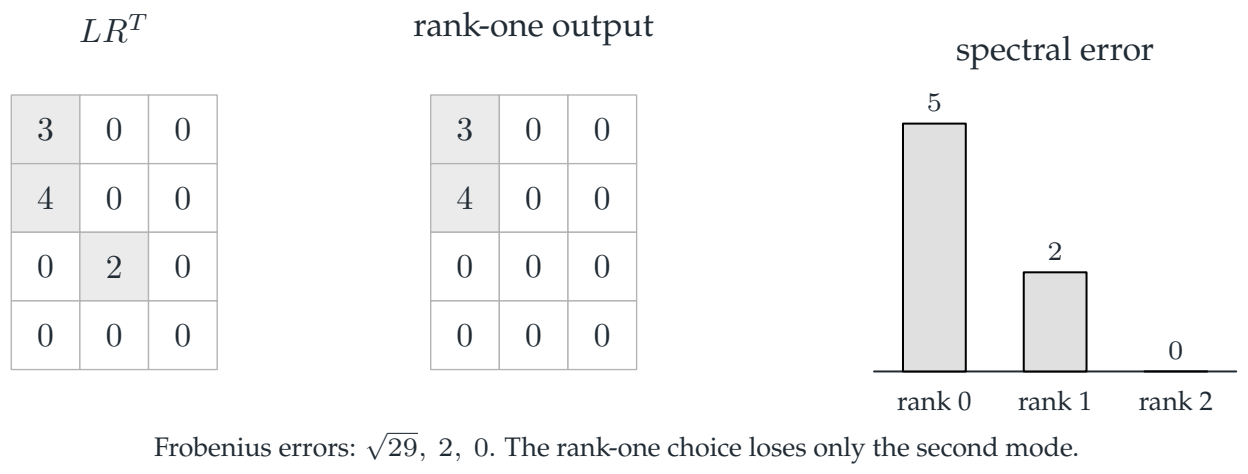
Reading the drawing
The core and ambient spaces are linked by the supplied isometric range factors. The comparison preserves the stated norms and rank constraints under those hypotheses.
Drawing labels and data 34 labels
Read the original labels as selectable text. Tables preserve grid relationships; other short labels are grouped compactly.
- \(LR^T\)
| Row / column | Column 1 | Column 2 | Column 3 |
|---|---|---|---|
| Row 1 | \(3\) | \(0\) | \(0\) |
| Row 2 | \(4\) | \(0\) | \(0\) |
| Row 3 | \(0\) | \(2\) | \(0\) |
| Row 4 | \(0\) | \(0\) | \(0\) |
- rank-one output
| Row / column | Column 1 | Column 2 | Column 3 |
|---|---|---|---|
| Row 1 | \(3\) | \(0\) | \(0\) |
| Row 2 | \(4\) | \(0\) | \(0\) |
| Row 3 | \(0\) | \(0\) | \(0\) |
| Row 4 | \(0\) | \(0\) | \(0\) |
- spectral error
- rank 0
- \(5\)
- rank 1
- \(2\)
- rank 2
- \(0\)
Frobenius errors: \(\sqrt{29},\ 2,\ 0\). The rank-one choice loses only the second mode.
Why an outside competitor cannot do better
For isometric outer factors, compression \(C(B)=Q_L^*BQ_R\) cannot increase rank or either matrix norm. Every ambient rank-\(k\) competitor therefore supplies an admissible core competitor. The lifted core residual has exactly the core residual norm. These two facts transfer a core optimum to the entire ambient matrix space, not just to competitors already lying in the supplied ranges.
For a \(d\)-dimensional diagonal core and \(0\le k<d\), the spectral lower bound has a concrete witness. A rank-at-most-\(k\) competitor has a nonzero kernel vector in the first \(k+1\) coordinates. On that vector the diagonal matrix acts with norm at least \(\sigma_{k+1}\) times the vector norm. The competitor cannot cancel that direction.
The Frobenius proof uses an orthonormal basis of the competitor's kernel. Its row weights lie in \([0,1]\) and sum to the kernel dimension. Weighting the decreasing squared singular values forces at least the discarded tail. The two norm arguments are distinct; one is not a graph of the other.
Read this as
Optimality is not inferred from the appearance of the singular-value plot. It follows from compression and a lower bound valid against every rank-bounded competitor.