
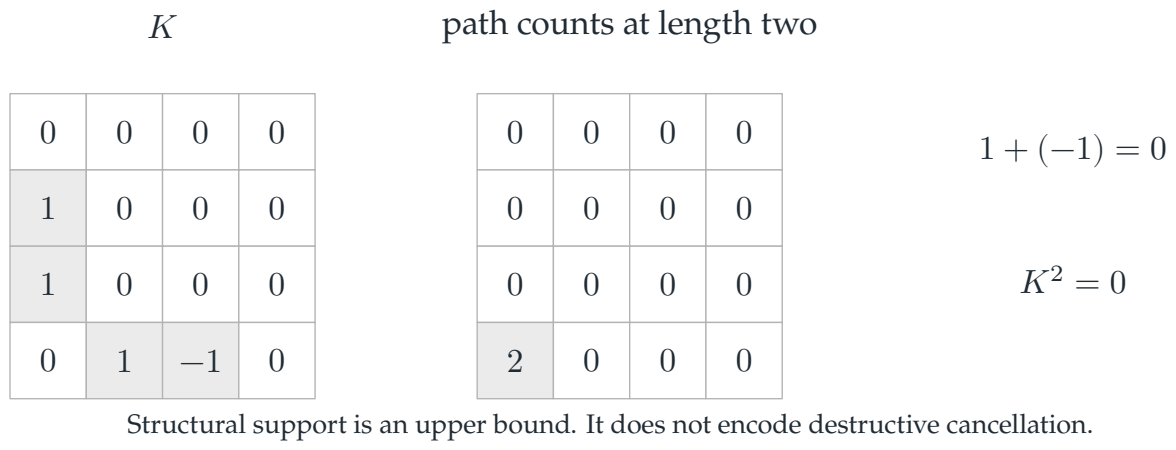
Let \(K\) have transfers \(0\to1\), \(0\to2\), \(1\to3\), and \(2\to3\), with coefficients \(1,1,1,-1\). There are two length-two routes from packet zero to packet three, but their contributions sum to zero.
Reading the drawing
Two contributions share an output address. Their signed values cancel, so structural support is an upper bound on the realized nonzero pattern.
Drawing labels and data 37 labels
Read the original labels as selectable text. Tables preserve grid relationships; other short labels are grouped compactly.
- \(K\)
| Row / column | Column 1 | Column 2 | Column 3 | Column 4 |
|---|---|---|---|---|
| Row 1 | \(0\) | \(0\) | \(0\) | \(0\) |
| Row 2 | \(1\) | \(0\) | \(0\) | \(0\) |
| Row 3 | \(1\) | \(0\) | \(0\) | \(0\) |
| Row 4 | \(0\) | \(1\) | \(-1\) | \(0\) |
- path counts at length two
| Row / column | Column 1 | Column 2 | Column 3 | Column 4 |
|---|---|---|---|---|
| Row 1 | \(0\) | \(0\) | \(0\) | \(0\) |
| Row 2 | \(0\) | \(0\) | \(0\) | \(0\) |
| Row 3 | \(0\) | \(0\) | \(0\) | \(0\) |
| Row 4 | \(2\) | \(0\) | \(0\) | \(0\) |
- \(1+(-1)=0\)
- \(K^2=0\)
Structural support is an upper bound. It does not encode destructive cancellation.
The matrix of path counts sees the two possibilities and forgets the signs. It therefore predicts possible support but not actual support. Replacing the inclusion \({\operatorname{supp}}(AB)\subseteq{\operatorname{supp}}(A)\circ{\operatorname{supp}}(B)\) by equality would be wrong even in this four-dimensional model.
What an acyclic graph does guarantee
If the longest strict directed path has \(h\) edges, then no term of \(K^{h+1}\) can survive. Thus \(K^{h+1}=0\). This is an upper bound on the nilpotence index, not an assertion that \(K^h\ne0\). Here the graph has paths of length two, while coefficient cancellation already gives \(K^2=0\).
A structurally permitted block may also vanish because a product of rectangular maps is zero before any sum is taken. A support graph cannot distinguish that mechanism from cancellation among separate routes. The actual block coefficients are therefore part of a proof-bearing operator representation.
Read this as
Use graph reachability to exclude impossible transfers. Use the algebra to determine which permitted transfers actually survive.