
Use a tree with one root and two terminal children. There are exactly two admissible prunings: keep the root, or split into both children. All declared errors and the split overhead are zero. Their additive total costs are:
| Cost component | Keep | Split |
|---|---|---|
| Setup paid once | 4 | 2 |
| Operator 1, per use | 2 | 8 |
| Operator 2, per use | 7 | 2 |
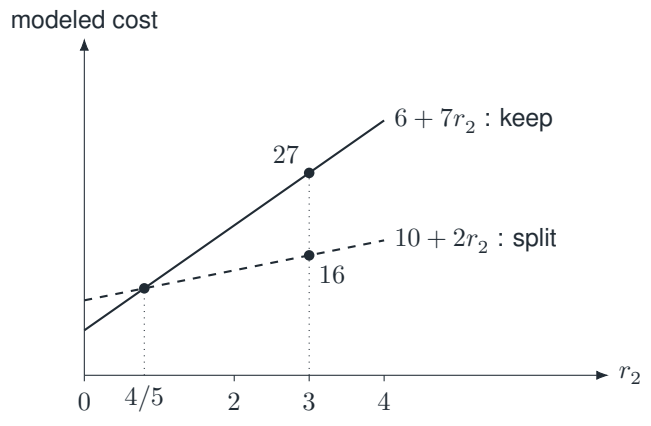
Reading the drawing
Solid and dashed affine cost lines compare keeping and splitting the same supplied tree. Their crossing and the marked integer samples determine the declared shared optimum.
Drawing labels and data 11 labels
Read the original labels as selectable text. Tables preserve grid relationships; other short labels are grouped compactly.
- \(r_2\)
- modeled cost
- \(6+7r_2\) : keep
- \(10+2r_2\) : split
- \(4/5\)
- \(0\)
- \(2\)
- \(3\)
- \(4\)
- \(27\)
- \(16\)
With reuse weights \((r_1,r_2)=(1,3)\), the aggregated objectives are
The exact shared optimum is split. Operator 1 alone prefers keep on its per-use costs, while operator 2 prefers split. Choosing independently and trying to combine those decisions would not solve the declared one-pruning problem.
A hand-computable decision threshold
Fix \(r_1=1\) and vary \(r_2=r\ge0\). Keeping costs \(6+7r\) and splitting costs \(10+2r\). Splitting is strictly cheaper when \(r>4/5\); its first integer reuse win is \(r=1\). The checker evaluates both admissible choices for integers zero through four and checks the displayed totals at three.
Where the common-tree proof applies
The family corollary aggregates local keep costs and errors, then uses the same exact subtree recurrence. In this example, each row denotes the sum of the selected local leaf terms; it does not conceal a nonlocal discount. A setup shared by distant unrelated nodes, overlapping candidates, or a global resource constraint would need an enlarged state or a different model.
Read this as
Reuse weights change the objective before compilation. Shared optimality is exact for the supplied common tree and additive family costs, rather than for an unspecified set of future workloads.