
6 Sparse transfer graphs and schedules
On this page · Permalink · Source line 946
6.1 Support under algebraic operations
On this page · Permalink · Source line 948
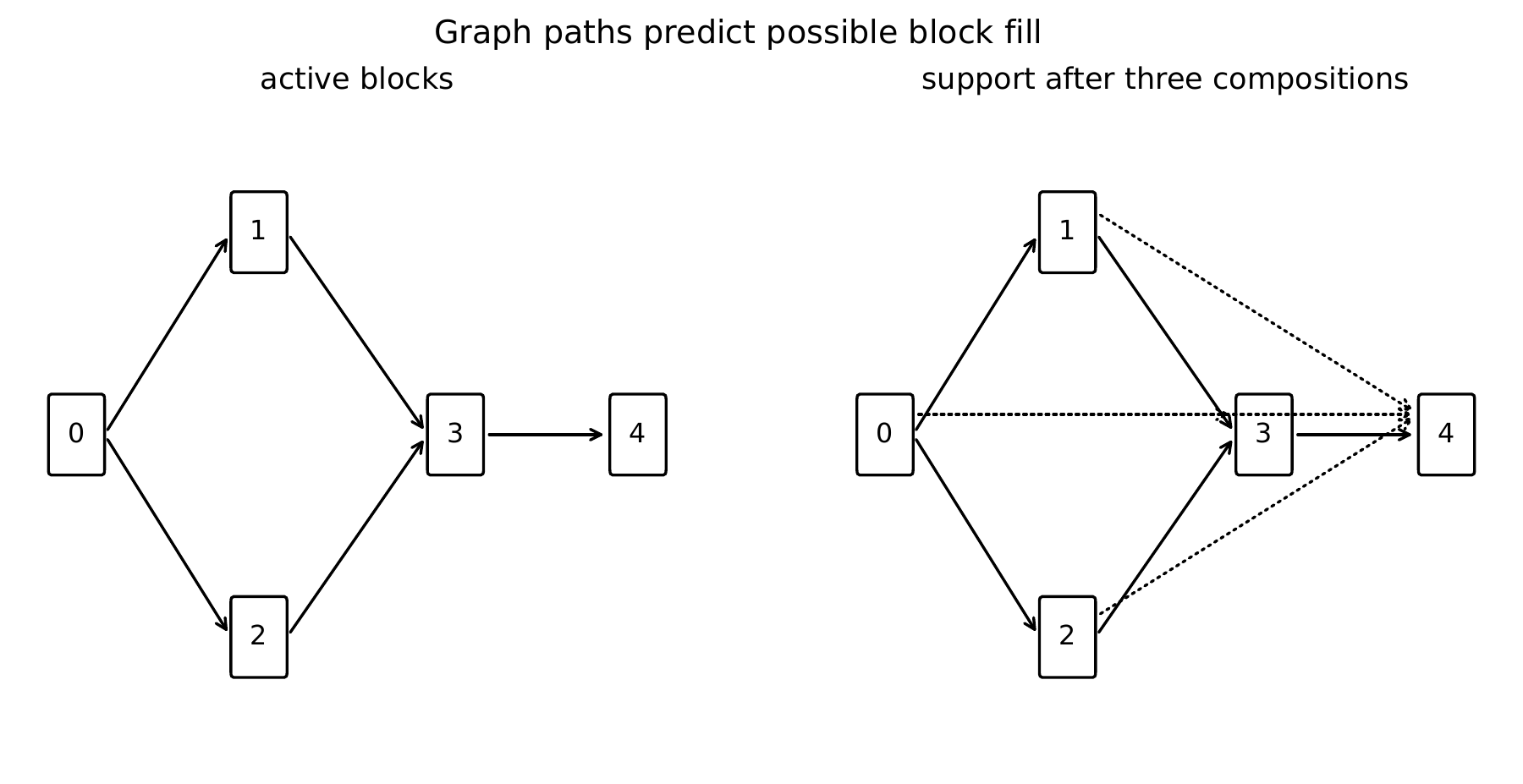
Theorem 6.1: Path support of powers
For every positive integer \(m\),
is the sum over directed walks (vertices may repeat)
in \(G_A\), with contribution
If no such path exists, the block vanishes.
Read proof · Visual guide: Two routes can cancel exactly · Visual guide: Inverse reachability is still an inclusion · Read statement and proof side by side · Permalink · Source line 950 · Claim record · Lean coverage · Code · Worked examples
Proof of Theorem 6.1
Insert the packet identity between every two consecutive factors of \(A\). Every nonzero term determines one path of length \(m\).
Back to statement · Read statement and proof side by side · Permalink · Source line 972 · Claim record · Lean coverage · Code · Worked examples
Corollary 6.2: Polynomial support
If
then
is contained in the union of the support relations of \(A^j\) for \(0\leq j\leq d\).
Read proof · Read statement and proof side by side · Permalink · Source line 976 · Claim record · Lean coverage · Code · Worked examples
Proof of Corollary 6.2
Apply Theorem 6.1 to every power in the polynomial.
Back to statement · Read statement and proof side by side · Permalink · Source line 988 · Claim record · Lean coverage · Code · Worked examples
Corollary 6.3: Acyclic transfer nilpotence
Let \(K\) contain only strict transfer blocks. If its support graph is acyclic and its longest directed path has \(h\) edges, then
Read proof · Visual guide: Two routes can cancel exactly · Visual guide: Inverse reachability is still an inclusion · Read statement and proof side by side · Permalink · Source line 992 · Claim record · Lean coverage · Code · Worked examples
Proof of Corollary 6.3
There is no directed path of length \(h+1\). Every block of \(K^{h+1}\) therefore vanishes by Theorem 6.1.
Back to statement · Read statement and proof side by side · Permalink · Source line 999 · Claim record · Lean coverage · Code · Worked examples
6.2 Block triangular solves
On this page · Permalink · Source line 1010
Definition 6.4: Topological level
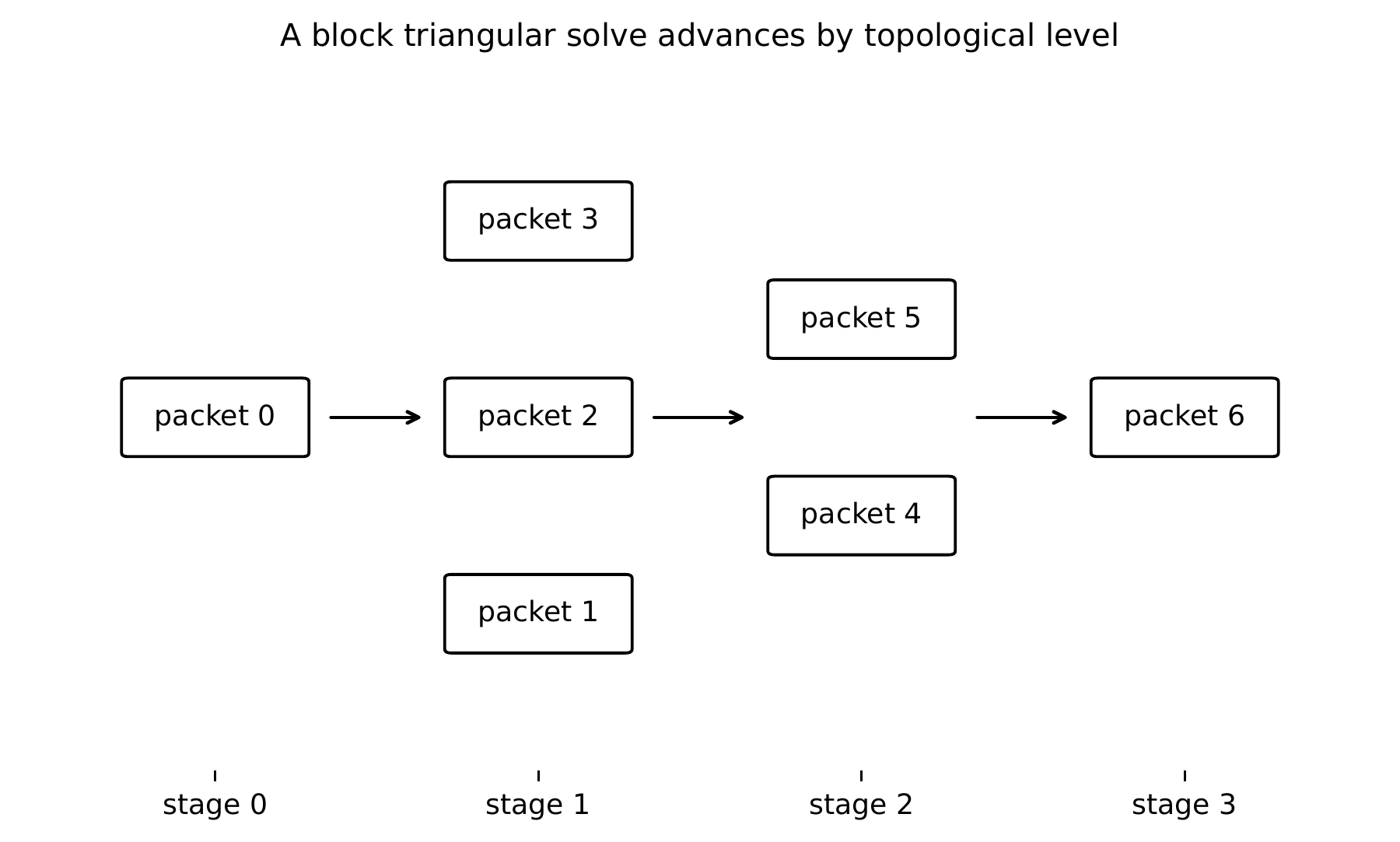
Let \(G\) be a directed acyclic graph. The first level contains its source vertices. Remove them. The next level contains the new sources. Continue until every vertex has been assigned.
Permalink · Source line 1012 · Claim record · Lean coverage · Code · Worked examples
Theorem 6.5: Level schedule for a triangular solve
Let \(A=D+K\) be block lower triangular after a topological ordering. Assume every diagonal block \(D_\alpha\) is invertible. The solve
can be completed in one sequential stage per topological level. Blocks in the same level may be solved independently after all earlier levels are known.
Read proof · Visual guide: A solve has a dependency clock · Read statement and proof side by side · Permalink · Source line 1016 · Claim record · Lean coverage · Code · Worked examples
Proof of Theorem 6.5
The equation in packet \(\beta\) is
Every predecessor of \(\beta\) lies in an earlier level. Once those values are available, \(x_\beta\) is obtained from the local solve with \(D_\beta\). Vertices in the same level have no directed edge between them, so their solves are independent.
Back to statement · Read statement and proof side by side · Permalink · Source line 1024 · Claim record · Lean coverage · Code · Worked examples
Corollary 6.6: Sequential depth
For a nonempty finite graph, the number of sequential stages in the level schedule equals one plus the length of the longest directed path. The empty graph has depth zero.
Read proof · Visual guide: A solve has a dependency clock · Read statement and proof side by side · Permalink · Source line 1036 · Claim record · Lean coverage · Code · Worked examples
Proof of Corollary 6.6
The recursive level of a vertex is one plus the largest level of its predecessors. For a nonempty graph, the largest level therefore counts the vertices on a longest path. For an empty graph, no task is scheduled and the depth is zero.
Back to statement · Read statement and proof side by side · Permalink · Source line 1040 · Claim record · Lean coverage · Code · Worked examples
6.3 Fill under elimination
On this page · Permalink · Source line 1051
Theorem 6.7: Inverse support lies in the transitive closure
Let \(A\) be an invertible packet operator. Reachability here includes a zero-length path from a packet to itself. If there is no directed path from packet \(\alpha\) to packet \(\beta\) in \(G_A\), then
Read proof · Visual guide: Elimination creates new interactions · Visual guide: Inverse reachability is still an inclusion · Read statement and proof side by side · Permalink · Source line 1053 · Claim record · Lean coverage · Code · Worked examples
Proof of Theorem 6.7
Let \(R\) be the set of packets reachable from \(\alpha\), including \(\alpha\), and set
No active edge leaves \(R\), so \(AX_R\subseteq X_R\). The restriction of \(A\) to the finite dimensional space \(X_R\) is injective. It is therefore onto \(X_R\). Hence \(A^{-1}X_R\subseteq X_R\). Since \(\beta\notin R\), the stated block of \(A^{-1}\) vanishes.
Back to statement · Read statement and proof side by side · Permalink · Source line 1062 · Claim record · Lean coverage · Code · Worked examples
Proposition 6.8: Schur support inclusion
Split the packets into retained indices \(R\) and hidden indices \(H\). Suppose the hidden block \(A_{HH}\) is invertible. The retained Schur complement is
A retained block \(({\beta},{\alpha})\) can be active only if it was already active in \(A_{RR}\), or if there is a directed walk from \(\alpha\) through hidden packets to \(\beta\). The internal hidden path may have length zero, so entrance and exit may use the same hidden packet.
Read proof · Visual guide: Elimination creates new interactions · Read statement and proof side by side · Permalink · Source line 1070 · Claim record · Lean coverage · Code · Worked examples
Proof of Proposition 6.8
The correction block is
It can be nonzero only when \(A_{HR}P_\alpha\) enters a hidden packet, the inverse hidden operator connects hidden packets, and \(P_\beta A_{RH}\) exits to \(\beta\). By Theorem 6.7, the hidden inverse can connect only packets joined by a hidden directed path. Cancellation may still remove an allowed block.
Back to statement · Read statement and proof side by side · Permalink · Source line 1082 · Claim record · Lean coverage · Code · Worked examples
Sparse elimination and fill are treated systematically in [Davis2006]. The packet graph records the same structural issue at block scale.