
3 Arithmetic, storage, and data movement
On this page · Visual guide: Compute the representation first · Permalink · Source line 245
We count one scalar multiplication and one scalar addition as two modeled floating point operations. These counts describe a declared event model for a representation. They do not predict wall time without a memory and launch model. A multiply–accumulate charges two scalar operations even for the first coefficient. Thin corrections accumulate into an already computed diagonal or sparse result. Index metadata, temporary workspace, launch overhead, discovery, transfer, and materialization are accounted for separately.
Theorem 3.1: Dense and packet application counts
A dense \(n\) by \(n\) matrix applied to \(q\) right hand sides has modeled cost
A packet representation with active edge set \(E\) has modeled cost
It stores
scalar entries.
Read proof · Visual guide: Work removed is not time measured · Read statement and proof side by side · Permalink · Source line 249 · Claim record · Lean coverage · Code · Worked examples
Proof of Theorem 3.1
The active block \(B_{\beta\alpha}\) is an \(n_\beta\) by \(n_\alpha\) matrix. Applying it to an \(n_\alpha\) by \(q\) input costs \(2n_\beta n_\alpha q\) modeled operations and stores \(n_\beta n_\alpha\) scalars. Summation over the active addresses gives both formulas.
Back to statement · Read statement and proof side by side · Permalink · Source line 278 · Claim record · Lean coverage · Code · Worked examples
Corollary 3.2: Equal diagonal packets
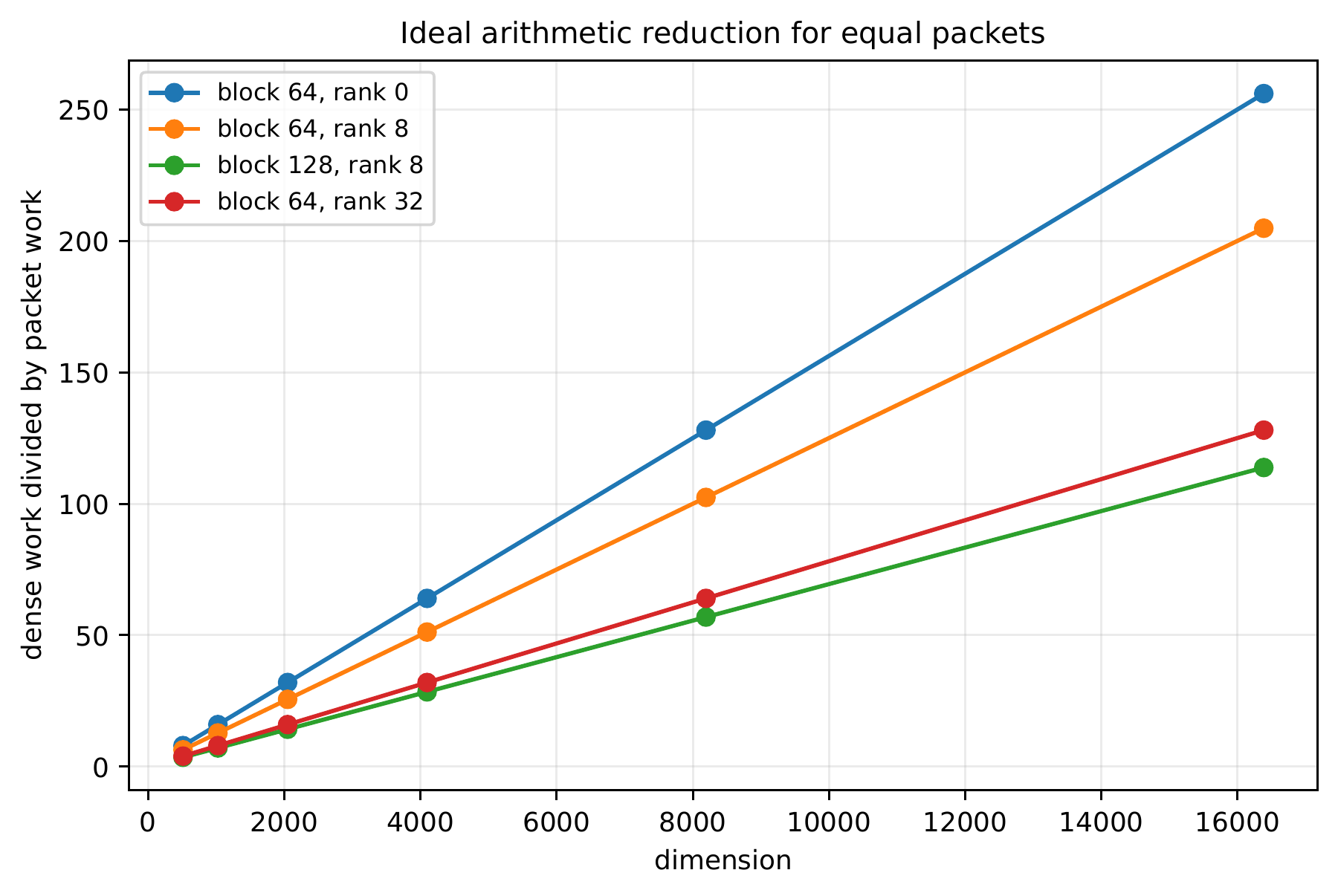
Let \(p\ge1\) and \(b\ge1\) be integers and \(n=pb\). Suppose \(n\) is divided into \(p\) equal diagonal packets of width \(b\). Then
The dense-to-block storage reduction factor is the following; the arithmetic reduction factor has the same value when \(q\ge1\):
Read proof · Visual guide: Work removed is not time measured · Read statement and proof side by side · Permalink · Source line 282 · Claim record · Lean coverage · Code · Worked examples
Proof of Corollary 3.2
There are \(n/b\) active diagonal blocks. Each contains \(b^2\) entries.
Back to statement · Read statement and proof side by side · Permalink · Source line 297 · Claim record · Lean coverage · Code · Worked examples
Definition 3.3: Block diagonal plus low rank operator
A block diagonal plus low rank operator has the form
where
The abbreviation BDLR will be used below.
Permalink · Source line 301 · Claim record · Lean coverage · Code · Worked examples
Theorem 3.4: BDLR application and storage
For \(q\) right hand sides,
has modeled cost
The representation stores
scalars. For \(n=pb\), with integers \(p,b\ge1\), the ideal dense storage reduction factor is the following; the arithmetic reduction factor has the same value when \(q\ge1\):
Read proof · Visual guide: A dense-looking matrix, one scalar coupling · Visual guide: Work removed is not time measured · Visual guide: Close the loop on the running example · Read statement and proof side by side · Permalink · Source line 315 · Claim record · Lean coverage · Code · Worked examples
Proof of Theorem 3.4
The block diagonal product costs
The products \(V^*Z\) and \(U(V^*Z)\) cost \(2nrq\) each. Storage consists of the diagonal blocks and the two low rank factors. For equal packets,
Back to statement · Read statement and proof side by side · Permalink · Source line 343 · Claim record · Lean coverage · Code · Worked examples
Definition 3.5: One pass streaming model
Fix a scalar size \(s\) bytes. For every active block, the one pass streaming model reads the block once, reads its source packet once, and reads and writes its target packet once. It does not assume cache reuse across edges.
Permalink · Source line 361 · Claim record · Lean coverage · Code · Worked examples
Proposition 3.6: Streaming byte count
Under Definition 3.5, applying a packet operator to \(q\) right hand sides moves
bytes.
Read proof · Visual guide: Batch shapes, account for traffic · Read statement and proof side by side · Permalink · Source line 365 · Claim record · Lean coverage · Code · Worked examples
Proof of Proposition 3.6
The three terms count the matrix block, the source values, and the read plus write traffic for the target accumulation. The model counts these quantities independently for every active edge.
Back to statement · Read statement and proof side by side · Permalink · Source line 383 · Claim record · Lean coverage · Code · Worked examples
Definition 3.7: Arithmetic intensity
When the modeled byte traffic is strictly positive, the modeled arithmetic intensity is
Permalink · Source line 387 · Claim record · Lean coverage · Code · Worked examples
Theorem 3.8: Roofline lower bound
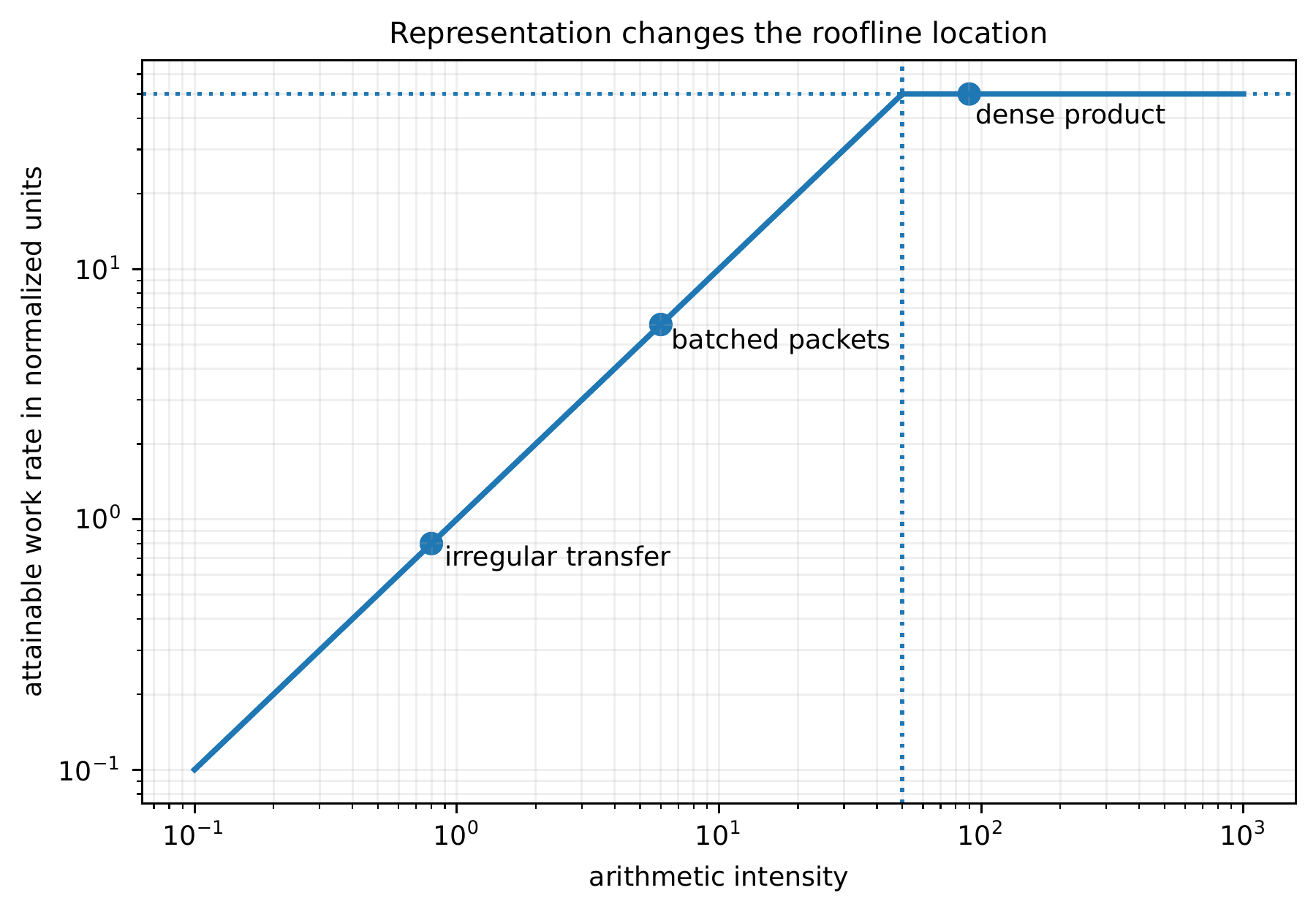
Suppose a device sustains at most \(P>0\) modeled operations per second and at most \(W>0\) bytes per second. A computation that requires \(F\) operations and \(B\) bytes satisfies
For positive elapsed time and positive byte traffic, its work rate is at most
Read proof · Visual guide: Batch shapes, account for traffic · Read statement and proof side by side · Permalink · Source line 396 · Claim record · Lean coverage · Code · Worked examples
Proof of Theorem 3.8
The operation capacity gives \(T\geq F/P\). The bandwidth capacity gives \(T\geq B/W\). Both restrictions hold at once.
Back to statement · Read statement and proof side by side · Permalink · Source line 413 · Claim record · Lean coverage · Code · Worked examples
The roofline model is a guide rather than an exact execution law [WilliamsWatermanPatterson2009]. Packet structure changes both \(F\) and \(B\). An irregular representation may remove arithmetic while lowering intensity enough to become bandwidth or launch limited.
Corollary 3.9: Capacity threshold
Let a device have available memory \(M\ge0\) bytes and scalar size \(s>0\), and let \(n\ge0\). The matrix representation alone can fit only when
The equal packet BDLR representation alone fits when
Read proof · Visual guide: Work removed is not time measured · Read statement and proof side by side · Permalink · Source line 426 · Claim record · Lean coverage · Code · Worked examples
Proof of Corollary 3.9
Substitute the dense and BDLR storage counts into the capacity inequality.
Back to statement · Read statement and proof side by side · Permalink · Source line 437 · Claim record · Lean coverage · Code · Worked examples
Proposition 3.10: Materialization cost
Materializing \(D+UV^*\) as an explicit matrix requires storage for \(n^2\) scalars and modeled arithmetic
when the low rank correction is formed by dense multiplication.
Read proof · Read statement and proof side by side · Permalink · Source line 441 · Claim record · Lean coverage · Code · Worked examples
Proof of Proposition 3.10
The product \(UV^*\) multiplies an \(n\) by \(r\) matrix by an \(r\) by \(n\) matrix. Adding the diagonal part changes only the lower order term.
Back to statement · Read statement and proof side by side · Permalink · Source line 449 · Claim record · Lean coverage · Code · Worked examples