
5 Auxiliary group algebras and augmentation
On this page · Permalink · Source line 458
Let \(\Delta\) be a finite abelian \(p\) group and let
The augmentation map is
Its kernel is the augmentation ideal \({\mathfrak a}\).
Proposition 5.1: Functorial group algebra transfer
A group homomorphism \(q:\Delta'\to\Delta\) induces an \({\mathcal O}\) algebra homomorphism
If \(q\) is surjective, then \(q_*\) is surjective. Augmentation commutes with the transfer:
Read proof · Visual guide: Augmentation in two variables · Read statement and proof side by side · Permalink · Source line 472 · Claim record · Lean coverage · Code · Worked examples
Proof of Proposition 5.1
Extend \(q\) linearly from the group basis. Multiplicativity follows from \(q(gh)=q(g)q(h)\). Surjectivity follows because every basis element of \({\mathcal O}[\Delta]\) has a preimage. Both augmentation maps send every group element to one, which gives the final identity.
Back to statement · Read statement and proof side by side · Permalink · Source line 483 · Claim record · Lean coverage · Code · Worked examples
Theorem 5.2: Residual augmentation algebra
Suppose
Choose generators \(\gamma_i\), and let \(X_i=\gamma_i-1\). Then
The augmentation ideal is generated by the \(X_i\), and \(k[\Delta]\) is local.
Read proof · Visual guide: Augmentation in two variables · Read statement and proof side by side · Permalink · Source line 487 · Claim record · Lean coverage · Code · Worked examples
Proof of Theorem 5.2
In characteristic \(p\),
Thus the assignment \(X_i\mapsto\gamma_i-1\) gives a surjective homomorphism from the displayed truncated polynomial ring to \(k[\Delta]\). Both sides have dimension \(\prod_ip^{n_i}={\left\lvert\Delta\right\rvert}\) over \(k\), so the map is an isomorphism. The quotient by the ideal generated by the \(X_i\) is \(k\). Since each \(X_i\) is nilpotent, that ideal is the unique maximal ideal.
Back to statement · Read statement and proof side by side · Permalink · Source line 506 · Claim record · Lean coverage · Code · Worked examples
Corollary 5.3: No residual character splitting
The residual group algebra \(k[\Delta]\) has no nontrivial idempotents. In particular, character projectors do not split a finite \(p\) group algebra in residue characteristic \(p\).
Read proof · Read statement and proof side by side · Permalink · Source line 514 · Claim record · Lean coverage · Code · Worked examples
Proof of Corollary 5.3
The first assertion follows from locality in Theorem 5.2. For the general finite \(p\) group assertion, let \(e\in k[G]\) be idempotent and write \(\epsilon:k[G]\to k\) for augmentation. Suppose \(\epsilon(e)=0\) and \(e\ne0\). The \({\mathbb F}_p\) span \(W\) of the left translates \(ge\) is a nonzero finite dimensional \({\mathbb F}_p\) vector space, stable under \(G\). Its cardinality is divisible by \(p\). The orbit counting formula implies that its fixed point set also has cardinality divisible by \(p\). Since zero is fixed, there is a nonzero fixed vector \(v\in W\).
A vector in the regular representation fixed by all left translations has constant coefficients. Consequently \(ve=\epsilon(e)v=0\). On the other hand, \(e^2=e\) implies \(we=w\) for every \(w\in W\), hence \(ve=v\), a contradiction. Thus every idempotent of augmentation zero is zero. Since \(\epsilon(e)^2=\epsilon(e)\) in the field \(k\), either \(\epsilon(e)=0\) or \(\epsilon(e)=1\); in the latter case apply the preceding argument to \(1-e\).
Back to statement · Read statement and proof side by side · Permalink · Source line 518 · Claim record · Lean coverage · Code · Worked examples
For \(M\otimes_{\Lambda,\epsilon}{\mathcal O}\), we use a right \(\Lambda\) module \(M\). The left module convention is \({\mathcal O}\otimes_{\Lambda,\epsilon}M\). Throughout, \({\mathfrak a} M\) denotes the augmentation relation submodule: it is generated by \(ma\) for right modules and by \(am\) for left modules, with \(a\in{\mathfrak a}\). This convention also applies to nonabelian groups in Corollary 11.2. For abelian groups, both tensor orders agree over the commutative group algebra.
Theorem 5.4: Coinvariant recovery
Let \(M\) be a free \(\Lambda\) module of rank \(d\). Then
The statement is valid for every coefficient prime, including two.
Read proof · Visual guide: Augmentation in two variables · Read statement and proof side by side · Permalink · Source line 526 · Claim record · Lean coverage · Code · Worked examples
Proof of Theorem 5.4
Choose a \(\Lambda\) basis of \(M\). Tensoring the resulting isomorphism \(M\cong\Lambda^d\) along augmentation gives \({\mathcal O}^d\). Tensoring by \(\Lambda/{\mathfrak a}\) is the same as quotienting by \({\mathfrak a} M\).
Back to statement · Read statement and proof side by side · Permalink · Source line 540 · Claim record · Lean coverage · Code · Worked examples
Standard fact 5.5: Iwasawa limit
For \(\Delta_m=({\mathbb Z}/p^m{\mathbb Z})^r\), the inverse limit of \({\mathcal O}[\Delta_m]\) is the Iwasawa algebra
where \(X_i\) corresponds to a chosen topological generator minus one [20].
Permalink · Source line 544 · Claim record · Lean coverage · Code · Worked examples
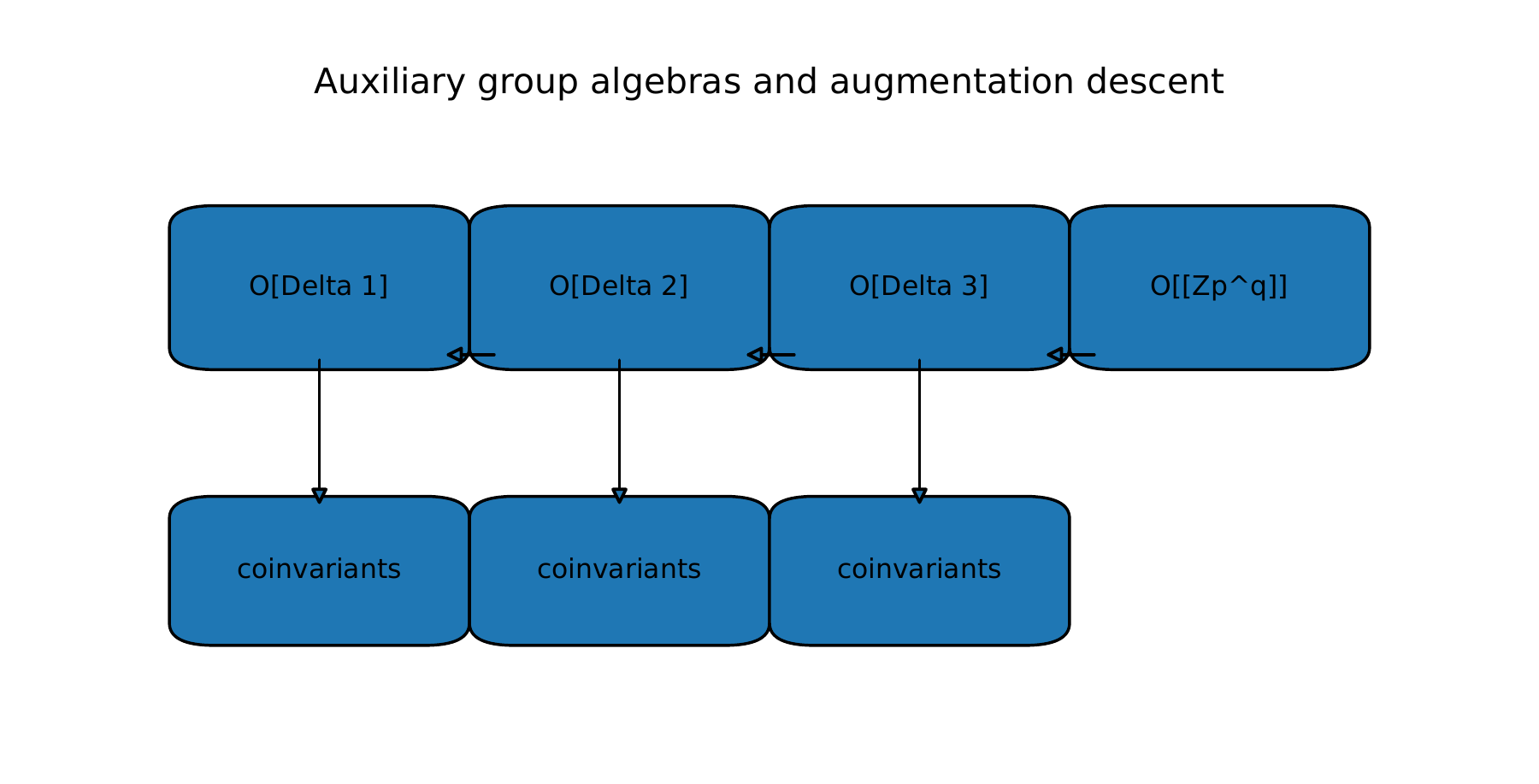
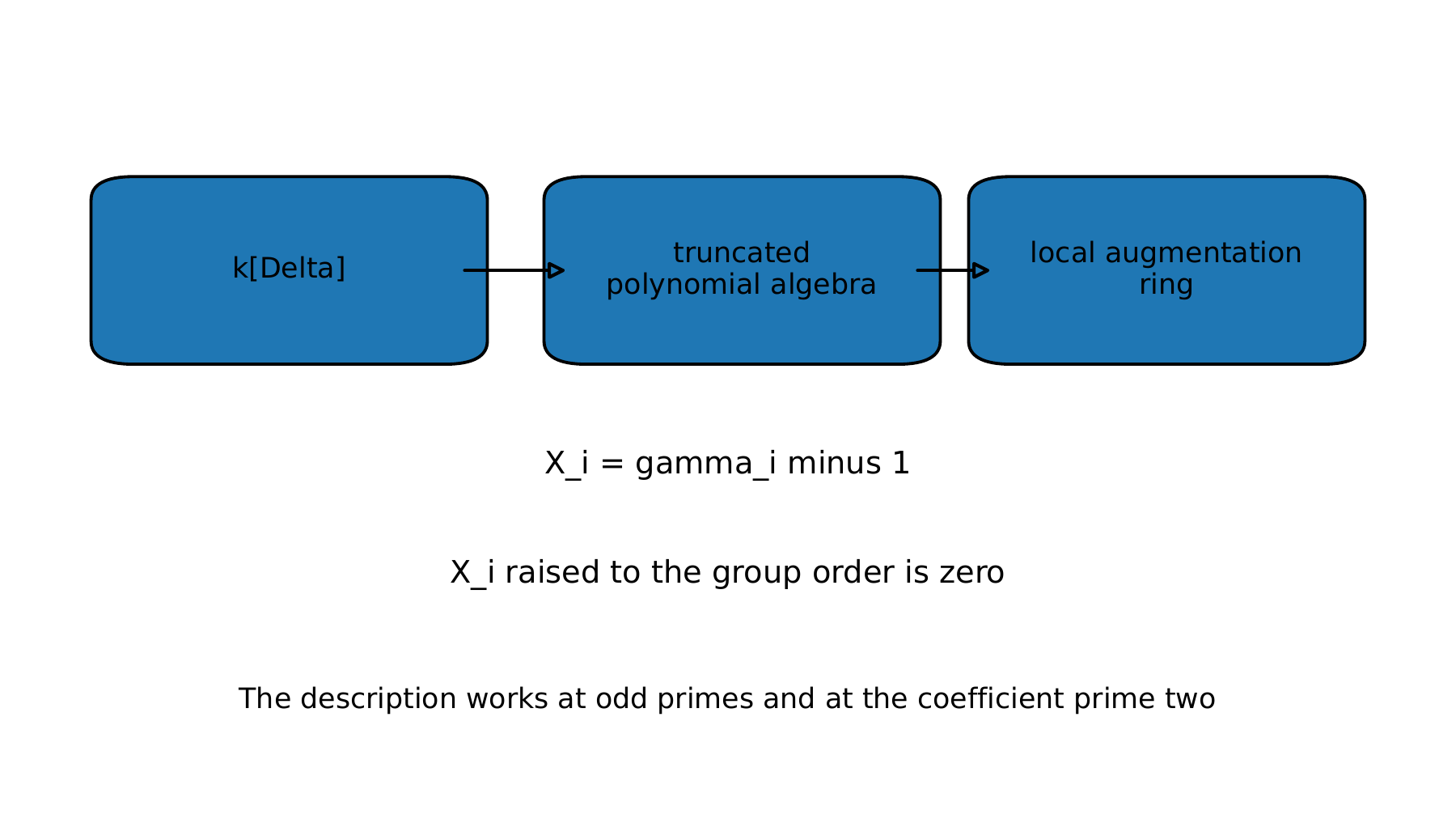
The augmentation formalism is uniform in \(p\). The difficult coefficient two questions lie elsewhere. Residual image hypotheses, local deformation geometry, and classicality may change at two even though coinvariant recovery remains exact.