
4 Adequacy and the residual input
On this page · Permalink · Source line 345
Adequacy is one of the residual image hypotheses used in several automorphy lifting theorems. The definition and its role are external to the support arguments below [13], [25], [17].
Standard fact 4.1: Adequate image
Let \(G\subseteq{\operatorname{GL}}(V)\) act absolutely irreducibly over a finite field \(k\) of characteristic \(p\). Under the standard definition, adequacy imposes vanishing conditions on \(H^1(G,k)\) and \(H^1(G,{\operatorname{ad}}^0V)\), a scalar condition, and a generalized eigenspace detection condition for every irreducible submodule of \({\operatorname{ad}}^0V\).
Permalink · Source line 349 · Claim record · Lean coverage · Code · Worked examples
The following small example makes the projector detection condition explicit. It is a certificate for one finite representation, not a new adequacy criterion.
Let \(G=S_3\), let \(k={\mathbb F}_7\), and let \(V\) be the standard two dimensional representation. In the basis
a transposition and a three cycle act by
Theorem 4.2: Finite adequacy certificate
The standard representation of \(S_3\) over \({\mathbb F}_7\) is adequate. More precisely,
and
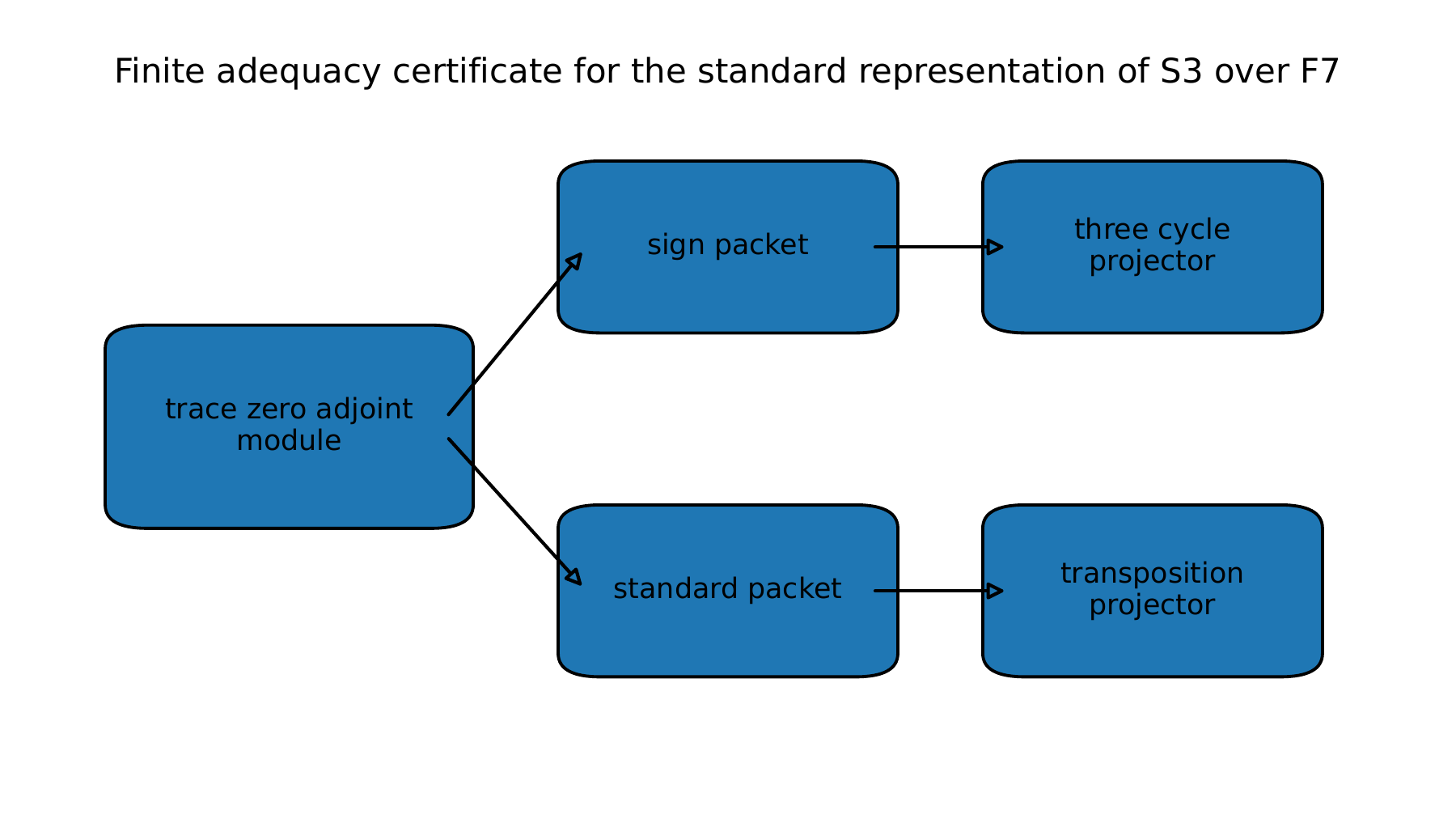
The sign summand is detected by an eigenprojector of a three cycle, and the standard summand is detected by an eigenprojector of a transposition.
Read proof · Visual guide: A finite adequacy calculation · Read statement and proof side by side · Permalink · Source line 376 · Claim record · Lean coverage · Code · Worked examples
Proof of Theorem 4.2
The coordinate map
identifies the displayed matrices with the permutation action on the sum zero subspace of \({\mathbb F}_7^3\). This action is faithful. The four matrices \(1,s,t,st\) span \(M_2\) over every field of characteristic seven: the determinant of their coordinate matrix is \(4\ne0\). A subspace stable under the group is therefore stable under every endomorphism, so the representation is absolutely irreducible. The characteristic polynomials of the identity, transpositions, and three cycles are respectively
Thus all eigenvalues already lie in \({\mathbb F}_7\).
A trace zero matrix fixed by conjugation by both \(s\) and \(t\) is zero, as follows by comparing its four entries. This proves \(H^0(S_3,{\operatorname{ad}}^0V)=0\). For any \({\mathbb F}_7[S_3]\) module \(M\) and one cocycle \(f\), put
Summing \(f(gh)=g f(h)+f(g)\) over \(h\) gives \(gu-u=f(g)\). Hence every one cocycle is a coboundary and \(H^1(S_3,M)=0\), giving both asserted first cohomology vanishings.
Write
The three coordinate columns have determinant \(3\ne0\). Under conjugation,
Consequently \((z,(a,b))\mapsto zZ+aA+bB\) is an equivariant isomorphism from \(\operatorname{sgn}\oplus V\) to \({\operatorname{ad}}^0V\).
The sign witness is \(W_{\mathrm{sgn}}=Z\), while \(W_{\mathrm{std}}=W(6,4,3)=3A+3B\) belongs to the standard summand. The corresponding projectors and trace pairings are
For an operator \(D\) with \((D-\alpha I)(D-\beta I)=0\) and \(\alpha\ne\beta\), the canonical projector is
Its image equals \(\ker((D-\alpha I)^n)\) for every \(n\ge1\), and it kills \(\ker((D-\beta I)^n)\). This identifies the displayed matrices with the generalized eigenspace projectors required in the adequacy definition.
For detection on every irreducible submodule, one can check the stronger assertion that canonical projectors detect every nonzero matrix. In addition to the two projectors above, use
The four trace pairings with these matrices have trivial common kernel in \(M_2({\mathbb F}_7)\), by row reduction. Every irreducible adjoint submodule contains a nonzero matrix, so some canonical projector has nonzero trace pairing on that submodule. This verifies the last adequacy clause and completes the certificate.
Back to statement · Read statement and proof side by side · Permalink · Source line 392 · Claim record · Lean coverage · Code · Worked examples
Remark 4.3
The theorem verifies adequacy for one finite image. A global automorphy lifting argument must verify the published residual image hypothesis for its actual representation. The calculation does not replace that step, and it does not provide a uniform coefficient prime two theorem.