
5 Exact low rank algebra and recompression
On this page · Permalink · Source line 656
5.1 Products and inverses
On this page · Permalink · Source line 665
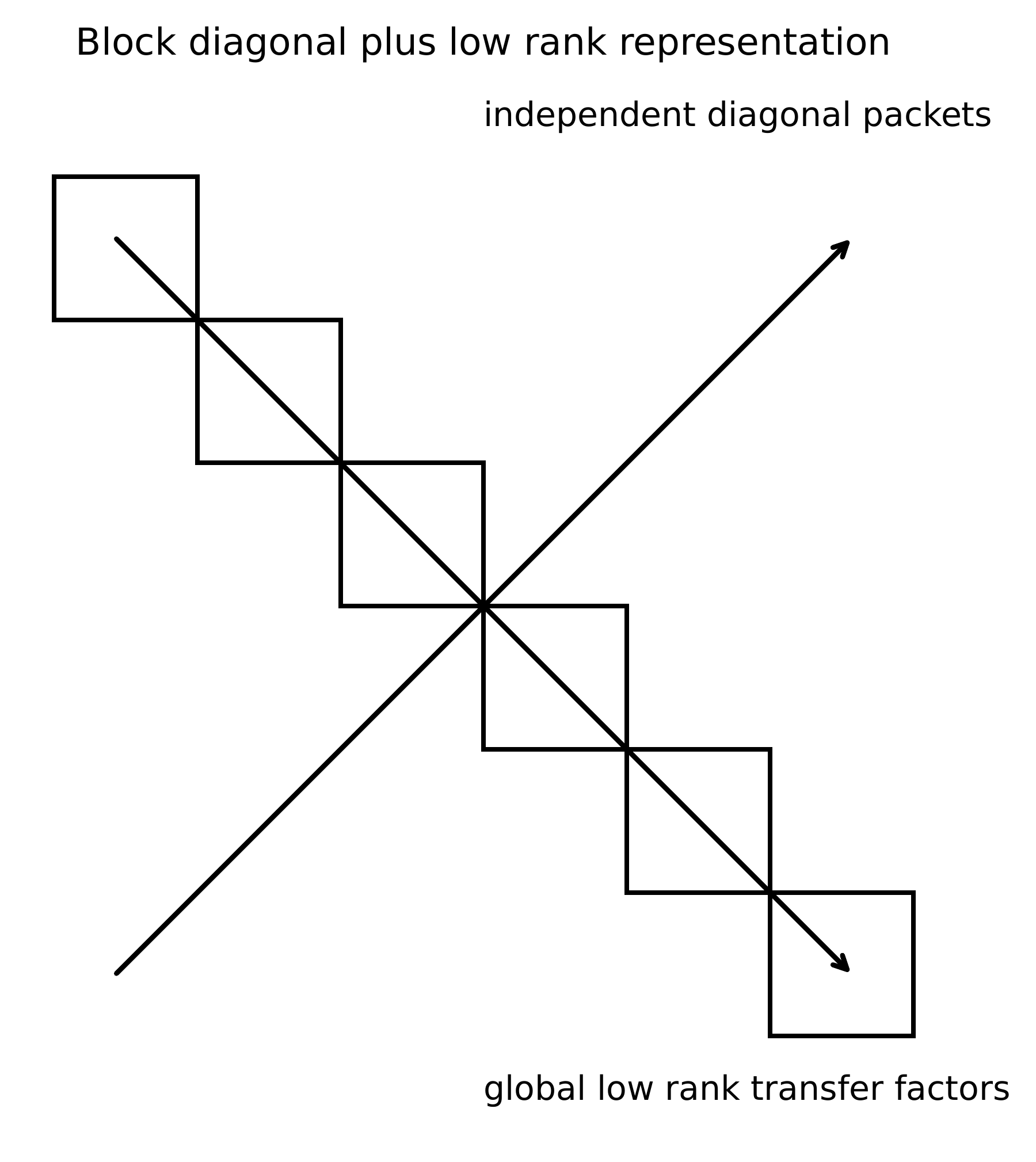
Theorem 5.1: Exact BDLR product
Let
use the same diagonal packet layout. Then
where
and
The unrecompressed correction rank is at most \(r_A+r_B\).
Read proof · Visual guide: The cross term has somewhere to go · Visual guide: Close the loop on the running example · Read statement and proof side by side · Permalink · Source line 667 · Claim record · Lean coverage · Code · Worked examples
Proof of Theorem 5.1
Expand the product:
The second and fourth terms share the right factor \(V_B^*\). The third term equals
Concatenation gives the stated factors.
Back to statement · Read statement and proof side by side · Permalink · Source line 697 · Claim record · Lean coverage · Code · Worked examples
Corollary 5.2: Rank growth in a product chain
Let
share one diagonal packet layout. Before recompression, the product
has a BDLR representation whose correction rank is at most
Read proof · Visual guide: The cross term has somewhere to go · Read statement and proof side by side · Permalink · Source line 714 · Claim record · Lean coverage · Code · Worked examples
Proof of Corollary 5.2
Apply Theorem 5.1 inductively. Each new factor adds at most its own correction rank.
Back to statement · Read statement and proof side by side · Permalink · Source line 733 · Claim record · Lean coverage · Code · Worked examples
Theorem 5.3: Woodbury inversion
Assume \(D\) and
are invertible. Then
Read proof · Visual guide: A large inverse, a small denominator · Read statement and proof side by side · Permalink · Source line 737 · Claim record · Lean coverage · Code · Worked examples
Proof of Theorem 5.3
Multiply the proposed inverse by \(D+UV^*\). The coefficient of \(V^*D^{-1}\) is
The remaining term is the identity. The right inverse calculation is the same.
Back to statement · Read statement and proof side by side · Permalink · Source line 753 · Claim record · Lean coverage · Code · Worked examples
The formula and its history are discussed in [Hager1989]. It reduces one large solve to packet solves with \(D\) and one dense solve with the small matrix \(S\).
Corollary 5.4: Inverse norm bound
Under the hypotheses of Theorem 5.3,
Read proof · Visual guide: A large inverse, a small denominator · Read statement and proof side by side · Permalink · Source line 763 · Claim record · Lean coverage · Code · Worked examples
Proof of Corollary 5.4
Apply the triangle inequality and submultiplicativity to the Woodbury formula.
Back to statement · Read statement and proof side by side · Permalink · Source line 776 · Claim record · Lean coverage · Code · Worked examples
5.2 Optimal factor recompression
On this page · Permalink · Source line 780
Standard fact 5.5: Eckart Young Mirsky theorem
If \(M\) has singular values
pad this finite sequence with zeros. For each integer \(k\ge0\), its truncated singular value decomposition \(M_k\) is a best rank-at-most-\(k\) approximation. It satisfies
and
Permalink · Source line 782 · Claim record · Lean coverage · Code · Worked examples
This is classical [EckartYoung1936], [Mirsky1960]. The next theorem shows that an \(n\) dimensional singular value decomposition is unnecessary when a correction is already factored.
Theorem 5.6: Small core recompression
Let
Take compact QR factorizations
where the columns of \(Q_L\) and \(Q_R\) are orthonormal. Form the small core
and let
be an ordered thin singular value decomposition, with nonnegative nonincreasing singular values. For an integer \(k\ge0\), retain \(\min\{k,d\}\) columns, where \(d\) is the number of supplied thin singular directions; tail singular values beyond \(d\) are zero. Define
Then
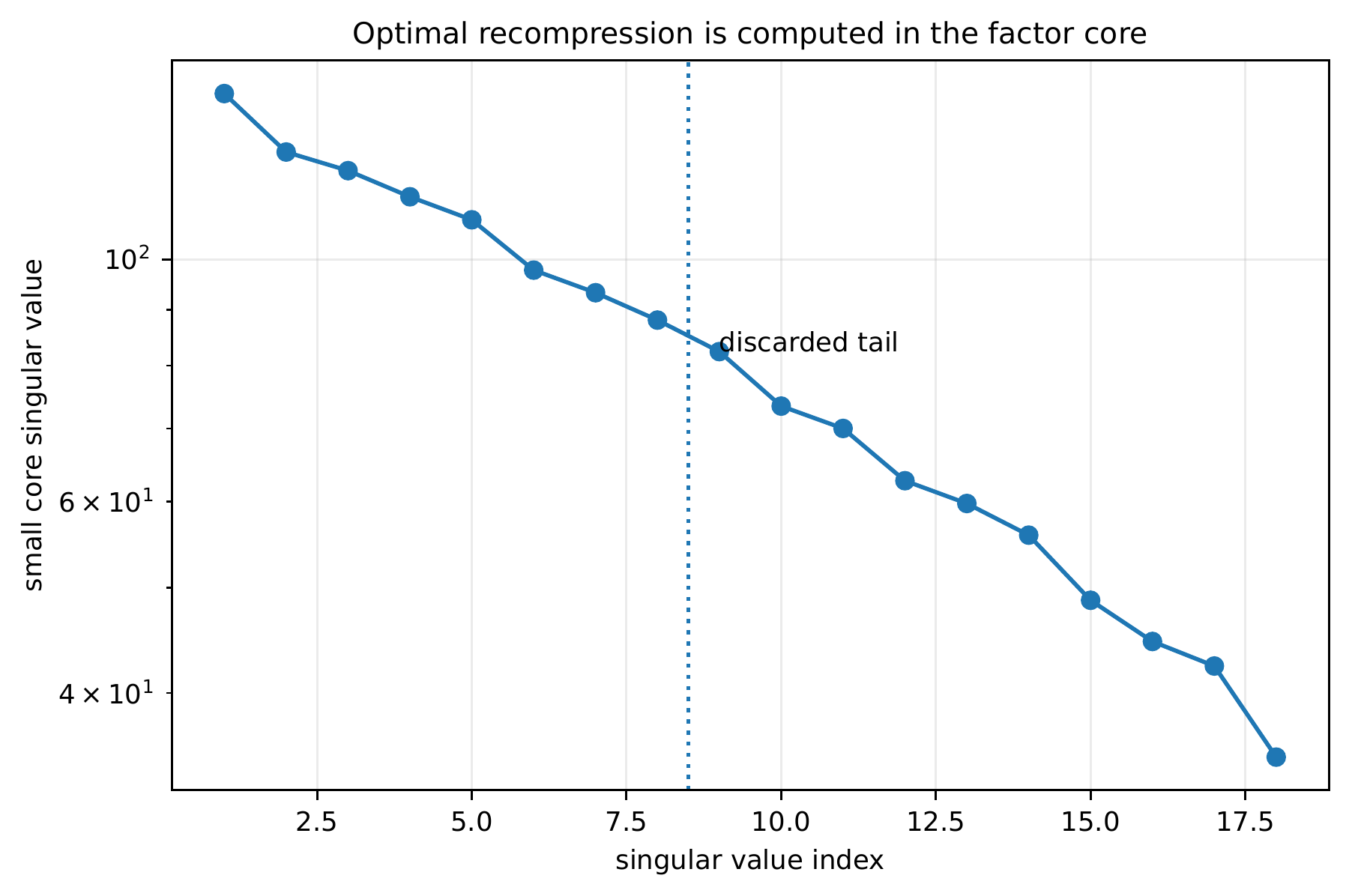
is a best rank at most \(k\) approximation to \(LR^*\). Its spectral and Frobenius errors are the singular value tails in Standard fact 5.5. The core dimensions equal the column ranks of the two input factors. A noncompact reduced QR may retain extra zero singular directions without changing the conclusion.
Read proof · Visual guide: Stored width is not intrinsic rank · Visual guide: Why a core optimum is global · Visual guide: A complex range needs an adjoint · Read statement and proof side by side · Permalink · Source line 803 · Claim record · Lean coverage · Code · Worked examples
Proof of Theorem 5.6
The exact factor product is
The two outer maps are isometries on their column spaces. They preserve the nonzero singular values and the spectral and Frobenius norms of the core. For every ambient rank-at-most-\(k\) competitor \(B\), its compression \(Q_L^*BQ_R\) has rank at most \(k\), and compression cannot increase either norm. Thus the core best-approximation inequality also lower-bounds the error of every ambient competitor. Truncating the singular value decomposition of \(G\) and applying Standard fact 5.5 gives the result. The compact QR dimensions equal the ranks of the factor column spaces.
Back to statement · Read statement and proof side by side · Permalink · Source line 837 · Claim record · Lean coverage · Code · Worked examples
Remark 5.7
The large matrices enter through QR factorizations of the factors. The singular value problem has dimension at most the unrecompressed rank. Updating and recompressing low rank factors is standard numerical linear algebra [GolubKahan1965], [BunchNielsen1978].
Theorem 5.8: Product chain perturbation
Let \(A_1,\ldots,A_m\) be exact factors and let
Then
Empty products are one.
Read proof · Visual guide: Errors enter at different places · Read statement and proof side by side · Permalink · Source line 858 · Claim record · Lean coverage · Code · Worked examples
Proof of Theorem 5.8
Use the telescoping identity
Take norms term by term.
Back to statement · Read statement and proof side by side · Permalink · Source line 885 · Claim record · Lean coverage · Code · Worked examples
Theorem 5.9: Certified repeated recompression
Let
be exact partial products. Suppose an implemented chain satisfies
where \(E_j\) is the additive error introduced after the \(j\)th multiplication, for example by factor recompression. Then
If \({\left\lVert E_j\right\rVert}\leq\delta_j\), the same formula with \(\delta_j\) gives a certified final error.
Read proof · Visual guide: Errors enter at different places · Read statement and proof side by side · Permalink · Source line 899 · Claim record · Lean coverage · Code · Worked examples
Proof of Theorem 5.9
Set \(D_j=\widehat P_j-P_j\). Then
Repeated substitution gives
Taking norms yields the result.
Back to statement · Read statement and proof side by side · Permalink · Source line 929 · Claim record · Lean coverage · Code · Worked examples