
7 Krylov methods and packet preconditioning
On this page · Permalink · Source line 1092
Definition 7.1: Krylov space
For a linear operator \(A\), a vector \(v\), and a positive integer \(m\), define
Permalink · Source line 1094 · Claim record · Lean coverage · Code · Worked examples
Proposition 7.2: Invariant packet Krylov decomposition
Assume
for every packet. If
then
for every \(j\geq0\), where
Hence
Read proof · Visual guide: Invariant does not mean independently addressable · Read statement and proof side by side · Permalink · Source line 1104 · Claim record · Lean coverage · Code · Worked examples
Proof of Proposition 7.2
Commutation gives
Apply this identity to each packet component of \(v\).
Back to statement · Read statement and proof side by side · Permalink · Source line 1134 · Claim record · Lean coverage · Code · Worked examples
Theorem 7.3: Approximate packet Krylov bound
Write
where \(D\) is packet diagonal. For every positive integer \(j\),
where
Consequently,
Read proof · Visual guide: Invariant does not mean independently addressable · Read statement and proof side by side · Permalink · Source line 1142 · Claim record · Lean coverage · Code · Worked examples
Proof of Theorem 7.3
Use the telescoping identity
Each term has norm at most \(M^{j-1}{\left\lVert K\right\rVert}\). The vector \(D^jv\) lies in the direct sum of local Krylov spaces.
Back to statement · Read statement and proof side by side · Permalink · Source line 1167 · Claim record · Lean coverage · Code · Worked examples
Theorem 7.4: Block Jacobi condition bound
Let
act on a nonempty finite coordinate space and be Hermitian positive definite with positive definite block diagonal part \(D\). Here \(D^{-1/2}\) is the actual inverse of the positive square root of \(D\). Suppose
is Hermitian and
Then
Read proof · Visual guide: Measure coupling after normalization · Read statement and proof side by side · Permalink · Source line 1178 · Claim record · Lean coverage · Code · Worked examples
Proof of Theorem 7.4
For every unit vector \(x\),
The Rayleigh quotient of \(I+E\) lies in \([1-\eta,1+\eta]\). The quotient of the extreme eigenvalue bounds gives the result.
Back to statement · Read statement and proof side by side · Permalink · Source line 1201 · Claim record · Lean coverage · Code · Worked examples
Standard fact 7.5: Preconditioned conjugate gradient convergence
Let \(A\) and \(M\) be Hermitian positive definite on a nonempty finite coordinate space, and set
In exact arithmetic, the energy norm error of preconditioned conjugate gradient satisfies
Visual guide: Measure coupling after normalization · Permalink · Source line 1209 · Claim record · Lean coverage · Code · Worked examples
This standard estimate is discussed in [Saad2003]. Combining it with Theorem 7.4 yields an explicit iteration certificate when the normalized cross packet coupling is small.
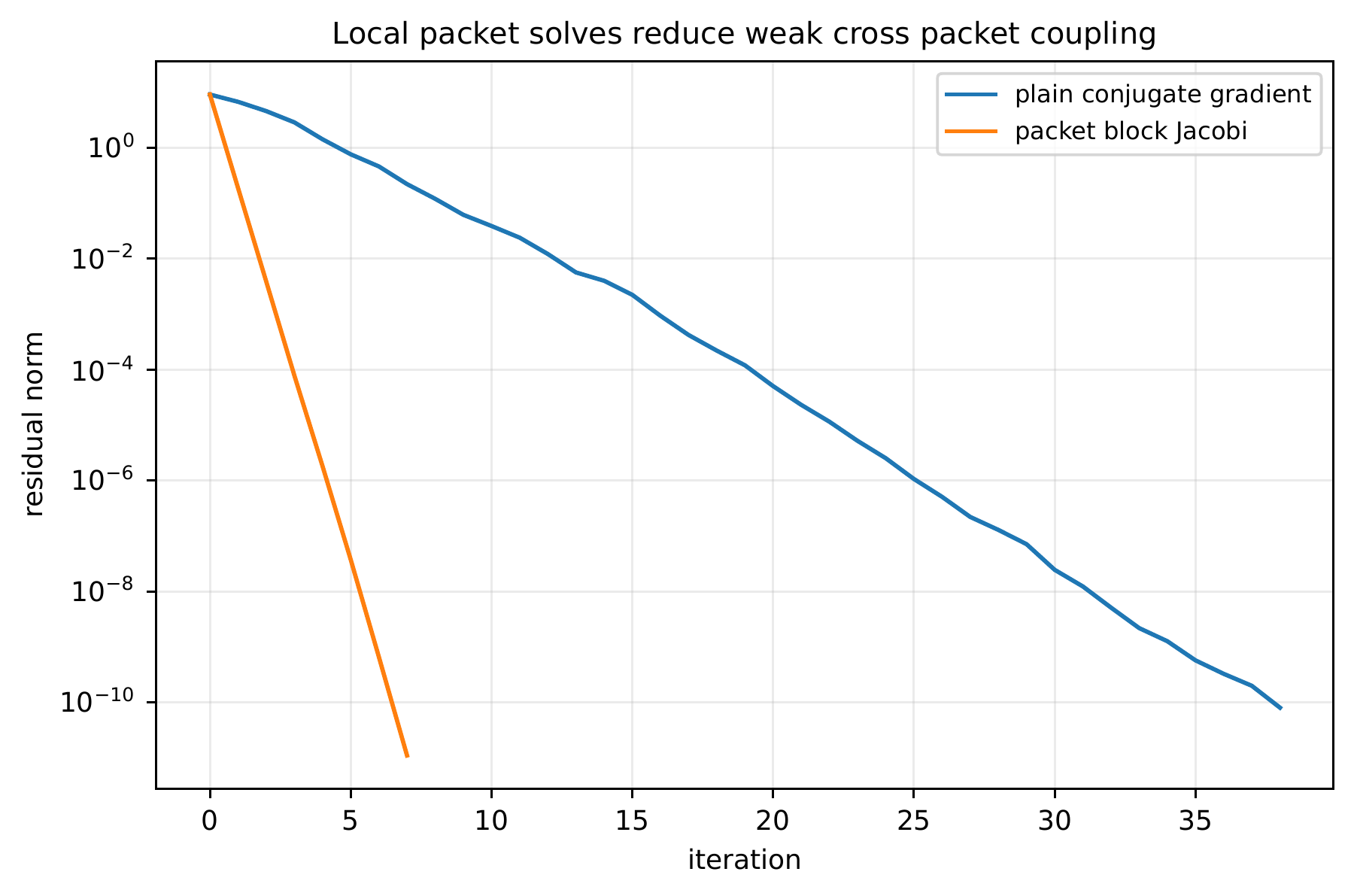
Corollary 7.6: Certified packet preconditioning
Under the hypotheses of Theorem 7.4, the convergence factor in Standard fact 7.5 is bounded by the value obtained from
Read proof · Visual guide: Measure coupling after normalization · Read statement and proof side by side · Permalink · Source line 1237 · Claim record · Lean coverage · Code · Worked examples
Proof of Corollary 7.6
Insert the condition bound from Theorem 7.4 into the monotone convergence factor in Standard fact 7.5.
Back to statement · Read statement and proof side by side · Permalink · Source line 1246 · Claim record · Lean coverage · Code · Worked examples