
A bilinear node distributes over two independently resolved inputs:
The four terms correspond to all ordered choices of one input packet from each slot. Keeping only matching packet labels loses the mixed terms.
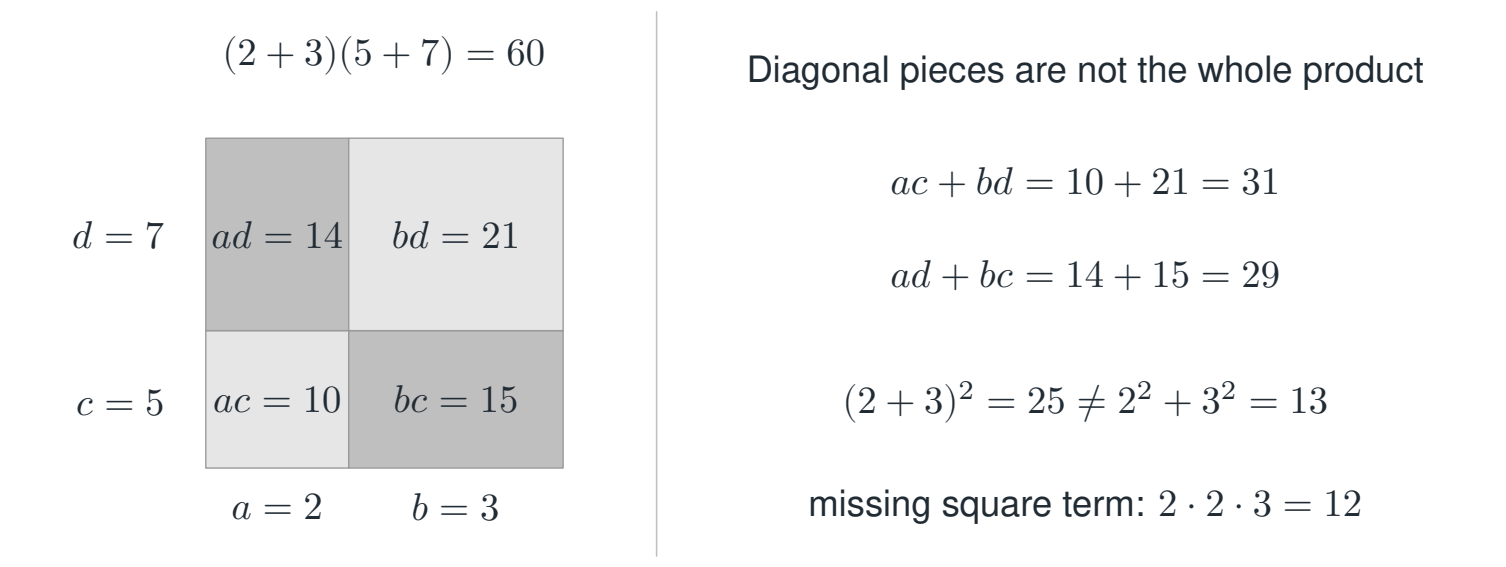
Reading the drawing
The rectangle splits into four products with separately scaled horizontal and vertical units. The diagonal pair alone omits two mixed contributions.
Drawing labels and data 14 labels
Read the original labels as selectable text. Tables preserve grid relationships; other short labels are grouped compactly.
- \(ac=10\)
- \(ad=14\)
- \(bc=15\)
- \(bd=21\)
- \((2+3)(5+7)=60\)
- \(a=2\)
- \(b=3\)
- \(c=5\)
- \(d=7\)
- Diagonal pieces are not the whole product
- \(ac+bd=10+21=31\)
- \(ad+bc=14+15=29\)
- \((2+3)^2=25\ne2^2+3^2=13\)
- missing square term: \(2\cdot2\cdot3=12\)
Evidence note from the source edition
The rectangle has width \(2+3\) and height \(5+7\), with differently scaled horizontal and vertical display units. Each cell is labeled by its actual product. The lighter diagonal pair contributes only \(31\) of the total \(60\).
For a unary square, inserting \(a+b\) does not give \(a^2+b^2\). The extra \(2ab\) arises because the operation is nonlinear in its single argument. It can be analyzed by representing the square using a binary multiplication node with a repeated input, but that is an additional choice of syntax and semantics.
The broader tree theorem needs its hypotheses
General packet tree expansion needs correctly typed input slots, finite sets of packet labels at each node, and multilinearity in every slot used for distributive expansion. Empty inputs and unary nodes need explicit conventions. Slot order must survive even when values or operations do not commute. The traditional paper supplies rooted tree reconstruction and pruning results in its ordinary mathematical development.
This page supplies elementary exact examples of the issue. The finite v1.0.1 Lean contract remains narrower: it contains syntactic input locality, not the general dependent tree expansion or the traditional paper's analytic convergence results.
Read this as
A branching picture does not justify throwing away mixed interactions. Exact packet expansion requires the appropriate multilinearity and typing, not merely a diagram that appears finite.