
Let the candidates be rational numbers and the packet labels be \(0,1\). Define
A candidate is a solution when both residuals vanish. The five candidate columns below are a display of this explicit residual function, not a search over an unspecified class.
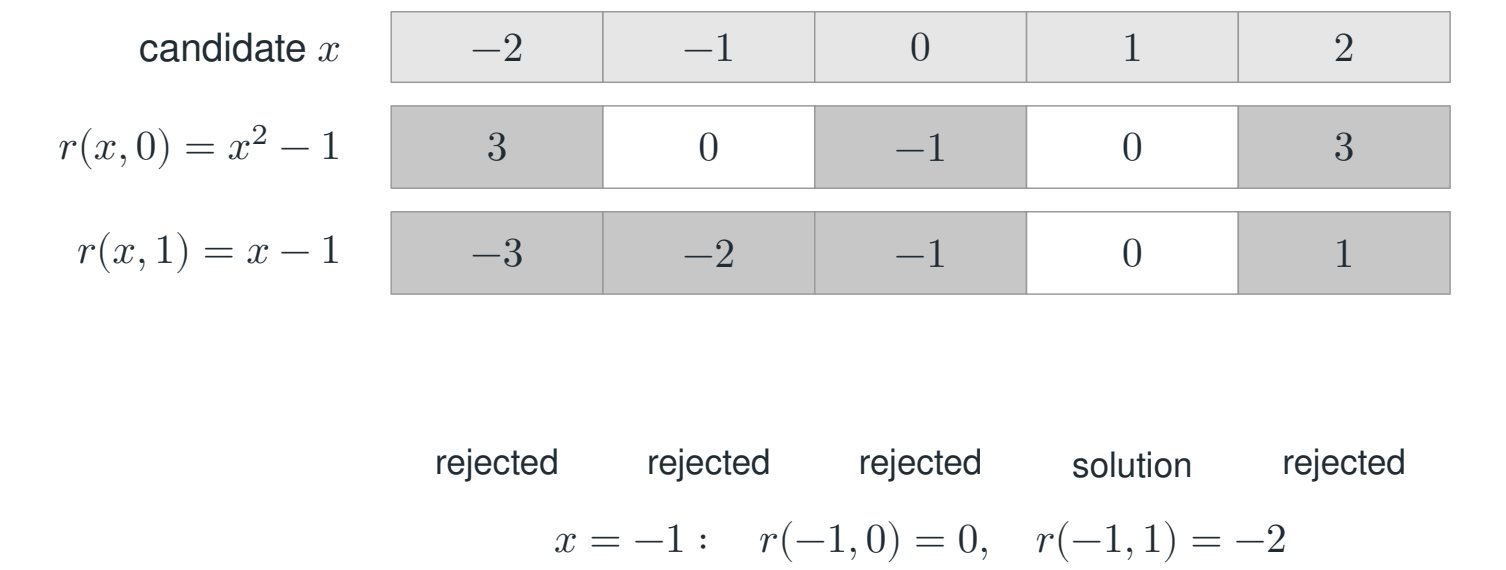
Reading the drawing
A shaded cell is a nonzero residual of the named candidate. A candidate passing one equation can fail another; rejection of that candidate does not reject the successful one.
Drawing labels and data 24 labels
Read the original labels as selectable text. Tables preserve grid relationships; other short labels are grouped compactly.
- \(-2\)
| Row / column | Column 1 | Column 2 | Column 3 | Column 4 | Column 5 |
|---|---|---|---|---|---|
| \(r(x,0)=x^2-1\) | \(3\) | \(0\) | \(-1\) | \(0\) | \(3\) |
| \(r(x,1)=x-1\) | \(-3\) | \(-2\) | \(-1\) | \(0\) | \(1\) |
- rejected
- \(-1\)
- rejected
- \(0\)
- rejected
- \(1\)
- solution
- \(2\)
- rejected
- candidate \(x\)
- \(x=-1:\quad r(-1,0)=0,\quad r(-1,1)=-2\)
Evidence note from the source edition
A shaded cell is a nonzero exact residual. At \(x=-1\), the first equation passes but the second supplies an obstruction. At \(x=1\), both pass. The rejected candidate does not obstruct the successful one.
The statement proved by the generic certificate has the form
The same candidate \(x\) appears on both sides. A certificate consists of the packet label and its nonvanishing proof. The general converse uses classical reasoning and does not itself provide an algorithm to find the label.
What would be required to rule out all solutions?
One would need the stronger assertion \(\forall x\,\exists p,\ r(x,p)\ne0\). The value \(x=1\) disproves that assertion in this example. A witness for \(x=-1\) supplies no evidence for it. Likewise, finding an obstruction block for one triangle of one chosen connection does not classify every possible connection.
The term obstruction in this generic interface does not automatically mean a cokernel class, a cohomology group, a norm bound, or a minimal certificate. Those require additional constructions and theorems.
Read this as
Keep the candidate attached to the witness. The theorem's strength is its exact logical scope, not a universal existence or nonexistence claim.