
Use the grammar's constant, input, unary, and binary constructors to build
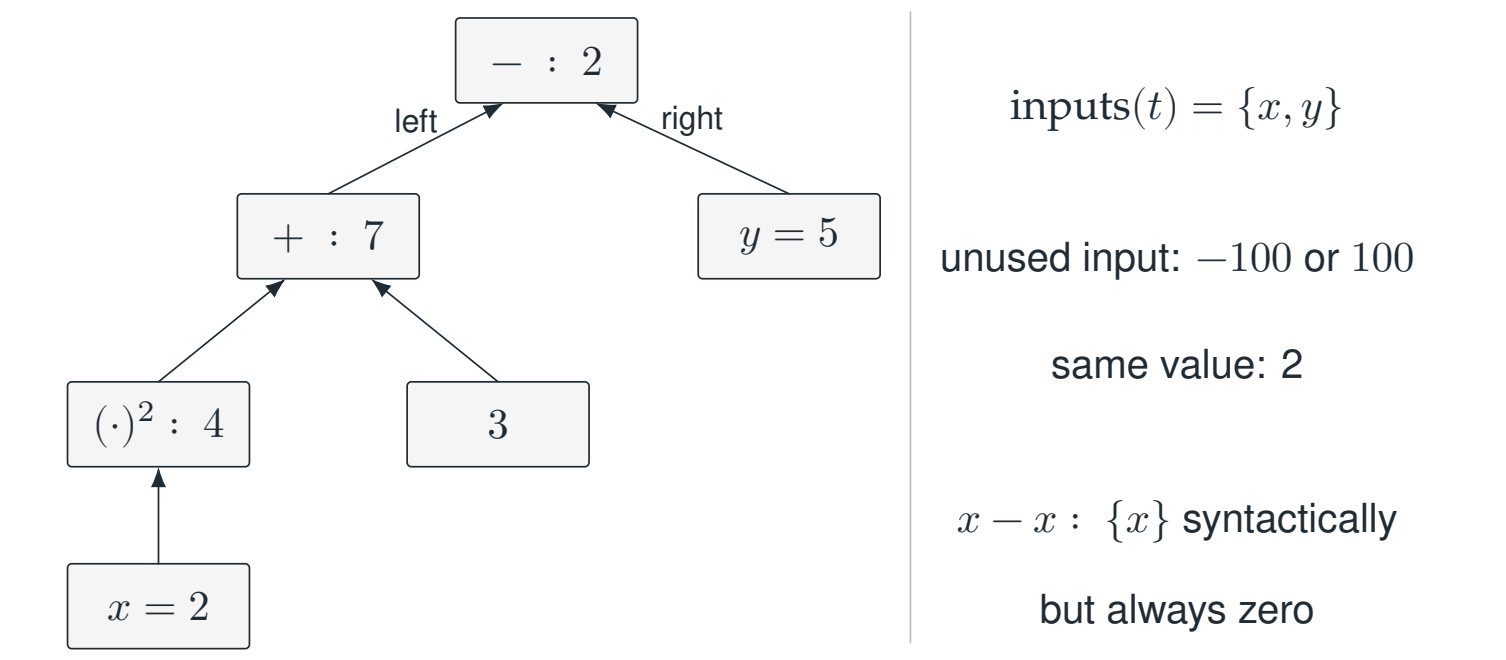
Here “square,” “add,” and “subtract” are explicitly supplied meanings of operation symbols. At \(x=2,y=5\), every node value can be evaluated exactly.
Reading the drawing
Ordered input slots feed the parent operation. Arrows indicate evaluation rather than chart transport; additional environment variables are unused by this tree.
Drawing labels and data 13 labels
Read the original labels as selectable text. Tables preserve grid relationships; other short labels are grouped compactly.
- \(-\ :\ 2\)
- \(+\ :\ 7\)
- \(y=5\)
- \((\cdot)^2:\ 4\)
- \(3\)
- \(x=2\)
- left
- right
- \(\operatorname{inputs}(t)=\{x,y\}\)
- unused input: \(-100\) or \(100\)
- same value: 2
- \(x-x:\ \{x\}\text{ syntactically}\)
- but always zero
Evidence note from the source edition
The rooted tree records the order of input slots. Arrows indicate evaluation from children to parent, not chart transport. An environment may contain additional variables, but this tree does not read them.
The input set is \(\operatorname{inputs}(t)=\{x,y\}\). If two environments agree at \(x\) and \(y\), structural induction proves that the two evaluations agree: input leaves agree, constants agree, and every parent applies the same supplied operation to equal child values.
Syntactic locality is not minimal dependence
The tree \(x-x\) has input set \(\{x\}\), although its value is always zero under ordinary subtraction. Locality provides a sufficient agreement condition. It does not compute the smallest set of semantically relevant variables. Nor does it prove that two different trees are equivalent.
The semantics may act on arbitrary values. For example, a binary concatenation symbol applied to strings “ab” and “cd” gives “abcd.” No linearity or differentiability is required. Conversely, swapping the ordered inputs of the subtraction root above changes the value from \(2\) to \(-2\).
Read this as
The proved tree theorem controls which input labels are read. It does not supply a nonlinear chain rule, a stability estimate, or a solution of a tree equation.