
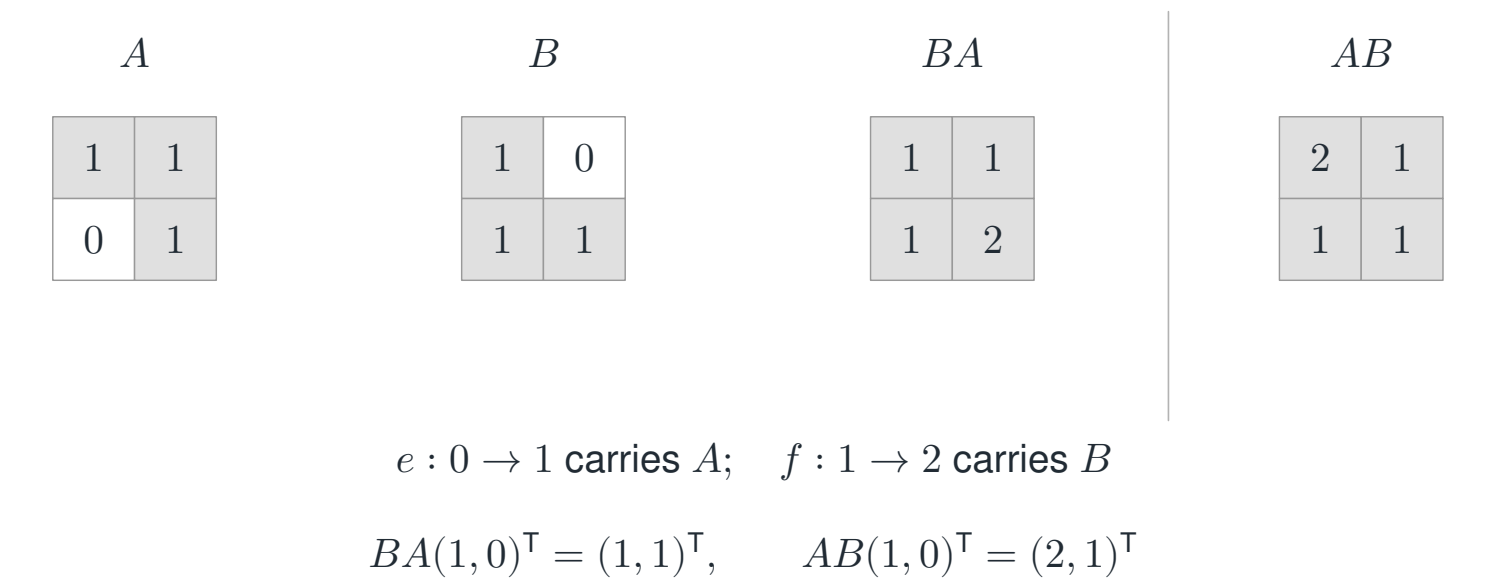
The edge theorem allows a noncommutative coefficient semiring. Use \(R=M_2({\mathbb Q})\) and let the two coefficients themselves be matrices:
Attach \(A\) to \(0\to1\) and \(B\) to \(1\to2\). The single surviving endpoint coefficient is \(BA\), not \(AB\).
Reading the drawing
The matrices and their products have exact integer entries. The products differ on the diagonal and send the same input vector to different outputs.
Drawing labels and data 22 labels
Read the original labels as selectable text. Tables preserve grid relationships; other short labels are grouped compactly.
- \(A\)
| Row / column | Column 1 | Column 2 |
|---|---|---|
| Row 1 | \(1\) | \(1\) |
| Row 2 | \(0\) | \(1\) |
- \(B\)
| Row / column | Column 1 | Column 2 |
|---|---|---|
| Row 1 | \(1\) | \(0\) |
| Row 2 | \(1\) | \(1\) |
- \(BA\)
| Row / column | Column 1 | Column 2 |
|---|---|---|
| Row 1 | \(1\) | \(1\) |
| Row 2 | \(1\) | \(2\) |
- \(AB\)
| Row / column | Column 1 | Column 2 |
|---|---|---|
| Row 1 | \(2\) | \(1\) |
| Row 2 | \(1\) | \(1\) |
Evidence note from the source edition
All entries are exact integers. The two products differ on the diagonal and act differently on the same input vector. This example is within the scalar model with semiring coefficients by taking the scalar ring to be \(M_2({\mathbb Q})\).
The distinction is visible before any abstraction:
For a written walk \((e_1,\ldots,e_n)\), its coefficient must therefore be
A commutative example can hide an orientation mistake because reversing the coefficients changes nothing. This one cannot.
One ring is not a dependent family of fibers
The \(3\times3\) matrix over \(M_2({\mathbb Q})\) can be displayed as an ordinary \(6\times6\) matrix with \(2\times2\) blocks. This is a concrete representation of the example over one ring. It does not establish an arbitrary family of differently typed edge fibers, which is outside the finite formal release's scalar interface for edge systems.
Read this as
The order rule carries mathematical information. It survives exact tests over a noncommutative ring and must not be inferred from pictures drawn over scalar real numbers alone.