
Return to \({\operatorname{Ob}}=E_{01}\). With the two standard coordinate projectors, both diagonal blocks vanish:
The obstruction nevertheless survives in the block outside the diagonal \(P_0{\operatorname{Ob}} P_1=E_{01}\).
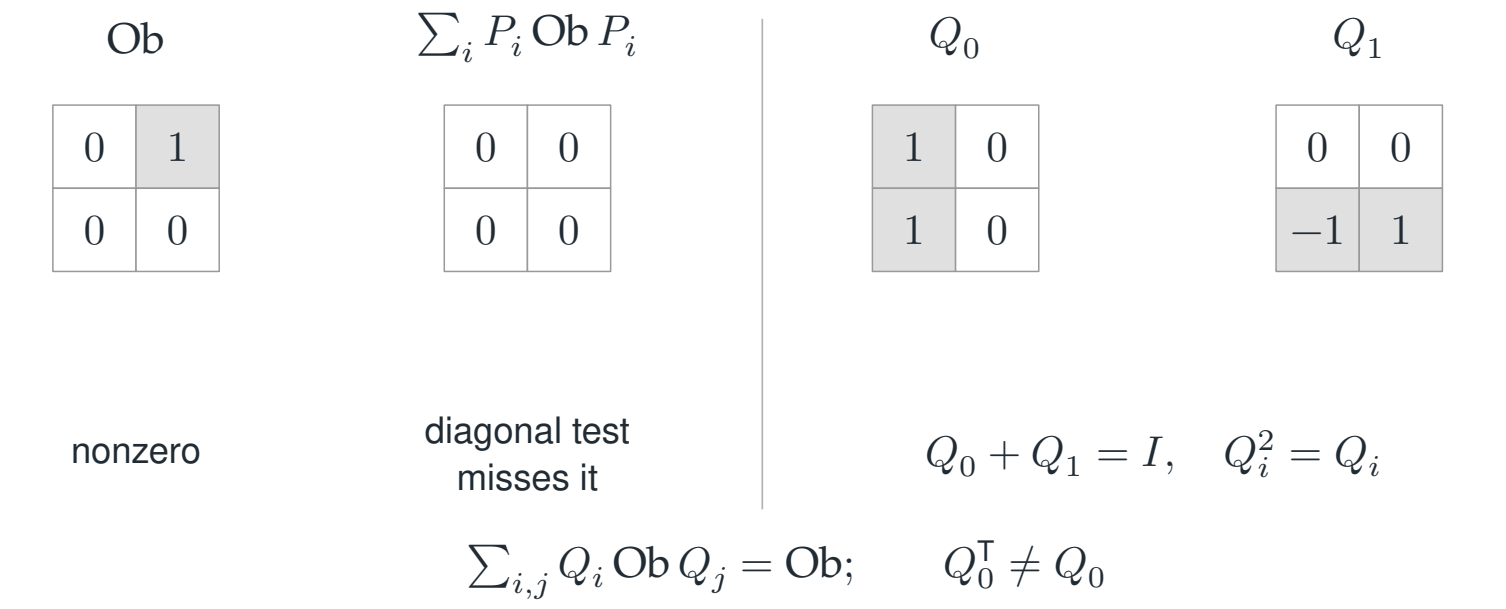
Reading the drawing
The first panel misses an off-diagonal obstruction when it checks only diagonal blocks. The other panel retains a complete resolution by projectors that need not be orthogonal.
Drawing labels and data 24 labels
Read the original labels as selectable text. Tables preserve grid relationships; other short labels are grouped compactly.
- \({\operatorname{Ob}}\)
| Row / column | Column 1 | Column 2 |
|---|---|---|
| Row 1 | \(0\) | \(1\) |
| Row 2 | \(0\) | \(0\) |
- \(\sum_iP_i{\operatorname{Ob}} P_i\)
| Row / column | Column 1 | Column 2 |
|---|---|---|
| Row 1 | \(0\) | \(0\) |
| Row 2 | \(0\) | \(0\) |
- nonzero
diagonal test
misses it
- \(Q_0\)
| Row / column | Column 1 | Column 2 |
|---|---|---|
| Row 1 | \(1\) | \(0\) |
| Row 2 | \(1\) | \(0\) |
- \(Q_1\)
| Row / column | Column 1 | Column 2 |
|---|---|---|
| Row 1 | \(0\) | \(0\) |
| Row 2 | \(-1\) | \(1\) |
- \(Q_0+Q_1=I,\quad Q_i^2=Q_i\)
Evidence note from the source edition
The test of diagonal blocks alone on the left misses the whole obstruction. On the right, the displayed oblique projectors still form a complete exact resolution. They need not be orthogonal projections for the Euclidean inner product.
There is a second failure mode. Supplying only \(P_0\) gives a family of idempotents but not a complete one. The single tested block is zero, while the omitted packet carries the missing input. The implication “all tested blocks vanish, therefore the operator vanishes” requires the completeness hypothesis.
Exact reconstruction does not require right angles
For the displayed \(Q_0,Q_1\),
but \(Q_0^\mathsf T\ne Q_0\). Expanding both copies of \(I\) still proves
The block reconstruction identity itself uses the condition that the projectors sum to the identity. Idempotence is additionally used when constructing a witness that remains supported in one packet after projection. The release does not require pairwise annihilation for its general reconstruction statement.
Read this as
Test every block from input to output of a complete resolution. Testing only the diagonal, or only the packets supplied so far, answers a weaker question.