
Work over \({\mathbb Z}\) with packets \(0,1,2\). Let \(e:0\to1\) have coefficient \(2\), and let \(f:1\to2\) have coefficient \(3\). The elementary operators are
The location of the nonzero entry records the type of the transfer, not an arbitrary matrix convention.
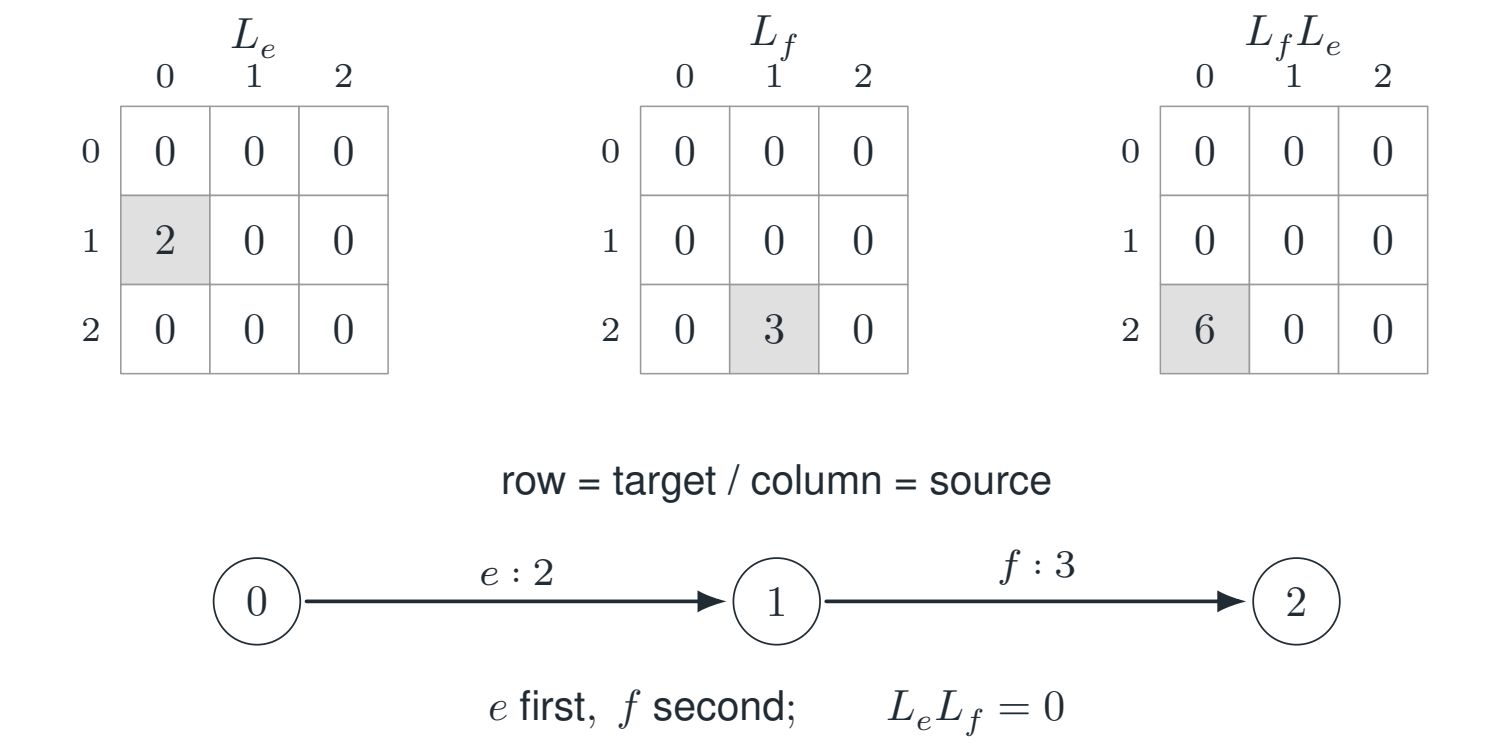
Reading the drawing
Three matrices compare the elementary transfers and their composition. Rows are outputs, columns are inputs, and the rightmost written factor acts first.
Drawing labels and data 55 labels
Read the original labels as selectable text. Tables preserve grid relationships; other short labels are grouped compactly.
- \(L_e\)
| Row / column | \(0\) | \(1\) | \(2\) |
|---|---|---|---|
| \(0\) | \(0\) | \(0\) | \(0\) |
| \(1\) | \(2\) | \(0\) | \(0\) |
| \(2\) | \(0\) | \(0\) | \(0\) |
- \(L_f\)
| Row / column | \(0\) | \(1\) | \(2\) |
|---|---|---|---|
| \(0\) | \(0\) | \(0\) | \(0\) |
| \(1\) | \(0\) | \(0\) | \(0\) |
| \(2\) | \(0\) | \(3\) | \(0\) |
- \(L_fL_e\)
| Row / column | \(0\) | \(1\) | \(2\) |
|---|---|---|---|
| \(0\) | \(0\) | \(0\) | \(0\) |
| \(1\) | \(0\) | \(0\) | \(0\) |
| \(2\) | \(6\) | \(0\) | \(0\) |
- row = target / column = source
- \(0\)
- \(1\)
- \(2\)
- \(e:2\)
- \(f:3\)
Evidence note from the source edition
Each grid is an actual \(3\times3\) matrix. The rightmost matrix factor acts first. In \(L_fL_e\), packet \(1\) is the shared intermediate index. In \(L_eL_f\) the interface is broken.
On a vector \((x_0,x_1,x_2)^\mathsf T\), the first step produces \((0,2x_0,0)^\mathsf T\), and the second produces \((0,0,6x_0)^\mathsf T\). Thus
For general edges, a summand in the entrywise product can survive only when the same intermediate packet is both \({\operatorname{tgt}}(e)\) and \({\operatorname{src}}(f)\):
This is why a broken interface annihilates the entire product, even if both edge coefficients are nonzero.
What the zero says
It says that this ordered composition does not pass data through the declared packet types. It does not say that either edge is individually zero. For a longer word, finding one broken adjacent interface is sufficient to prove that the whole word vanishes.
Read this as
Write the traversed edges first. Then reverse their order when writing the operator product: \(e\) followed by \(f\) is \(L_fL_e\).